In this lesson
- Introduction
- Navigation guide — which subsections apply to your situation
- Schedule F Walkthrough
- Cash vs Accrual Method
- Farm Expense Categories
- Livestock Tax Treatment
- Weather-Related Sales and Deferrals
- Income Averaging (Schedule J)
- Agricultural Program Payments
- Farm Depreciation and Section 179
- Conservation Expense Deductions
- Sale of Farmland (with OBBBA Installment Payment Option)
- Prepaid Farm Supplies
- Farm Losses and the Hobby Loss Concern
- Connection to other lessons
- What to gather for farmer returns
- Check Yourself: The Livestock-Classification Sorter
- Audit & Scam Watch: The Farm-Return Danger Zone
- If This Already Happened to You
- Where to Get Help — the Recourse Stack
- The Questions Almost Every Farmer Asks
Farmers and Ranchers
Schedule F, livestock treatment, income averaging, weather deferrals, farm depreciation, and the provisions unique to agricultural operations
What you'll learn
- Complete Schedule F using the correct income and expense categories for farming operations
- Apply the cash versus accrual method choice and understand prepaid farm supply limits
- Distinguish between livestock raised for sale, purchased for resale, and breeding/dairy/draft animals — each with different tax treatment
- Use income averaging (Schedule J) to reduce tax in high-income farm years
- Apply weather-related sale deferrals under IRC sections 451(g) and 1033(e)
- Navigate farm depreciation periods, Section 179, and the restored 100% bonus depreciation for farm property
- Identify farm loss limitations and the hobby loss safe harbor for farming
Introduction
Farmers and ranchers have one of the most specialized tax situations in the individual tax code. The complexity stems from the unique nature of farming: seasonal cash flows that don't match standard tax year reporting, livestock that may be raised for sale or for use in the business, weather-related events that can force unplanned sales, government programs that create various forms of taxable payments, equipment investments that require depreciation decisions, and inventory considerations that differ from typical businesses. The tax code provides specific provisions to address farming's unique characteristics — provisions that often aren't available to other businesses.
Most farming operations file Schedule F instead of Schedule C. Schedule F looks superficially similar to Schedule C but has farming-specific income and expense categories. The reporting flows the same way at the end: Schedule F net profit goes to Schedule 1, then to Form 1040 line 8. Self-employment tax applies through Schedule SE. The major differences are the categories of income and expenses, the available elections (income averaging, weather-related deferrals, etc.), and the specialized depreciation rules for farm property.
This lesson assumes the self-employed foundation from Lesson 15 is in place — the concepts of business income, business expenses, depreciation, and self-employment tax all carry over. This lesson focuses on what's different and additional for farming operations.
Schedule F looks like a wall of livestock and expense lines, and that first impression scares people off. But you only ever touch the handful of lines that match your own operation — a corn-and-cattle farm like Wesley and Carol Barnes' never fills in the poultry, orchard, or aquaculture rows. We'll follow the Barnes (Wesley 58, Carol 56; a Nebraska corn-and-cattle operation) all the way through, and you'll see that most of the form is simply not your row. Learn to find your handful of lines and the rest is just reference.
Navigation guide — which subsections apply to your situation
Lesson 17, Level 200 Applied: Farmers and Ranchers — Schedule F, livestock treatment, income averaging, weather deferrals, farm depreciation, and the provisions unique to agricultural operations. By the end you can fill in the handful of Schedule F lines that match your own operation and ignore the rest, sort livestock into raised for sale, purchased for resale, and breeding, dairy, or draft — each taxed differently — use Schedule J income averaging and the Section 451(g) and 1033(e) weather deferrals when income spikes, choose between Section 179 and 100 percent bonus depreciation for a big equipment purchase, and spot the farm loss limits and the hobby-loss safe harbor. The lesson follows Wesley and Carol Barnes, ages 58 and 56, who run a corn-and-cattle operation in Nebraska; the whole lesson runs on their Schedule F.
Schedule F Walkthrough
Schedule F (Profit or Loss From Farming) has a structure similar to Schedule C but with farm-specific categories. The form runs longer than Schedule C because of the additional farming details required.
Header information.
- Line A: Principal crop or activity (corn, dairy, beef cattle, etc.)
- Line B: Code from the IRS principal crop/activity codes list
- Line C: Accounting method (cash or accrual)
- Line D: EIN (if applicable; sole proprietors usually don't need one)
- Line E: Did you materially participate? (Important for passive loss treatment)
- Line F: Did you make payments requiring 1099s?
- Line G: Did you file required 1099s?
Part I — Farm Income (Cash Method). Lines 1-8 capture income for cash-method farmers.
- Line 1a: Sales of livestock and other items purchased for resale (gross)
- Line 1b: Cost or basis of livestock sold (for resale items)
- Line 1c: Subtract 1b from 1a — the gain on resale items
- Line 2: Sales of livestock, produce, grains, and other products you raised
- Line 3a: Cooperative distributions (Form 1099-PATR) — gross
- Line 3b: Taxable portion
- Line 4a: Agricultural program payments — gross
- Line 4b: Taxable portion
- Line 5a-5d: Commodity Credit Corporation (CCC) loans
- Line 6a-6d: Crop insurance proceeds and federal crop disaster payments
- Line 7: Custom hire (machine work) income
- Line 8: Other income (fuel tax credits, refunds, etc.)
- Line 9: Gross income — sum of the above for cash method
Part II — Farm Expenses. Lines 10-32 cover specific expense categories:
- Line 10: Car and truck expenses
- Line 11: Chemicals (fertilizers, herbicides not on line 17)
- Line 12: Conservation expenses
- Line 13: Custom hire (machine work) paid to others
- Line 14: Depreciation and Section 179 (from Form 4562)
- Line 15: Employee benefit programs (not on line 23)
- Line 16: Feed
- Line 17: Fertilizers and lime
- Line 18: Freight and trucking
- Line 19: Gasoline, fuel, and oil
- Line 20: Insurance (other than health)
- Line 21a: Mortgage interest paid to banks (real estate)
- Line 21b: Other interest
- Line 22: Labor hired (less employment credits)
- Line 23: Pension and profit-sharing plans
- Line 24a: Vehicle/machinery rent or lease
- Line 24b: Other property rent or lease
- Line 25: Repairs and maintenance
- Line 26: Seeds and plants
- Line 27: Storage and warehousing
- Line 28: Supplies
- Line 29: Taxes
- Line 30: Utilities
- Line 31: Veterinary, breeding, and medicine
- Line 32: Other expenses (with detail in Part V if applicable)
- Line 33 — Total expenses.
Line 34 — Net farm profit or loss. Gross income minus total expenses. This flows to Schedule 1 line 6 then to Form 1040 line 8.
Line 36 — Loss situations. If line 34 shows a loss, you check boxes indicating whether all your investment was at risk (line 36a) or only some (line 36b). This determines if at-risk rules limit the deduction.
Part III — Farm Income (Accrual Method). Lines 37-50 are completed by accrual-method farmers instead of Part I. The accrual method recognizes income when earned and expenses when incurred, rather than when received and paid.
Part IV — Principal Agricultural Activity Codes. Reference list for line B.
Part V — Detail of "Other Expenses" from Line 32.
To see the whole form filled in on a real operation, here is Wesley and Carol Barnes' Schedule F. Notice how few lines actually carry a number — their corn-and-cattle operation touches Line 2 for the calves and corn they raised, Line 14 for the equipment they expensed, a handful of expense lines, and Line 34 for the net profit. The rest of the form is simply not their operation.
A sample of Wesley and Carol Barnes' complete 2026 Schedule F, Profit or Loss From Farming, shown whole. The header identifies the principal crop or activity as corn and beef cattle, the activity code, the cash accounting method, material participation yes, and the 1099 questions. Part I, farm income on the cash method, shows Line 2, sales of livestock and products the Barnes raised, at $210,000 — their weaned calves and corn — which is the highlighted line, plus agricultural program payments and crop insurance, for gross farm income on Line 9 of $228,000. Part II, farm expenses, lists feed, fertilizer, fuel, repairs, labor, and depreciation with Section 179 on Line 14 at $80,000, the highlighted equipment line, for total expenses on Line 33 of $196,000. Line 34, net farm profit, is $32,000, the highlighted result, which flows to Schedule 1 line 6 and then to Form 1040 line 8. Line 36 is where a farm reporting a loss checks whether all investment is at risk. This return shows a profit, so the loss boxes are not checked.
The number that leaves the farm and reaches the rest of the return is Line 34 — the $32,000 net profit — which flows to Schedule 1 line 6 and then to Form 1040 line 8, exactly as described above. Everything else on the form exists to build up to that single figure.
Cash vs Accrual Method
Farmers have a choice of accounting methods that other businesses generally don't have.
Cash method. Income reported when received; expenses deducted when paid. Most small farms use cash method because it aligns with how cash actually flows through the operation. Allows planning flexibility — you can accelerate or delay income/expenses by timing actual payments.
Accrual method. Income reported when earned; expenses deducted when incurred. Required for farms with average gross receipts exceeding certain thresholds (approximately $32 million for 2026). Provides more accurate matching of income and expenses to the period they relate to. Required tracking of accounts receivable, accounts payable, and inventory.
Crop method. Hybrid method where you deduct the entire cost of a crop in the year the crop is sold (rather than the year expenses are paid). Available with IRS approval; not commonly used.
Practical implications of cash method. Most farmers use cash for tax planning reasons. You can:
- Prepay expenses in high-income years to reduce taxable income (subject to the prepaid farm supplies rule below)
- Defer sales to next year if pricing is favorable and you don't need cash immediately
- Accelerate sales into the current year if the next year is expected to have higher income or rates
Changing methods. Once chosen, your accounting method generally requires IRS permission to change. Form 3115 (Application for Change in Accounting Method) handles the request.
IRS Publication 225 (Farmer's Tax Guide); Schedule F Instructions; IRC sections 446-448.
Farm Expense Categories
Farm expenses follow the same "ordinary and necessary" standard as other business expenses, but the categories on Schedule F reflect farming's specific operational needs.
Key categories with farming-specific notes:
Feed (Line 16). Feed for livestock. The deduction follows the feed expense — when you buy feed, you generally deduct it then. Special rules apply to large prepayments (see Prepaid Farm Supplies section below).
Fertilizers, lime, and chemicals (Lines 11 and 17). Most fertilizers are deductible when applied. Long-term soil amendments (lime) used over multiple years may be capitalized.
Custom hire (Line 13). Payments to others for machine work (someone hired to harvest your crops, plant, plow). Different from contract labor (employees of others performing services).
Seeds and plants (Line 26). Annual crop seeds are deducted when planted. Permanent plantings (orchards, vineyards) are capitalized and depreciated.
Veterinary and breeding (Line 31). Livestock veterinary care, breeding fees, medicine.
Storage and warehousing (Line 27). Off-farm storage of grain, hay, or other production.
Conservation expenses (Line 12). Subject to specific deduction limit (25% of gross farm income) — covered in detail below.
Labor hired (Line 22). Wages paid to farm employees. Includes the farmer's children employed by the parent's sole proprietorship farm operation (special FICA exemption for children under 18). Reduced by employment credits if claimed.
Mortgage interest on farm real estate (Line 21a). Interest on loans secured by farm real estate. Reported separately from other interest expenses on Line 21b.
What's NOT deductible. Same as other businesses: personal expenses, capital expenditures (depreciated instead), penalties and fines, value of farmer's own labor.
IRS Publication 225; Schedule F Instructions.
Livestock Tax Treatment
Livestock has unique tax treatment depending on whether the animals are raised for sale, purchased for resale, or used in the business (breeding, dairy, draft).
Livestock raised for sale. Animals you raised and then sell. No cost basis (other than feed and care, which were already deducted as expenses). Full sale proceeds are taxable income on Schedule F Line 2. Example: Wesley and Carol Barnes run a cow-calf operation in Nebraska — their herd raises calves that they sell at weaning, so the sale proceeds are ordinary income on Schedule F Line 2.
Livestock purchased for resale. Animals you bought (typically as feeders) and then sell. Cost basis equals what you paid for the animal. Gain on sale (sale price minus basis) is income on Schedule F Line 1a-1c. Example: if the Barnes instead bought feeder cattle, raised them on grain, and sold them as finished — the gain (sale minus purchase cost) would be reported on Lines 1a-1c. (Their actual operation raises calves rather than buying feeders, so this is the contrasting purchased-for-resale case.)
Breeding, dairy, and draft livestock. Animals used in the business rather than sold. These are depreciable capital assets, not inventory. Cost basis equals what you paid (for purchased animals) or accumulated costs (for raised replacements). Depreciated over 5 or 7 years depending on type. When eventually sold (typically when production declines), the sale is reported on Form 4797 (Sales of Business Property), not Schedule F. Gain on sale of breeding livestock held more than 24 months (for cattle and horses) or 12 months (for other livestock) qualifies for Section 1231 treatment — long-term capital gain treatment for net gains.
Section 1231 advantage. Net Section 1231 gains (from sale of business property held over the holding period) are treated as long-term capital gains. Net Section 1231 losses are treated as ordinary losses. This is the best of both worlds — capital gain rates on gains, ordinary deduction on losses.
Holding period rules. For Section 1231 treatment of breeding livestock:
- Cattle and horses: 24 months
- All other livestock: 12 months
- Raised animals start their holding period at birth. Purchased animals start at purchase.
The three categories, side by side, make the split concrete — same animals, very different tax paths:
A side-by-side comparison of the three ways livestock is taxed. Livestock the Barnes raised for sale, such as their weaned calves, is reported on Schedule F Line 2, has no cost basis because feed and care were already deducted, is ordinary income on the full proceeds, is not depreciated, and has no Section 1231 holding period. Livestock purchased for resale, such as feeders bought to finish, is reported on Schedule F Lines 1a through 1c, has a cost basis equal to what you paid, is ordinary income on proceeds minus that basis, is inventory rather than a depreciable asset, and has no holding period. Breeding, dairy, and draft animals kept for use in the business are reported on Form 4797 rather than Schedule F, have a basis of purchase cost or accumulated raising cost, are depreciable capital assets over three to seven years, and qualify for Section 1231 treatment — long-term capital gain on a net gain — once held past the holding period, which is twenty-four months for cattle and horses and twelve months for other livestock.
Reading across, the Barnes' raised calves are the left column — ordinary income on Line 2 with no basis. A culled breeding cow held past 24 months is the right column — Form 4797, with §1231's best-of-both-worlds treatment.
Decision points. Whether to classify replacement animals as "raised for the herd" (no immediate income) versus inventory (potentially taxable upon raising to maturity). How to time sales of culled breeding stock for Section 1231 treatment. Coordination with depreciation methods for purchased breeding stock.
IRS Publication 225 (Farmer's Tax Guide); IRC section 1231; Form 4797 Instructions.
Weather-Related Sales and Deferrals
Farmers and ranchers who must sell livestock due to weather-related conditions (drought, flood, other weather events) have a specific election to defer income recognition. When a Nebraska drought forces Wesley and Carol Barnes to sell more cattle than usual, these deferral rules are exactly what let them spread the income shock.
The deferral election. If you sell more livestock than usual because of weather-related conditions, you can elect to report the income from the excess sales in the following tax year. This addresses the cash-flow mismatch when forced sales spike income unexpectedly while replacement costs may come in later years.
Eligibility requirements.
- Your principal trade or business is farming
- You use cash method accounting
- You can show the sales would not have happened except for the weather-related conditions
- The area where the livestock was raised must be designated as eligible for federal assistance (typically through a federal disaster declaration)
The two types of deferrals.
- Section 451(g) deferral — for sales due to weather. Defer the income one year. The deferred income is reported in the year after the forced sale year. Applies to all livestock types.
- Section 1033(e) deferral — for sales of breeding/dairy/draft animals. Allows you to defer recognition of gain on involuntary conversion if you replace the animals within 4 years (or 5 years for federally declared disasters). The gain is deferred until the replacement period ends or you actually replace the animals.
Documentation. Maintain records showing:
- Normal historical sales patterns
- Actual sales during the weather-affected year
- The weather event triggering the forced sales
- Federal disaster designation for the area
- Replacement plans if using Section 1033(e)
Tax planning implications. The deferral provides cash-flow relief but doesn't eliminate the income — it just shifts the timing. Sometimes a one-year deferral helps; sometimes it just moves a problem from one year to the next. Income averaging (Schedule J, covered next) may provide better relief for some situations.
IRC sections 451(g), 1033(e); IRS Publication 225; Schedule F Instructions.
Income Averaging (Schedule J)
A unique provision available only to farmers and fishermen — three-year income averaging that can reduce taxes in a high-income year.
How it works. Schedule J lets you compute your tax as if your current-year elected farm income had been spread evenly over the current year and the three prior years. If your current year had unusually high farm income while prior years had lower income (and thus you were in lower brackets), averaging can move some of the current-year income into lower bracket years and reduce overall tax.
Eligibility. Must be a farmer or fisherman (someone with farm or fishing income). The income must come from farming activities — sales of crops, livestock, agricultural products, fishing.
The mechanics. Schedule J doesn't change prior year returns. Instead, it calculates current year tax by:
- Determining "elected farm income" from current year
- Computing what tax would have been if 1/3 of that elected amount had been added to each of the three prior years' taxable income
- Adding those incremental tax amounts to the current year's tax (computed on income minus the elected farm income)
- The result is your current year tax
When averaging helps. When current year farm income is substantially higher than the three prior years, AND those prior years had lower marginal tax brackets. Common scenarios:
- Selling out of a long-term farming operation
- A particularly good harvest after several mediocre years — for example, a high-corn-income year for Wesley and Carol Barnes after several ordinary years, which they can spread over the three prior years on Schedule J
- Receiving a large lump-sum agricultural payment
When averaging doesn't help. When current year farm income is similar to or lower than recent years, or when prior years were also at high brackets. Sometimes income averaging actually increases tax (the calculation is required regardless of outcome — you can choose not to use it if it doesn't help).
Practical use. Most tax software calculates Schedule J automatically and tells you whether averaging is beneficial. Always run the calculation if you had a high farm income year — sometimes the savings are substantial.
Coordination with other rules. Income averaging affects regular tax only. It doesn't affect self-employment tax (still calculated on current year SE earnings) or Net Investment Income Tax thresholds.
IRC section 1301; Schedule J Instructions; IRS Publication 225.
Agricultural Program Payments
Government agricultural programs generate various forms of taxable payments. Each has specific reporting requirements.
Direct payments and subsidies. Reported on Schedule F Line 4. Generally taxable income in the year received. Includes payments under farm bill programs.
Commodity Credit Corporation (CCC) loans. Farmers can pledge crops as collateral for CCC loans. Generally treated as loans (not income) when received. Two options for tax reporting:
- Treat as loans, report income when commodity is actually sold
- Election under IRC section 77 to treat as income in the year received (Schedule F Line 5)
The election under section 77 is generally not advantageous (you're prepaying tax). But once elected, you must continue treating CCC loans as income consistently.
Crop insurance proceeds and disaster payments. Reported on Schedule F Line 6. Generally taxable. Cash-method farmers can elect to defer one year if they normally would have sold the crops in the year after the loss.
Conservation Reserve Program (CRP) payments. Rental payments for taking land out of production. Generally treated as rental income (not subject to SE tax for non-farmers receiving payments on inherited land, but farmers actively operating typically include CRP in farm income subject to SE tax).
Forms received. Form 1099-G for various government payments. Form CCC-1099-G specifically for CCC payments and other USDA payments. Form 1099-PATR for cooperative distributions.
IRS Publication 225; IRC section 451 and related provisions on income recognition; Schedule F Instructions.
Farm Depreciation and Section 179
Farm property has specific depreciation rules different from general business property.
Farm property depreciation periods.
- Single-purpose agricultural structures (hog barns, dairy parlors, poultry houses): 10 years
- General-purpose farm buildings (barns, shops): 20 years
- Land improvements (drainage tile, fencing, paved farm lots): 15 years
- Farm machinery and equipment (tractors, combines, balers): 7 years
- Vehicles (trucks, cars): 5 years
- Breeding cattle and dairy cows: 5 years
- Other breeding livestock (horses, mules, sheep, swine): 3-7 years depending on type
- Computer equipment: 5 years
Section 179 expensing. Allows immediate expensing of certain qualifying property up to dollar limits ($2.56 million for 2026 (phase-out begins $4.09 million)). Available for most farm machinery and equipment. Particularly useful for farms making large equipment purchases — like Wesley and Carol Barnes buying a combine or a replacement tractor, where the whole cost can be written off in the year of purchase.
100% bonus depreciation (restored by OBBBA). OBBBA restored 100% bonus depreciation for qualifying property acquired after January 19, 2025. This applies to assets with recovery periods of 20 years or less — including most farm equipment, vehicles, and many farm structures. Farmers can now fully expense substantial equipment purchases in the year of acquisition.
Pre-OBBBA bonus depreciation. Property acquired before January 20, 2025 or placed in service from earlier acquisition is subject to the prior phase-down (60% in 2024, was scheduled for 40% in 2025 before OBBBA restoration).
Choosing between Section 179 and bonus depreciation. Both achieve immediate expensing but have different rules:
- Section 179 is limited by business income (can't create a loss); bonus depreciation can create losses
- Section 179 has a dollar cap; bonus depreciation has no overall cap
- Section 179 is elective per asset; bonus depreciation applies automatically unless elected out
- Bonus depreciation may produce farm losses usable against off-farm income for material participants
A side-by-side comparison of Section 179 expensing and 100 percent bonus depreciation for farm equipment in tax year 2026. Section 179 has a dollar cap of $2.56 million with a phase-out beginning at $4.09 million, is limited to business income so it cannot create a loss, cannot produce a loss usable against off-farm income, is elected in per asset, applies to most farm machinery and equipment, and has higher caps under OBBBA. One hundred percent bonus depreciation has no overall dollar cap, no income limit so it can create a loss, can produce a farm loss that offsets off-farm income for a material participant, applies automatically unless you elect out, covers property with a recovery period of twenty years or less including equipment and most structures, and was permanently restored by OBBBA for property acquired after January 19, 2025. The bottom line: both fully expense a purchase, but bonus is the more flexible default because it can create a deductible loss, while Section 179 is the tool to reach for when you want to expense some assets but not others and stay just short of a loss.
When the Barnes buy a combine, 100% bonus is the simple default — it can push the farm to a loss that shelters Carol's off-farm wages. They reach for §179 instead when they want to expense some assets but not others, or dial the deduction to stop just short of a loss in a low-income year.
Special rules for farm vehicles. Trucks with gross vehicle weight rating over 6,000 pounds are exempt from the luxury auto depreciation limits. Pickup trucks commonly used in farming often qualify for full Section 179 or bonus depreciation.
Soil and water conservation depreciation. Some conservation expenses are deducted under the conservation expense rules (covered below) rather than capitalized and depreciated.
IRS Publication 946; IRS Publication 225; Form 4562 Instructions; IRC sections 167, 168, 179.
Conservation Expense Deductions
Farmers can deduct certain soil and water conservation expenses that would otherwise be capitalized.
What qualifies. Expenses for the conservation of soil and water on land used in farming. Examples:
- Earth-moving (leveling, grading, terracing, contour furrowing)
- Drainage improvements
- Erosion prevention structures
- Water diversions and waterways
- Conservation plans approved by USDA or relevant agency
The 25% limitation. Deduction limited to 25% of gross farm income for the year. Excess deductions carry forward to future years (subject to the same 25% limit each year).
Plan requirement. Conservation expenses must be consistent with a plan approved by the USDA Natural Resources Conservation Service (NRCS), a state conservation agency, or a comparable plan. Without an approved conservation plan, the expenses must be capitalized and depreciated rather than deducted.
What doesn't qualify. Construction of dams, ponds, or impoundments (except small structures incidental to conservation). New land clearing for production (typically capitalized). Building roads not related to conservation.
Decision points. Whether to deduct conservation expenses or capitalize them. For farmers near the 25% limit, capitalizing some expenses may make sense to preserve the deduction for future years. For most farmers, immediate deduction is preferred.
IRC section 175; IRS Publication 225.
Sale of Farmland (with OBBBA Installment Payment Option)
Selling farmland triggers specific tax considerations, with a new OBBBA option for paying tax in installments.
Capital gains treatment. Farmland held more than one year qualifies for long-term capital gains treatment when sold. The gain equals sale price minus adjusted basis (original purchase price plus capital improvements).
Basis and the step-up at inheritance. Wesley Barnes inherited 320 acres from his father, Harold, who had bought the land in 1962 for $180 an acre ($57,600). Because inherited property takes a stepped-up basis equal to its fair market value at death, Wesley's basis is not Harold's old $57,600 but the land's value when Harold died in 2020 — roughly $5,900 an acre, or $1,888,000. If Wesley and Carol later sell, their taxable gain is measured against that stepped-up $1,888,000, not the 1962 cost. Decades of appreciation that happened during Harold's lifetime simply disappear from the taxable gain.
Section 1231 treatment. Farmland used in the trade or business of farming qualifies as Section 1231 property. Net Section 1231 gains receive long-term capital gain treatment.
Depreciation recapture. Depreciation on improvements (drainage tile, conservation work, single-purpose agricultural structures) is recaptured at sale. The recapture amount is ordinary income up to the depreciation taken on certain assets, or unrecaptured Section 1250 gain (25% maximum rate) for certain depreciable real estate. Land itself isn't depreciated, so the underlying land doesn't generate depreciation recapture.
Section 1031 like-kind exchange. Farmers selling farmland and acquiring replacement farmland can use Section 1031 to defer gain recognition (covered in Lesson 16). Same rules apply — 45-day identification, 180-day completion, qualified intermediary required.
OBBBA created a new election allowing farmers to pay tax on the sale of farmland over installments rather than in a single year. This is different from the existing installment sale provisions in IRC section 453 (which allow spreading the gain itself across multiple years based on payment receipts) — this new OBBBA provision applies to the tax owed on the sale. The election allows the tax payment to be spread over a number of years specified in the legislation, helping farmers manage cash flow when selling appreciated farmland. This provision is now codified as IRC section 1062: the net tax on the gain from qualified farmland sold to a qualified farmer can be paid in four equal, interest-free installments. Qualified farmland requires roughly ten years of farming use, and the buyer must agree to a ten-year farming covenant. IRS Notice 2026-3 provides related estimated-tax relief. The election has specific requirements regarding the type of land (must be farmland used in a farming trade or business) and the type of sale (must be a recognized sale, not a 1031 exchange or other tax-deferred transaction).
Special use valuation for inherited farmland. Section 2032A allows special use valuation for inherited farmland, reducing estate tax. If farmland is being transferred by inheritance, this provision may apply. Different from income tax considerations but relevant for farmland transitions.
State tax considerations. State conformity to federal farmland sale rules varies. Some states have their own farmland sale provisions, agricultural use property valuations, or other special treatments. For the Barnes in Nebraska, two state wrinkles matter: Nebraska levies a county-level inheritance tax (with rates that depend on the heir's relationship to the deceased — confirm the current class rates, which the legislature has been lowering), and many states, Nebraska among those that decouple, do not fully conform to federal bonus depreciation, so a purchase the Barnes fully expensed for federal purposes may still be depreciated more slowly on the state return.
IRC sections 1231, 453, the new OBBBA installment payment provision (Public Law 119-21); IRS Publication 225; IRS Publication 544.
Prepaid Farm Supplies
Farmers using cash method can prepay for next year's supplies and deduct the prepayment now, but with specific limitations.
General rule. Cash-method farmers can deduct supply purchases (feed, seed, fertilizer, chemicals, fuel) when paid for, even if the supplies aren't used until the next year. This timing flexibility is one advantage of the cash method.
The 50% limit. Prepaid farm supplies for use in a future year are deductible only up to 50% of other deductible farm expenses for the year. This rule prevents farmers from converting all their next-year expenses into current-year deductions by prepaying everything.
Example. Wesley and Carol Barnes, with $100,000 of other deductible farm expenses, can prepay up to $50,000 of fertilizer, fuel, and feed for next spring's corn planting and deduct them now. Any prepayment above $50,000 is deductible only in the year the supplies are actually used.
Exceptions. The 50% limit doesn't apply if:
- You're a "farm-related" taxpayer (your principal residence is on the farm OR your principal business is farming) AND prior-year deductible farm expenses were less than 50% of total deductible expenses
- Excess prepaid expense relative to historical patterns must be unintentional (no economic substance abuse)
Tax planning use. Many farmers strategically prepay supplies near year-end to reduce taxable income for the current year. The 50% rule limits but doesn't eliminate this strategy. Common scenario: a profitable year where a farmer like the Barnes prepays fertilizer, fuel, or feed for the spring planting season, capturing the deduction in the high-income year.
Coordination with cash method. This strategy requires cash method accounting. Accrual method farmers can't use the prepayment timing strategy.
IRC section 464; IRS Publication 225; Schedule F Instructions.
Farm Losses and the Hobby Loss Concern
Farms losing money face several specific rules limiting loss deductions.
At-risk rules. Limits losses to the amount you have "at risk" in the activity — typically the amount you invested plus loan amounts you're personally liable for. Non-recourse loans (where you're not personally liable beyond the collateral) don't increase at-risk amounts. If at-risk limits apply, Form 6198 calculates the deductible loss.
Passive activity loss rules. Farms where you don't materially participate are passive activities, with losses limited to passive income. Most active farmers materially participate (working in the operation regularly and substantially) and aren't subject to passive activity limits. Absentee farm investors may be passive and have limited loss deductibility.
Excess business loss limits. Under IRC section 461(l), high-income filers can't deduct excess business losses against non-business income. The excess gets converted to a Net Operating Loss carryforward. The 2026 threshold for excess business loss is approximately $256,000 single / $512,000 MFJ.
Activities are presumed to be businesses (not hobbies) if profitable in 3 of any 5 consecutive years. For horse breeding, racing, or training activities, the safe harbor is 2 of 7 years. This safe harbor is generous compared to typical hobby loss rules — recognition of farming's inherent year-to-year volatility.
What if the IRS claims your farm is a hobby? "Hobby" classification means losses aren't deductible against other income (but income still gets reported). The IRS examines factors like:
- Manner of operation (businesslike records, separate accounts)
- Expertise of operator
- Time and effort devoted
- Expectation that assets will appreciate (farmland appreciation is a legitimate profit motive)
- Success in similar activities
- Years of profits versus losses
- Amount of occasional profits
- Financial status of taxpayer
- Personal pleasure or recreation involved
Farms with multiple consecutive loss years and significant personal use elements (hobby farms, "ranchettes") face the most scrutiny.
IRC sections 183, 461(l), 465, 469; IRS Publication 225; relevant tax court cases.
Connection to other lessons
The Farmers and Ranchers lesson assumes the self-employed foundation (Lesson 15) is in place. The general concepts of business income, business expenses, depreciation, the half-SE-tax deduction on Schedule 1, the self-employed health insurance deduction, the self-employed retirement plans, and the quarterly estimated tax requirements all apply to farmers — this lesson just adds farming-specific complexity.
Lesson 4 (Income) covered how Schedule F net profit flows through Schedule 1 to Form 1040. Same path applies to farm income.
Lesson 9 (Other Taxes) covered self-employment tax mechanics on Schedule SE. Farm net earnings flow to Schedule SE the same way self-employment earnings do. Farmers have one specific SE option not available to other self-employed: the "optional method" allowing low-income farmers to pay SE tax based on a higher amount than actual earnings to qualify for Social Security credits.
Lesson 10 (Payments) covered estimated tax requirements. Farmers have a specific rule — they can pay all their estimated tax for the year by January 15, 2027 (or file the 2026 return by March 1, 2027 with full payment) instead of making quarterly payments, if more than two-thirds of their gross income comes from farming. This accommodates the seasonal nature of farm income — for Wesley and Carol Barnes, whose cash arrives in lumps at corn harvest and cattle sales, the single January payment fits far better than four evenly spaced quarterly estimates.
The special estimated-tax rule for qualifying farmers, shown as two paths for the 2026 tax year. A farmer whose gross income is more than two-thirds from farming, in either the current or the preceding year, does not have to make the usual four quarterly estimated payments. Instead there are two options. Path one: pay all of the 2026 estimated tax in a single payment by January 15, 2027, then file by the normal April deadline. Path two: skip the January payment and instead file the complete 2026 return and pay the entire balance by March 1, 2027, with no estimated-tax penalty. The gate is the two-thirds test: more than two-thirds of gross income must come from farming. This accommodates seasonal cash flow, which for Wesley and Carol Barnes arrives in lumps at corn harvest and cattle sales rather than evenly through the year.
Lesson 15 (Self-Employed) covered the QBI deduction. Farming activities qualify for QBI like other businesses, subject to the same income thresholds and limitations.
Lesson 16 (Real Estate) covered Section 1031 like-kind exchanges, which apply equally to farmland.
What to gather for farmer returns
Records of all farm income by category: livestock sales, crop sales, custom hire income, agricultural program payments (Form 1099-G, Form CCC-1099-G), cooperative distributions (Form 1099-PATR), crop insurance proceeds, weather-related sales documentation.
Records of all farm expenses organized by Schedule F line: car/truck, chemicals, conservation, custom hire, depreciation/Section 179, employee benefits, feed, fertilizer, freight, fuel/gasoline/oil, insurance, mortgage and other interest, labor hired, pension contributions, rent/lease, repairs, seeds, storage, supplies, taxes, utilities, vet/breeding/medicine, other expenses.
Form 4562 for depreciation tracking on all farm property.
For livestock: counts of beginning and ending inventory if accrual; records of breeding vs market animals; sales documentation distinguishing types.
For weather-related sales: documentation of the weather event, federal disaster designation, your normal sales patterns, the excess sales caused by the event.
For income averaging: prior three years' tax returns to identify potential benefit, current year farm income amounts that qualify for averaging.
For conservation: NRCS or state conservation agency plan documentation, expense receipts for conservation projects.
For prepaid supplies: invoices showing prepayments, calculation of 50% limit based on other deductible expenses.
For breeding livestock sales: holding period documentation (purchase or birth dates), Section 1231 calculations on Form 4797.
For farmland sales: original purchase records, improvement documentation, depreciation history.
Check Yourself: The Livestock-Classification Sorter
The single decision that trips up more farm returns than any other is classifying an animal correctly, because the same cow can land on Schedule F Line 2, Schedule F Lines 1a-1c, or Form 4797 depending on how it was acquired and how it was used. Answer three questions — did you raise it or buy it, is it held to sell or kept for use, and how long have you held it — and the sorter names the correct line, the basis rule, and whether the Section 1231 holding period is met.
An interactive livestock-classification sorter. You choose whether the animal being sold was raised or purchased, whether it is held to sell or kept for use in the business as breeding, dairy, or draft, its species as cattle-or-horse or other, and how many months you have held it. It classifies the animal and reports the correct form and line, the cost-basis rule, the character of the income as ordinary or Section 1231 long-term capital gain, and whether the Section 1231 holding period is met. Raised-for-sale livestock goes on Schedule F Line 2 as ordinary income with no basis. Purchased-for-resale livestock goes on Schedule F Lines 1a through 1c as ordinary income on proceeds minus cost. Breeding, dairy, and draft animals go on Form 4797 with Section 1231 treatment once held past the holding period, which is twenty-four months for cattle and horses and twelve months for other livestock. It is pre-filled with the Barnes' weaned calf: raised and held to sell, so raised-for-sale, reported on Schedule F Line 2 as ordinary income. Nothing is saved.
Start with the Barnes' weaned calf already loaded: raised on the farm and held to sell, it is raised-for-sale, so it belongs on Schedule F Line 2 as ordinary income with no basis. Then change the answers — make it a purchased feeder, or a breeding cow held 30 months — and watch the correct treatment shift. Sell a breeding animal a month too soon and the sorter shows the Section 1231 deal slipping away.
Audit & Scam Watch: The Farm-Return Danger Zone
Farm returns carry a few dangers that honest operators should know by name — not to frighten anyone, but because knowing the tell is what keeps you clear of it. Two are things the IRS scrutinizes (a chronic-loss farm that looks like a hobby, and fabricated fuel credits), and one is a person to avoid (a preparer who won't sign your Schedule F).
Audit and Scam Watch for farmers and ranchers. First danger: a farm that reports losses year after year, especially a small ranchette with heavy personal-use elements, can be reclassified as a hobby under the Section 183 rules, which stops the losses being deductible while the income is still taxed; your defenses are the three-of-five-year profit safe harbor, two of seven for horses, and businesslike records. Second danger: the fabricated fuel tax credit on Form 4136 is a recurring IRS Dirty Dozen scam that name-checks farmers, where promoters invent off-road fuel gallons to manufacture a refund; the false claim and its penalties land on you, the signer. Third danger: a ghost preparer who prepares your Schedule F, bases the fee on the refund, invents deductions, and refuses to sign or enter a PTIN. The one rule: you sign your return and are legally responsible for it, so claim only real farm losses with a genuine profit motive, only fuel you actually used for a qualifying purpose, and never let a preparer refuse to sign. To report: a bad preparer goes on Form 14157, or Form 14157-A if they altered or filed your return without consent; an abusive-scheme promoter goes on Form 14242; and phishing emails or texts posing as the IRS are forwarded to phishing at irs dot gov.
The through-line is the same rule that protects you: you sign your return and you are legally responsible for it. Run your farm for profit and keep businesslike records, claim only fuel you actually used for a qualifying purpose, and never let a preparer refuse to sign or tie their fee to the size of your refund. If a report is warranted, filing one is blame-free and helps the next farmer.
If This Already Happened to You
Maybe you are reading this after the fact — you missed a weather-deferral election, took a fuel credit you should not have, got a letter questioning whether your farm is a hobby, or watched a big income year sail by without running Schedule J. Set the self-blame down first. Farm tax braids together weather-forced sales, three kinds of livestock, income that arrives in lumps, and a hobby-loss rule; careful people get caught, and that is not a personal failing. Almost every version is fixable.
If this already happened to you — the reassurance fixture for farmers and ranchers. Farm tax braids together weather-forced sales, three kinds of livestock, income that arrives in lumps, and a hobby-loss rule, so careful people get caught; it is not a personal failing, and nearly every version is fixable. If you missed the weather-deferral election on a drought-forced cattle sale, you can often still make or perfect the Section 451(g) or 1033(e) election on Form 1040-X from Lesson 34 within the amendment window, and ask about section 9100 relief for a late election. If you took a fuel tax credit you were not entitled to, amend on Form 1040-X to back it out and pay the difference before the IRS asks, since voluntarily fixing an honest error avoids the harsher false-claim penalties. If the IRS sent a letter questioning whether your farm is a hobby, respond with your businesslike records and lean on the three-of-five-year profit safe harbor, two of seven for horses; it is a document exchange, not a verdict. And if you had a huge farm income year and never ran Schedule J, income averaging can be claimed on an amended return, often recovering thousands. Free and low-cost help: VITA and TCE at 1-800-906-9887, the Taxpayer Advocate Service at 1-877-777-4778, your state's land-grant extension farm-tax program, and a certified public accountant or enrolled agent with agricultural experience. One missed election or one bad credit is a setback, not a verdict.
The common thread is the amendment window: a missed election, an unrun Schedule J, or a bad credit can usually be corrected on Form 1040-X within three years, and a hobby-loss letter is a document exchange you can win with records and the profit safe harbor. A single mistake is a setback, not a verdict.
Where to Get Help — the Recourse Stack
You do not have to sort a hard farm question out alone, and you do not have to start by paying someone. The honest ladder runs cheapest first — the free authoritative sources, then free preparation and the taxpayer's backstops, then a paid pro when the return truly earns it, and finally the formal recourse if the IRS adjusts your return.
The help and recourse stack for farm-tax issues. Rung one: the IRS channel and the Farmer's Tax Guide — Publication 225 is the free authoritative source updated yearly, walking livestock, weather deferrals, income averaging, and depreciation with examples, and a notice names the office and issue to respond to. Rung two: free preparation and the taxpayer's backstop — VITA and TCE volunteers, Free File for filers with adjusted gross income of $89,000 or less for the 2026 season, Free File Fillable Forms for anyone, and the Taxpayer Advocate Service and Low-Income Taxpayer Clinics for a dispute. Rung three: a paid certified public accountant or enrolled agent with agricultural experience, worth it for a weather-deferral election, a Section 1231 breeding-stock sale, income averaging on a spike year, or the OBBBA Section 1062 farmland installment election, plus a low-cost land-grant university extension farm-tax program. Rung four: IRS Appeals and the U.S. Tax Court, the formal recourse if the IRS adjusts your return or reclassifies the farm as a hobby. The honest caveat: IRS phone service and processing can be slow, especially at filing season, so start early and keep records. IRS Direct File is not available for the 2026 season; the durable free options are Free File, Free File Fillable Forms, and VITA and TCE.
One honest caveat: IRS phone service and processing can be slow, especially at filing season, so start early and keep your livestock inventories, fuel logs, disaster designations, and prior-year returns close at hand. IRS Direct File is not available for the 2026 season; the durable free options are IRS Free File, Free File Fillable Forms, and VITA/TCE.
The Questions Almost Every Farmer Asks
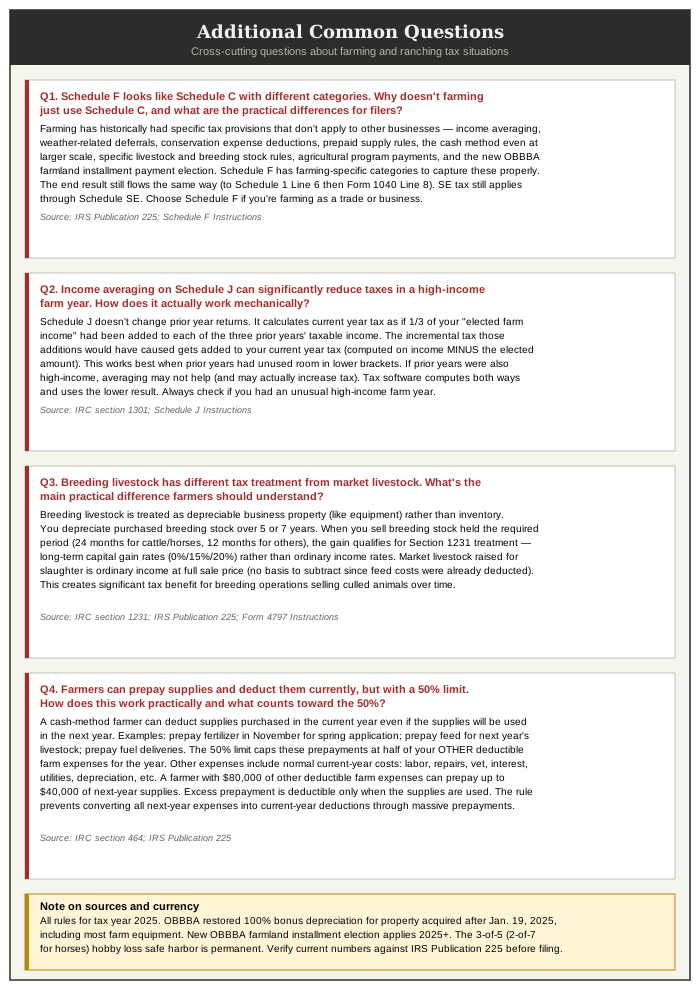
A handful of questions come up every filing season on farm returns — Schedule F versus Schedule C, whether CRP income owes self-employment tax, whether the whole new tractor can be written off this year, whether quarterly estimates are required, and what a drought-forced sale really costs. Here are the short, plain answers.
The questions farmers and ranchers ask most, paraphrased with short answers. You file Schedule F if you are in the business of farming and Schedule C for a non-farm business such as custom harvesting for hire. CRP rental income is subject to self-employment tax for an actively operating farmer but generally not for someone merely holding inherited land. A new tractor can usually be fully expensed in year one via 100 percent bonus depreciation, which has no dollar cap and can create a loss, or Section 179, which has a 2026 cap of $2.56 million and is income-limited. You do not need quarterly estimates if over two-thirds of gross income is from farming; instead pay it all by January 15, 2027, or file and pay in full by March 1, 2027. A drought-forced early sale can often be deferred — Section 451(g) pushes the weather-forced portion one year, and Section 1033(e) defers gain on breeding, dairy, or draft animals if replaced within four years, five for a federal disaster. Raised calves are ordinary income on Schedule F Line 2, bought-to-resell cattle are taxed on proceeds minus cost on Lines 1a through 1c, and breeding stock goes on Form 4797 with Section 1231 treatment. Three loss years are not automatically a problem — the hobby-loss safe harbor treats you as a business if you profit in three of five years, two of seven for horses. A huge income year can be smoothed with Schedule J income averaging. And on the cash method you can prepay next year's feed and fertilizer to lower this year's tax, but only up to fifty percent of your other deductible farm expenses.
Every one of these ties back to a section above — the livestock split, the weather deferrals, the estimated-tax shortcut, the depreciation choice, and the hobby-loss safe harbor. If a question here surprised you, that is exactly the section worth re-reading.
Key takeaways
- Schedule F mirrors Schedule C but with farm-specific income lines (raised livestock, purchased-for-resale livestock, CCC loans, crop insurance, cooperative distributions) and expense lines (feed, fertilizer, seeds, custom hire, vet/breeding, conservation)
- Livestock tax treatment has three distinct categories: raised for sale (full proceeds ordinary income), purchased for resale (gain = proceeds minus basis), and breeding/dairy/draft animals (depreciable assets with Section 1231 treatment on sale after holding period)
- Income averaging (Schedule J) lets farmers spread a high-income year across the current year and three prior years — always run the calculation when farm income spikes significantly
- Weather-related forced sales can be deferred one year under Section 451(g) for all livestock, or gain deferred longer under Section 1033(e) for breeding/dairy/draft animals with replacement
- OBBBA restored 100% bonus depreciation for farm property acquired after January 19, 2025 — most farm equipment, vehicles, and structures now qualify for full year-one expensing
- Cash-method farmers can prepay next year's supplies and deduct now, but the deduction is capped at 50% of other deductible farm expenses for the year
- The hobby loss safe harbor for farming requires profitability in only 3 of 5 years (2 of 7 for horse activities) — more generous than other activities, but farms with chronic losses and personal use elements still face scrutiny
- Qualifying farmers (over two-thirds of gross income from farming) can skip quarterly estimates and instead pay it all by January 15 or file and pay in full by March 1 — a rule built for seasonal farm cash flow
- OBBBA's farmland-installment election is now IRC section 1062: the net tax on gain from qualified farmland sold to a qualified farmer can be paid in four equal, interest-free installments, given a ten-year farming-use history and a ten-year covenant
- Inherited farmland takes a stepped-up basis equal to its fair market value at the decedent's death, so appreciation during the prior owner's lifetime escapes income tax when the heir later sells
Knowledge check
10 questions
A rancher raises calves from birth and sells them at weaning. How are the sale proceeds reported?