In this lesson
- Opening
- Gross vs net income — the number you earn isn’t the number you have
- The paystub — your first Document Walkthrough
- The monthly budget — telling your money where to go
- The budget worksheet — your second Document Walkthrough
- The emergency fund — your first line of defense
- Debt-to-income — the number the lender actually uses
- The affordability gap — what a lender will approve vs what you can live with
- The true cost of a payment — the ripple through your whole budget
- Predator Watch
- If This Already Happened to You
- The Ability-to-Repay rule — and why you’re the one who has to use it
- Most Common Questions
Affordability — Can She Afford It?
How to read your real income, build a budget, calculate your DTI, and tell what a lender approves from what you can actually live with.
What you'll learn
- Distinguish gross income from net take-home pay, and explain why budgeting from the wrong one is the single most common budgeting mistake.
- Read a paystub field by field — earnings, withheld taxes, deductions, employer contributions, and the gross-to-net summary — and verify each number.
- Build a monthly budget from net income, separating fixed from variable expenses and sorting spending into needs, wants, and savings.
- Calculate front-end and back-end DTI the way a lender does, and understand what the ratio can and cannot see.
- Name the five structural reasons a lender's approved amount runs above what a real budget can carry, and apply the ceiling-not-target rule.
- Recognize the max-approval push predator, name the tell that separates it from honest help, and know when it crosses into reportable territory.
- Explain what the Ability-to-Repay rule requires, where its coverage stops, and why you are the ATR rule for most of your borrowing life.
Opening
Lesson 1 taught Maya her credit identity. Lesson 2 taught her what borrowing costs. This lesson answers the question that should come before she ever signs anything: can she actually afford it? — and it turns out that question has two very different answers depending on who's asking.
When a lender looks at Maya, it asks: “Will this person probably pay us back?” That’s a question about risk, and the lender will answer “yes” right up to the edge of its comfort — approving her for the largest payment its formulas think she’ll likely survive. When Maya looks at the same loan, she has to ask a different question: “Can I make this payment and still live the rest of my life — eat, fill the gas tank, save a little, and not panic when the car needs a repair?” Those are not the same question, and they don’t have the same answer. The lender’s “yes” is about whether she’ll default; her own “yes” has to be about whether she’ll thrive. The space between those two answers is exactly where people end up “house poor” or “car poor” — current on a payment they technically qualified for, while everything else in their life gets squeezed.
So this lesson is about answering Maya’s question, not the lender’s — and building the tools to do it: reading what she actually earns (which is not the number on the job offer), building a budget that reflects her real life, calculating her debt-to-income ratio the way a lender does so she can see what they see, and then spotting the gap between approved and affordable clearly enough to stay on the right side of it.
One thing worth saying plainly up front, because money carries a lot of shame: budgeting is not about deprivation, and being on a budget is not a sign you’re bad with money. A budget is simply the tool that makes your money go where you want it to instead of disappearing. The most financially secure people in the country use one. There’s nothing here to feel bad about — only something useful to learn.
It starts with a number most people think they already know but usually don’t: how much they actually earn. That gets the next turn.
Gross vs net income — the number you earn isn’t the number you have
There are two income numbers on every paycheck, and almost everyone knows only the first. Gross income is the headline — the salary on the job offer, the “$50,400 a year” or “$4,200 a month” figure. Net income, or take-home pay, is what actually lands in Maya’s bank account after everything is taken out. The gap between them is large, it’s normal, and budgeting from the wrong one is the single most common budgeting mistake there is.
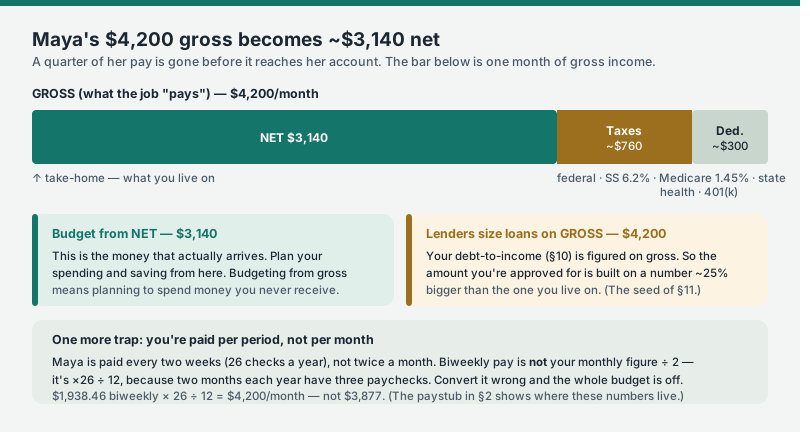
What stands between gross and net is two kinds of subtractions. The first is taxes: federal income tax (withheld from each check), state income tax (which varies — Ohio takes a modest cut; some states take none), sometimes a local or city tax, and FICA — the payroll tax that funds Social Security (6.2%) and Medicare (1.45%), 7.65% combined, that comes out of essentially every paycheck. The second is deductions Maya elects: pre-tax ones like her share of health-insurance premiums and her 401(k) retirement contribution (taken out before tax is calculated, which lowers her taxable income), and post-tax ones like a Roth contribution, union dues, or a wage garnishment. For Maya, a $4,200-a-month gross becomes roughly $3,140 net — about $1,060 a month, a quarter of her pay, gone before she ever sees a dollar of it. That’s not unusual; nobody takes home their salary.
Two consequences of that gap matter enough to state directly, because they’re the backbone of the whole lesson.
The first is the budgeting rule: budget from net. The $3,140 is the money that actually arrives, so it’s the only honest number to plan spending and saving against. Budgeting from the $4,200 gross — which is exactly what people do when they reason “I make $4,200, so I can spend roughly that” — means planning to spend over a thousand dollars a month that was never going to reach the account. That single error is why so many budgets feel mysteriously tight: they were built on money the person never had.
The second is the twist that makes this lesson necessary, and it points straight at the affordability gap in §11: lenders calculate your borrowing capacity on gross. Maya’s debt-to-income ratio — the number that determines what she’s approved for — is figured against her $4,200 gross, not her $3,140 net. So the amount a lender will hand her is sized to a number about 25% larger than the one she actually lives on. A loan that looks perfectly reasonable “on paper” against her gross can quietly strangle her net, where her rent and groceries and gas actually come from. That’s the seed of the gap between approved and affordable, and it’s worth carrying forward as we go.
Two practical notes round out the picture. First — the trap in the widget’s bottom panel — you’re paid per pay period, not per calendar month, and converting between them trips people up constantly. Maya is paid biweekly (every two weeks, 26 checks a year), and biweekly pay is not the monthly figure divided by two: it’s the per-check amount times 26 divided by 12, because two months each year contain a third paycheck. Treating her $1,938.46 biweekly check as if two of them ($3,877) were her month understates her real monthly income by hundreds of dollars and throws the whole budget off. (The paystub in §2 shows exactly where these numbers live.) Second, for anyone whose income is irregular — tips, commission, gig work, self-employment — the same discipline applies but harder: budget from a conservative average of recent months, never the best month, and know that lenders will average it too, usually over two years, when sizing a loan.
With the right income number in hand — net to live on, gross to be approved against — the next step is to see where these figures actually appear, on the document that produces them: the paystub. That’s the lesson’s first Document Walkthrough, and it gets its own turns.
The paystub — your first Document Walkthrough
What it is, where Maya meets it, and how she encounters it. The two income numbers from §1 — gross and net — don’t live in her head; they live on a document, the paystub (or “pay statement”) that comes with every paycheck. It’s the itemized record of how this pay period’s gross pay became net pay, line by line, plus the running year-to-date totals. Maya gets one every two weeks, either attached to a paper check or, far more commonly now, in her employer’s online payroll portal (ADP, Workday, Gusto, and the like) as a PDF she can download.
It’s a document she receives and reads — nothing to fill out or sign — but it rewards a real look, for three reasons. It’s the source of every number in this lesson: her net pay (what she budgets from), her gross (what lenders approve her against), and the exact taxes and deductions in between. It’s a record she’ll be asked for constantly — by a lender on a loan application, by a landlord, by herself at tax time. And it’s where she verifies she’s being paid and taxed correctly, because payroll errors are real and a wrong withholding or a missing 401(k) contribution is hers to catch. Here is her most recent one:
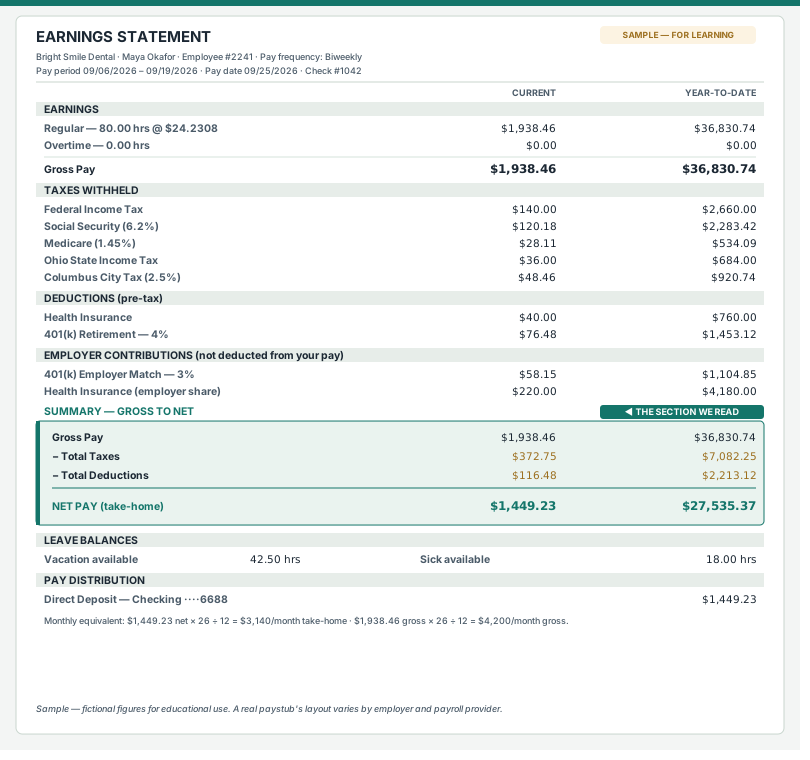
That’s the whole document, not just the take-home line — six sections, each with a current and a year-to-date column, and we’ll read it top to bottom across the next two turns. The shape of what’s there: Earnings (the gross pay, and the hours and rate behind it); Taxes Withheld (the federal, FICA, state, and city pieces government takes); Deductions (the pre-tax health and retirement amounts Maya elected); Employer Contributions (money the employer adds on top of her pay, which doesn’t reduce her check); the tinted Summary (the gross-to-net journey from §1, made real); and the Leave Balances and Pay Distribution that close it out.
Holding to the separation rule, the breakdown gets two turns, not one: the Earnings and Taxes sections first — where her gross is established and government’s cut comes out — then the Deductions, Employer Contributions, Summary, and the YTD/distribution pieces, with the tinted gross-to-net summary taught at full depth as the heart of the document.
The masthead frames the whole document, and two of its fields carry real weight.
Employer, employee, pay frequency — Bright Smile Dental · Maya Okafor · Biweekly.
What it is: whose stub this is, for what job, and how often she’s paid. What it does: it identifies the record and, crucially, states the pay frequency. Why it matters: “Biweekly” is the key that unlocks the §1 conversion trap — it tells Maya she gets 26 checks a year, so converting any figure here to monthly means ×26÷12, not ×2. Miss this label and every monthly number she builds will be wrong.
Pay period, pay date, check # — 09/06–09/19 · paid 09/25 · #1042.
What it is: the window of work this stub covers, the date the money actually arrives, and the record number. What it does: the period defines what the “current” column measures; the pay date is when the cash hits her account. Why it matters: ↳ the period and the pay date are different dates, and the pay date is the one that matters for budgeting — this check pays for work done 09/06–09/19 but doesn’t arrive until 09/25, so it’s late-September money, not mid-September money. Budgeting by when money arrives, not when it was earned, is what keeps a month’s cash flow honest.
The Earnings section is where her gross pay is built.
Regular — 80.00 hrs @ $24.2308 → $1,938.46.
What it is: pay for her standard hours this period — 80 hours (40 a week across two weeks) at her hourly rate of $24.2308. What it does: it’s the foundation the entire stub rests on; gross pay starts here. Why it matters: the rate-times-hours is shown on purpose so she can verify she was paid for every hour she worked — for an hourly worker a single miscounted hour is real money she’s owed. ↳ 80 hours “feels” like half a month but isn’t — it’s one biweekly period, the §1 trap again; this is per-period pay, not a monthly figure. (A salaried worker would see a flat amount here instead of hours × rate.)
Overtime — 0.00 hrs → $0.00.
What it is: hours worked beyond 40 in a week, which a non-exempt hourly worker must be paid at a premium — typically 1.5× — under the federal Fair Labor Standards Act. What it does: it would add to gross if she’d worked overtime this period. Why it matters: ↳ the line teaches even at zero — it’s a reminder that as a non-exempt hourly worker, Maya is legally entitled to time-and-a-half past 40 hours a week, so if she works it and it doesn’t appear here, that’s a real wage issue to raise. And when overtime is present, it’s irregular income — real, but not something to build a budget on (the §1 rule).
Gross Pay — $1,938.46 current / $36,830.74 year-to-date.
What it is: total earnings before anything is taken out — the headline number from §1. What it does: it’s the starting point everything below is subtracted from; the YTD column is everything she’s earned this year. Why it matters: this is the figure lenders run her debt-to-income against (§1’s “approved on gross”) — so it’s the number that determines what she qualifies for. ↳ the YTD gross is what a lender or landlord asks for to verify her income, because it proves her annualized earnings, and it’s the figure that flows onto her W-2 at tax time. The current column is one paycheck; the YTD column is her financial resume.
The Taxes Withheld section is government’s cut, and each line behaves differently.
Federal Income Tax — $140.00 / $2,660.00.
What it is: an estimate of her federal income tax, withheld each period according to the W-4 form she filled out when hired. What it does: it prepays her federal tax bill in small pieces across the year, so she doesn’t face one big bill in April. Why it matters: ↳ this is an estimate she controls, not her final tax — the W-4 sets how much comes out; withhold too much and she gets a refund, too little and she owes. ↳ and a big refund isn’t a bonus — it’s her own money she lent the government interest-free all year, which is why someone who consistently gets a large refund might adjust their W-4 to keep more of each check instead.
Social Security — 6.2% · $120.18 / $2,283.42.
What it is: her share of the Social Security payroll tax (half of “FICA”), a flat 6.2% of gross. What it does: it funds the Social Security system and builds her own future benefit eligibility. Why it matters: ↳ unlike income tax, this isn’t adjustable — it’s a fixed 6.2% she can’t change, and her employer quietly pays a matching 6.2% she never sees on the stub. ↳ there’s an annual wage cap (around $184,500, raised each year) above which Social Security tax stops — far above Maya’s income, but worth knowing it exists.
Medicare — 1.45% · $28.11 / $534.09.
What it is: her share of the Medicare payroll tax, a flat 1.45% of gross. What it does: it funds Medicare. Why it matters: ↳ like Social Security it’s fixed and employer-matched, but it has no wage cap — it applies to every dollar (a small extra 0.9% kicks in only for very high earners, not Maya). Social Security’s 6.2% plus Medicare’s 1.45% is the 7.65% FICA figure from §1 — now she can see exactly where that number comes from on the actual document.
Ohio State Income Tax — $36.00 / $684.00.
What it is: state income tax withheld for Ohio. What it does: prepays her Ohio tax across the year. Why it matters: ↳ this line varies enormously by state — several states (Texas, Florida, and others) have no income tax, so this line would read $0 there; Ohio’s is modest. The same gross salary nets differently in different states, which is a real factor anyone weighing a move or a remote job should price in.
Columbus City Tax — 2.5% · $48.46 / $920.74.
What it is: a municipal income tax levied by the city of Columbus, 2.5% of her gross. What it does: prepays her city tax. Why it matters: ↳ most people don’t know city or local income taxes exist until one appears on their stub — Columbus, like many Ohio cities, charges one, and at ~$48 a check it’s over $1,200 a year, a genuine bite that surprises people who move to a taxing city or start a job in one. It’s based on where she works and/or lives, and it’s exactly the kind of overlooked line that quietly shrinks take-home below what someone budgeted from a salary figure alone.
Read this far, the top half of the paystub has done two jobs: it’s established Maya’s gross (the number lenders approve her against) and itemized every piece of government’s claim on it — federal, Social Security, Medicare, state, and city — with the adjustable lines (income tax) cleanly separated from the fixed ones (FICA). What remains is the deductions she chose, the employer’s contributions on top, and the summary that lands on her true take-home — which is the next turn.
Where the taxes were government’s claim on Maya’s pay, the Deductions are amounts she chose — and the “pre-tax” label on them does something genuinely valuable.
Health Insurance — $40.00 / $760.00 (pre-tax).
What it is: her share of the premium for her employer’s health plan, taken out of each check. What it does: it pays for her coverage — and because it’s pre-tax, it comes out before her income tax is calculated, which lowers her taxable income. Why it matters: ↳ pre-tax is a quiet discount most people miss — a $40 pre-tax deduction costs her less than $40 of take-home, because she never pays income tax on that $40 in the first place. ↳ and the $40 here is only her slice; the employer pays a much larger share she’ll see lower on the stub, so the real value of the coverage is far more than this line suggests. It’s a genuine cost, but a tax-advantaged one.
401(k) Retirement — 4% · $76.48 / $1,453.12 (pre-tax).
What it is: the amount Maya elected to send to her workplace retirement account — here 4% of her gross — also taken pre-tax. What it does: it moves money into long-term investments for her future, untaxed now (she’ll pay tax when she withdraws in retirement). Why it matters: this is the §2 compounding force from Lesson 2 pointed in her favor — money invested young grows on itself for decades. ↳ and it’s only partly “her” money leaving — because it’s pre-tax, a $76.48 contribution reduces her take-home by less than $76.48, and (as the next section shows) her employer adds money on top. ↳ the one caution: this is the deduction to fund at least up to the match, because not doing so leaves free employer money on the table — which is exactly what the next section reveals.
The Employer Contributions section is the one most people skim past, and it’s the one that changes how the whole stub should be read.
401(k) Employer Match — 3% · $58.15 / $1,104.85.
What it is: money Maya’s employer puts into her 401(k) on top of her own contribution — here matching up to 3% of her pay. What it does: it adds to her retirement savings without coming out of her paycheck at all. Why it matters: ↳ this is free money, and it reframes her own 401(k) line entirely — her $76.48 contribution is met with a $58.15 employer match, an immediate, guaranteed ~76% return before a single dollar is even invested. ↳ this is why “contribute at least up to the match” is the most repeated advice in personal finance — anyone contributing less than the match threshold is declining a raise their employer already offered. The match is the single strongest reason the 401(k) deduction above is worth funding even on a tight budget.
Health Insurance, employer share — $220.00 / $4,180.00.
What it is: the portion of Maya’s health premium the employer pays. What it does: it covers most of the true cost of her insurance, on top of her $40 share. Why it matters: ↳ it reveals the real price of her coverage and the real value of the job — her health plan actually costs about $260 a month total ($40 from her + $220 from the employer), so the employer is contributing $220 of compensation she never sees as cash. ↳ it also explains why losing or leaving a job is so financially jarming for insurance: she’d have to replace that hidden $220 herself. Neither line in this section reduces her paycheck — they’re value added on top, which is why a paystub read only for the net number undersells what the job is actually worth.
The Summary is the tinted heart of the document — the gross-to-net journey from §1, now on a real form.
Gross Pay — $1,938.46 / $36,830.74.
What it is: the starting total, carried down from Earnings. What it does: it’s the number everything is subtracted from. Why it matters: it’s the lender’s number (DTI runs on this) and the anchor of the summary — seeing it restated at the top of the gross-to-net block is what makes the subtractions that follow legible.
− Total Taxes — $372.75 / $7,082.25.
What it is: every tax line from §3 added together — federal, Social Security, Medicare, state, city. What it does: it’s government’s total claim on this check. Why it matters: ↳ seeing taxes as one consolidated number is sobering and useful — $372.75 of a $1,938.46 check, about 19%, gone to taxes alone, before her own elected deductions; the YTD figure ($7,082) is what she’s paid the various governments so far this year. It’s the single clearest answer to “where did my paycheck go?”
− Total Deductions — $116.48 / $2,213.12.
What it is: her elected pre-tax deductions (health + 401k) summed. What it does: it’s the total she chose to route to insurance and retirement. Why it matters: ↳ this is the one block of subtractions that’s mostly working for her — unlike taxes, this money buys her coverage and builds her future, and part of it (the 401k) is still hers. Distinguishing “taxes (gone)” from “deductions (mine, redirected)” is what keeps her from resenting her whole stub equally.
NET PAY (take-home) — $1,449.23 / $27,535.37.
What it is: what actually lands in her account — gross minus taxes minus deductions. What it does: it’s the §1 net income, now produced line by line on the real document. Why it matters: ↳ this is the only number she budgets from (§1’s rule), and the stub proves it: $1,449.23 a check, which converts to ~$3,140 a month (×26÷12), not the $4,200 gross the job “pays.” ↳ the gap between the $1,938.46 at the top of this block and the $1,449.23 at the bottom — about $489 a check — is the entire reason budgeting from gross fails. The summary makes the abstract gross-vs-net idea from §1 concrete, traceable, and verifiable.
The document closes with two practical footers.
Leave Balances — Vacation 42.50 hrs · Sick 18.00 hrs.
What it is: the paid time off she’s accrued and not yet used. What it does: it tracks a benefit she’s earned in hours. Why it matters: ↳ accrued vacation is often money — in many states unused vacation must be paid out if she leaves the job, so these 42.5 hours are a real asset (~$1,030 at her rate), not just days off. Knowing the balance helps her plan time off and understand what she’d be owed on departure.
Pay Distribution — Direct Deposit, Checking ····6688 — $1,449.23.
What it is: where the net pay actually went — direct-deposited to her checking account, shown by its last four digits. What it does: it confirms the money’s destination. Why it matters: ↳ this is her verification the right amount reached the right account — the figure here must equal the net pay above, and the masked account should be hers; a mismatch (a split deposit she didn’t set up, a wrong account) is caught right here. It’s the final checkpoint that the whole gross-to-net journey actually delivered.
Read in full, the paystub stops being a slip to glance at and becomes the foundation of the entire lesson: it gives Maya her net (to budget from), her gross (to be approved against), a clear separation of taxes (gone) from deductions (redirected), and the often-overlooked employer contributions that reveal what the job is truly worth. Every number she’ll need for the rest of this lesson starts here.
The monthly budget — telling your money where to go
A budget is simply a plan for where your money goes, made before the month starts instead of discovered after it ends. That’s the whole shift: from “where did it all go?” — the question people ask staring at an empty account on the 28th — to “where will it go?” — decided in advance, on purpose. And it’s built, always, from net income (§1), because that’s the money that actually arrives. For Maya, that’s her ~$3,140 a month.
There are two useful lenses for sorting spending, and they answer different questions. The first is fixed versus variable. Fixed expenses are the same every month — rent, her car payment, insurance, a subscription. Variable expenses change — groceries, gas, dining out, entertainment. This split matters because it tells her where her control lives: fixed costs are predictable but hard to change quickly (she can’t lower rent this month), while variable costs are where she has real month-to-month flexibility. When money is tight, the variable column is where the adjustments happen — which also means the fixed column is where she has to be most careful committing, because a new fixed payment (like a car loan) locks in for years.
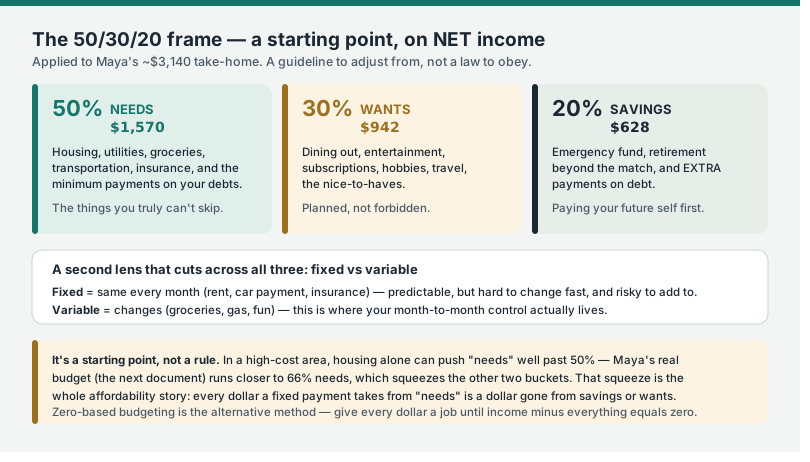
The second lens is needs versus wants versus savings, and it’s the basis of the most common budgeting starting point, the 50/30/20 frame: aim roughly 50% of net income at needs, 30% at wants, and 20% at savings and extra debt payoff.
A few things about that frame matter more than the percentages themselves.
First, it’s a guideline, not a law. The 50/30/20 split is a sane starting point, but real life — especially housing costs — bends it constantly. In an expensive city, rent alone can consume most of the “needs” budget, pushing that bucket well past 50% and squeezing wants and savings down to make room. Maya’s own budget, which the next document shows in full, runs closer to 66% needs, because her rent and car payment together are large relative to her take-home. That squeeze isn’t a moral failing; it’s arithmetic, and it’s the entire affordability story in miniature: every dollar a fixed payment claims from the “needs” bucket is a dollar that disappears from savings or wants. A bigger car payment doesn’t come from nowhere — it comes out of her emergency fund or her life.
Second, the buckets have a deliberate order of priority that the percentages don’t convey. Needs come first because they’re non-negotiable. But savings — the 20% — is meant to be paid like a need, not treated as “whatever’s left over,” because “whatever’s left over” is reliably nothing. The discipline of paying your future self first (automating savings before the month’s spending begins) is what separates people who build a cushion from people who intend to. And wants are not the enemy here — a budget that forbids every pleasure is a budget no one keeps. Wants are planned, sized to a number, and enjoyed without guilt. That reframe matters, because the goal of a budget isn’t to spend less; it’s to spend on purpose.
Third, the 50/30/20 frame is one method; the other common one is zero-based budgeting, where every single dollar of net income is assigned a job — needs, wants, savings, debt — until income minus all those assignments equals exactly zero, so no dollar is unaccounted for. Neither method is “correct”; the right one is the one a person will actually stick with, because a budget abandoned in week two helps no one.
What all of this builds toward is the lesson’s core question. A budget isn’t an end in itself — it’s the instrument that reveals, in real numbers, how much room actually exists for a new payment. When a lender approves Maya for a bigger car loan, the budget is what tells her whether that payment fits without crowding out her savings or her essentials. That’s the difference between approved and affordable — and to see it, she needs her budget written down as a real document, which is the lesson’s next Document Walkthrough.
The budget worksheet — your second Document Walkthrough
What it is, where Maya meets it, and how she encounters it. This is the document §5’s frame becomes once it has real numbers in it — a monthly budget worksheet that lists her net income, plans every category of spending and saving, and lands on what’s left. It’s unlike anything else in this course in one important way: it’s the only document she authors rather than receives. There’s no lender, employer, or government on the other side — she builds it herself, in a notebook, a spreadsheet, or a budgeting app (YNAB, EveryDollar, Monarch, or the tool built into her bank’s site).
Because she creates and updates it, it’s a living document, and that’s exactly why it’s powerful: it’s the instrument that answers her affordability question rather than the lender’s. It shows, in her own real numbers, whether her money balances, where every dollar goes, and — in the single most important line, the leftover — how much room actually exists for a new payment or an unexpected bill. It’s where she’d test “can I afford a bigger car payment?” before a lender ever weighs in. Here is her budget for the coming month:
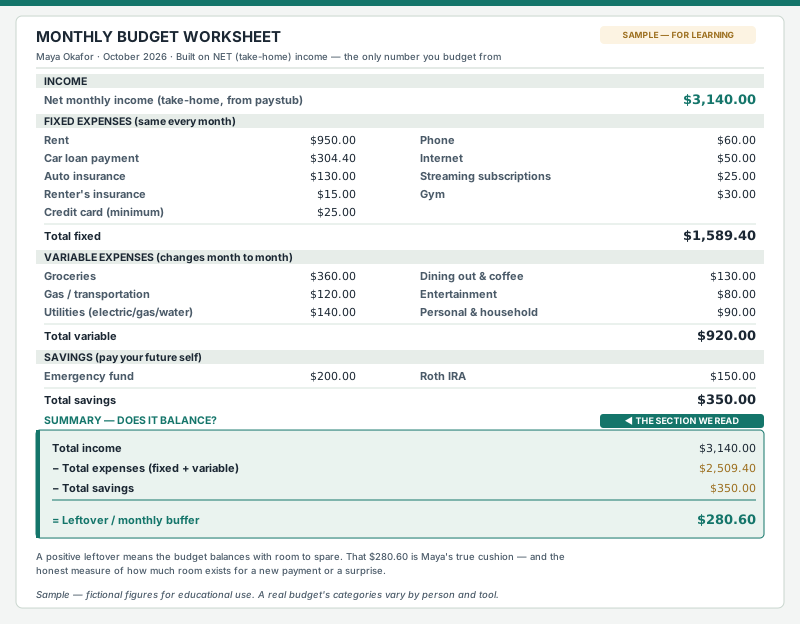
That’s the whole worksheet — five sections, not just the bottom line — and we’ll read it top to bottom across the next two turns. The shape of what’s there: Income (her net, the one number a budget is built on); Fixed Expenses (the same-every-month commitments, including her car payment); Variable Expenses (the month-to-month spending where her control lives); Savings (the future-self bucket); and the tinted Summary, where income minus expenses minus savings lands on a leftover of $280.60 — the figure that is her affordability, the honest measure of how much room exists for a new payment or a surprise.
One number to carry forward already: her expenses lean heavily toward needs. Rent and the car payment alone are over $1,250 of fixed cost, and her essential spending runs to about two-thirds of her take-home — well past the 50% guideline from §5, exactly as that section warned a real budget often does. That’s not a problem to be ashamed of; it’s the reason the $280.60 leftover is as thin as it is, and it’s why the size of any new fixed payment matters so much.
Holding to the separation rule, the breakdown gets two turns: the Income and Fixed Expenses first — her net and her locked-in commitments — then the Variable, Savings, and the tinted Summary, with the leftover taught at full depth as the heart of the document.
The masthead carries one line that governs everything: “Built on NET income.” What it is: the declaration of which income number the worksheet uses. What it does: it anchors every category below to take-home pay. Why it matters: it’s the §1 rule enforced right at the top — a budget built on gross plans to spend money that never arrives, so this single note is the most important methodological choice on the page.
The Income section is the pool everything draws from.
Net monthly income — $3,140.00.
What it is: Maya’s take-home pay expressed as a monthly figure — her biweekly net of $1,449.23 converted with ×26÷12. What it does: it’s the total that every expense and savings line is subtracted from; it sets the ceiling on the entire budget. Why it matters: two things have to be right here or the whole budget is wrong. ↳ it must be net, not gross — using her $4,200 gross would invent $1,060 a month she doesn’t have. ↳ and it must be the converted figure, not two paychecks — using $3,877 (just two checks) would understate her income by hundreds, because two months a year carry a third check. (If her pay were irregular — tips or commission — this line would use a conservative average of recent months, never her best one.)
The Fixed Expenses are her locked-in commitments — the costs that are the same every month and hard to change quickly.
Rent — $950.00.
What it is: her monthly housing cost. What it does: it’s her single largest expense and the anchor the rest of the budget bends around. Why it matters: housing is the biggest lever on affordability there is. At $950 against $3,140 net, it’s about 30% of her take-home — right at the healthy benchmark (a common rule of thumb keeps housing at or under ~30% of income). ↳ it’s also the hardest line to change — a lease locks it for a year, so it constrains everything beneath it; a more expensive apartment wouldn’t just cost more, it would cascade through every other category by shrinking what’s left.
Car loan payment — $304.40.
What it is: her monthly auto-loan payment, carried from Lessons 1 and 2. What it does: it’s a fixed commitment locked in for the next five years. Why it matters: this is the lesson’s central cautionary number. ↳ it competes directly with her savings and her leftover — combined with rent, $1,254 of her $3,140 is committed to just housing and a car before a single other need is met. ↳ and it’s a multi-year lock she can’t trim next month the way she could groceries — which is precisely why §5 warned that a new fixed payment deserves the most caution before signing. The car payment is the affordability decision this whole lesson is about, sitting right here in her budget.
Auto insurance — $130.00.
What it is: the required insurance on her financed car. What it does: it protects her, satisfies state law, and meets the lender’s coverage requirement. Why it matters: ↳ this is the hidden cost people forget when sizing a car payment — the true monthly cost of her car isn’t $304, it’s $304 plus $130, or $434. ↳ and a financed car requires full coverage, not just minimum liability, because the lender protects its collateral — so financing a car costs more in insurance than owning one outright. Anyone weighing a car payment who ignores insurance is underestimating the real commitment by a third.
Renter’s insurance — $15.00.
What it is: coverage for her belongings and personal liability in her rental. What it does: it protects her possessions against theft or fire and shields her from liability claims. Why it matters: ↳ it’s the highest-value-per-dollar line on the page — at $15 a month it’s easy to dismiss, but it’s the difference between a recoverable setback and a catastrophe if her apartment is burglarized or burns; many landlords now require it, and it’s protection no one should skip to save the price of a couple coffees.
Phone — $60.00.
What it is: her cell-phone plan. What it does: a fixed monthly utility. Why it matters: it’s a modern essential, but ↳ it’s one of the fixed costs that’s actually negotiable — unlike rent, a cheaper carrier or smaller plan can genuinely lower it, which makes it one of the first places to look when a budget needs room.
Internet — $50.00.
What it is: her home internet service. What it does: a fixed utility. Why it matters: essential for work and daily life, and like the phone it’s somewhat flexible — promotional rates and plan tiers mean the price isn’t truly fixed if she’s willing to shop or call to renegotiate.
Streaming subscriptions — $25.00.
What it is: her recurring streaming services. What it does: a fixed monthly charge that renews automatically. Why it matters: ↳ this is the classic “subscription creep” line — small auto-renewing charges that quietly pile up and keep billing whether or not they’re used. It sits in the fixed column but it’s really a want wearing fixed clothing, which makes it one of the easiest places to free up money by periodically auditing what she’s actually using.
Gym — $30.00.
What it is: her gym membership. What it does: a fixed recurring charge. Why it matters: like the subscriptions, it’s a want structured as a fixed cost — and ↳ this is where the two lenses from §5 diverge: it’s “fixed” (same every month) but it’s not a “need,” so it’s a candidate for trimming if money tightens, in a way rent never could be. Naming it as a want-in-fixed-clothing is what keeps it from feeling untouchable.
Credit card (minimum) — $25.00.
What it is: the minimum payment on her secured card from Lesson 1. What it does: paying it keeps the account current and protects her credit. Why it matters: ↳ this line is a genuine need in the budget — a minimum debt payment that must be made — but it’s also the direct bridge to Lesson 2’s trap: the $25 is the floor, and paying only the minimum is the slow, expensive path. True affordability means having enough leftover to pay above this line and actually clear the balance, which is exactly what the savings section and the leftover are for.
Total fixed — $1,589.40.
What it is: all her fixed commitments added together. What it does: it’s the locked-in portion of her budget — the money spoken for before she makes a single discretionary choice. Why it matters: ↳ this is the number that matters most for affordability, because it’s the hardest to change — $1,589 of her $3,140, just over half her take-home, is committed before she buys one grocery. The more of a budget that’s tied up in fixed costs, the less room there is to absorb a surprise or a rate hike — and a new fixed payment (a bigger car, a personal loan) adds here, permanently, which is why the size of any new commitment has to be measured against this total, not against her income as a whole.
Read this far, the top of the worksheet has done two things: it’s locked in the one honest income figure to plan from, and it’s laid out everything Maya has already committed — over half her take-home, much of it impossible to change quickly. What’s left to read is the flexible spending where her real control lives, the savings she’s protecting, and the leftover that all of it produces — which is the next turn.
Where the fixed expenses were locked in, the Variable Expenses are where Maya’s month-to-month control actually lives — the categories she can dial up or down.
Groceries — $360.00.
What it is: her planned monthly food-at-home spending. What it does: it covers a genuine need, but as a variable one she can influence. Why it matters: it’s both essential and adjustable, which makes it the most useful line in the budget. ↳ it’s a “need” she has real control over — she can’t skip eating, but she can shift what she spends through planning, store choice, and cooking, so when a month runs tight, groceries flex in a way rent never can. It’s the difference between an essential category and a fixed amount.
Gas / transportation — $120.00.
What it is: fuel and transit costs to get around. What it does: it makes the car (and her commute) usable. Why it matters: ↳ it’s the third hidden piece of her car’s true cost — the car payment is $304, insurance is $130, and gas is another $120, so the real monthly cost of owning and operating her car is closer to $554, not the $304 payment alone. Anyone budgeting only the loan payment underestimates a car by hundreds of dollars a month — a point that will matter enormously when the lesson reaches affordability.
Utilities (electric/gas/water) — $140.00.
What it is: her home energy and water bills. What it does: keeps the apartment functioning. Why it matters: ↳ it’s “semi-variable” — a need that swings with the season, higher in summer and winter than spring and fall, which is why it sits in the variable column even though she can’t really skip it. Budgeting an average rather than one month’s bill is what keeps a hot August from blowing up the plan.
Dining out & coffee — $130.00.
What it is: meals and drinks out — a discretionary want. What it does: it’s planned enjoyment, sized to a number. Why it matters: ↳ this is where the budget gives her permission, not guilt — $130 is a real, allotted amount for eating out, and spending it isn’t “failing”; it’s the plan working. ↳ it’s also the most elastic line on the page, so it’s the first place to find money when a need spikes — but the point of naming it is that she enjoys it within the number rather than pretending it’s zero and then overspending.
Entertainment — $80.00.
What it is: movies, events, hobbies, fun. What it does: discretionary spending she’s chosen to keep. Why it matters: like dining, it’s a planned want — a budget that erases all fun is one she’ll abandon by week two (the §5 reframe). Sizing it deliberately is what makes the whole budget sustainable instead of a brief act of self-denial.
Personal & household — $90.00.
What it is: toiletries, cleaning supplies, haircuts, the miscellaneous. What it does: it absorbs the small recurring purchases that don’t fit elsewhere. Why it matters: ↳ it’s the catch-all that keeps the budget honest — without a “miscellaneous” line, the dozens of small unplanned buys leak out of other categories and make the whole plan feel like it doesn’t work. A realistic budget expects the small stuff and gives it a home.
Total variable — $920.00.
What it is: all her flexible spending summed. What it does: it’s the adjustable portion of the budget. Why it matters: ↳ this is Maya’s maneuvering room — when a need spikes or income dips, this $920 (not the $1,589 fixed) is where she finds the give. The ratio of fixed to variable is itself a health signal: a budget that’s almost all fixed has no shock absorbers, while a healthy variable cushion means she can flex without missing a commitment.
The Savings section is the future-self bucket — and where it sits in the math is deliberate.
Emergency fund — $200.00.
What it is: money set aside for unexpected costs — a car repair, a medical bill, a gap between jobs. What it does: it builds the cushion that keeps a surprise from becoming debt. Why it matters: ↳ this is the line that prevents the whole rest of the course’s troubles — without it, the next $800 car repair goes on the 22.99% card from Lesson 2 and starts compounding; with it, it’s just an annoyance. It gets its own full section next (§9), because it’s the single most protective habit in personal finance — and the fact that it’s in the budget as a planned line, not “whatever’s left,” is what makes it actually happen.
Roth IRA — $150.00.
What it is: a retirement contribution beyond her workplace 401(k) — into an individual account she controls, funded with after-tax money. What it does: it invests for her future, growing tax-free (she pays no tax on the withdrawals in retirement). Why it matters: ↳ it’s the §-Lesson-2 compounding force working for her on her own terms — money invested in her twenties has decades to grow on itself. ↳ the Roth’s distinction is worth knowing — unlike the pre-tax 401(k), she pays tax now and owes nothing later, which is often the better deal for a young earner whose tax rate is likely lower now than it’ll be in the future. It’s a deliberate choice to pay her future self after she’s paid for insurance but before she spends what’s left.
Total savings — $350.00.
What it is: her two savings contributions combined. What it does: it’s the money she’s routing to her future before discretionary spending. Why it matters: ↳ its position in the math is the lesson — it’s subtracted as a line item, like a bill, not left as a hope for leftovers. “Pay yourself first” (§5) is enforced right here: savings is treated as non-negotiable as rent, which is the only way it reliably happens.
The Summary is the tinted heart of the worksheet — where everything reconciles and affordability becomes a single readable number.
Total income — $3,140.00.
What it is: her net income, carried down. What it does: it’s the pool everything is measured against. Why it matters: restating it here, against the subtractions, is what makes the bottom line legible — it’s the “out of this much” that gives the leftover meaning.
− Total expenses (fixed + variable) — $2,509.40.
What it is: all her spending, fixed and variable, combined ($1,589.40 + $920). What it does: it’s everything going to living costs. Why it matters: ↳ seeing it as one number is the gut-check — $2,509 of $3,140, about 80% of take-home, goes to simply living; it’s the clearest answer to “where does my money go” and the figure that shows how little slack a real budget at her income carries.
− Total savings — $350.00.
What it is: her future-self contributions, subtracted next. What it does: it removes savings before the leftover is computed. Why it matters: ↳ the order proves the priority — savings comes out above the leftover line, not after, so her cushion and retirement are funded first and the “extra” is what remains after she’s paid her future self, not before.
= Leftover / monthly buffer — $280.60.
What it is: what remains after every expense and every savings goal — income minus expenses minus savings. What it does: it’s the true free space in her month. Why it matters: this is the number the entire lesson has been building toward. ↳ a positive leftover means the budget balances with room to spare — Maya’s plan works, with $280.60 of genuine slack. ↳ and this figure is her affordability — it’s the honest measure of how much room exists for a new payment or an unexpected bill. When a lender approves her for a bigger car loan, this $280.60 is what tells her whether the higher payment fits; a new $250 payment would nearly erase her entire buffer, leaving her one bad month from going negative. The leftover converts the lender’s abstract “approved” into her concrete “can I actually live with this” — which is the gap the next sections take apart.
Read in full, the budget worksheet does what no lender’s approval ever will: it shows Maya, in her own real dollars, exactly where her money goes, what she’s protecting, and precisely how much room she has — a single number, $280.60, that is the truthful answer to “can I afford it.” Every affordability decision in her life can be tested against that line.
The emergency fund — your first line of defense
Of the two savings lines in Maya’s budget, one deserves to be funded before almost anything else, because of what it prevents. An emergency fund is cash set aside for genuine, unplanned necessities — a job loss, a medical bill, a car or home repair, an urgent trip. It’s the first priority not because it grows her wealth (it barely does) but because it’s the wall between a surprise and debt. Without it, the next $800 car repair has nowhere to go but the credit card, where it starts compounding at 22.99% (Lesson 2) and outlasts the repair by years. With it, that same repair is a bad afternoon, not a financial event. This one habit quietly prevents most of the trouble the back half of this course exists to deal with — it is, dollar for dollar, the most protective thing in personal finance.
How big it should be has two answers, and conflating them is why people never start. The destination is 3–6 months of essential expenses — but that’s a years-long goal, and treating it as the starting line is paralyzing. The first milestone is a starter fund of about $1,000 (or one month of essentials), because that alone covers the great majority of common surprises and breaks the cycle of charging emergencies to a card. Build the starter first; then grow toward the full cushion. Use the calculator to see Maya’s targets and how long each takes:
Maya's emergency fund — targets and timeline
Built on ESSENTIAL expenses (needs only) — the things she truly couldn't cut if income stopped.
Starter (do this first)
$1,000
~2 months
3-month cushion
$5,250
~10 months
6-month (full)
$10,500
~1.6 years
Three details turn this from a slogan into something Maya can actually execute.
First, the denominator is essential expenses, not her whole budget — and that makes the goal far more reachable than it first looks. In a real emergency like a job loss, she’d cut the wants immediately: dining out, subscriptions, the gym. So the fund only needs to cover her necessities — roughly $2,150 a month, not her full $2,860 of spending — which is why her 3-month target is $6,450 rather than something larger. Sizing the fund to needs, not lifestyle, keeps the number honest and the goal achievable.
Second, where she keeps it matters as much as how much. The right home is a high-yield savings account (HYSA) — money she can withdraw in a day or two, held separately from her checking account so she isn’t tempted to spend it, and earning real interest (around 4%, with the best accounts near 4.1% as of mid-2026). It should not be invested in stocks, because the market could be down exactly when she needs the cash, and it should not sit in her checking account, where it earns nothing and is too easy to spend. The emergency fund’s entire job is availability and safety, not growth — it’s the one pool of money where “boring and accessible” is the whole point.
Third, the emergency fund has a specific place in a priority order, and knowing it resolves the constant tension between saving, investing, and paying off debt. A widely-used sequence runs: first, the ~$1,000 starter fund, so a surprise doesn’t blow up everything else; then capture the full employer 401(k) match (the free money from her paystub in §4); then attack high-interest debt (her 22.99% card from Lesson 2); then build the full 3–6 month fund; and only then push into more retirement and other goals. The starter comes first precisely because, without it, the very first emergency derails every other step — there’s no point aggressively paying down a card if the next flat tire just runs the balance right back up.
Two closing rules keep the wall standing. Use it only for true emergencies — a genuine, unplanned necessity, never a sale or a vacation; the moment it becomes a slush fund, it stops being protection. And after she does use it, refilling it becomes the next priority, because a fund that’s been spent and not replaced is a wall with a hole in it. Maya’s automated $200-a-month line is what makes all of this happen quietly in the background — the most important $200 in her budget, because it’s the one that keeps every other dollar from being one bad day away from a credit card.
This is also the bridge to the lesson’s central tension. A budget with a healthy leftover and a growing emergency fund is what real affordability looks like — and it’s exactly what a lender’s “approved” ignores. The lender doesn’t care whether Maya has a cushion; it only cares whether she’ll pay them. That gap — between what she qualifies for and what leaves her financially safe — is the next thing to take apart, starting with the number lenders actually use: debt-to-income.
Debt-to-income — the number the lender actually uses
When a lender decides what Maya qualifies for, the single most influential number isn’t her credit score — it’s her debt-to-income ratio (DTI): her monthly debt payments divided by her gross monthly income. The score tells the lender how reliably she’s paid debts in the past; the DTI tells it whether she can realistically afford to take on more. And note the income it uses — gross, her $4,200, not her $3,140 net (the §1 twist made concrete). The lender measures her capacity against the bigger number, which is the first reason “approved” tends to sit above “affordable.”
DTI comes in two flavors, and the difference matters. The front-end ratio (the “housing ratio”) is just her housing payment divided by gross income. The back-end ratio (total DTI) is all her monthly debt payments — housing plus everything else — divided by gross income, and it’s the one lenders weigh most heavily. Try it with Maya’s numbers, and see how a new payment moves them:
Debt-to-income calculator
DTI uses GROSS income and counts only debt payments — not utilities, food, insurance, or savings.
Front-end (housing only) — guideline ≤ 28%
Back-end (all debt) — comfortable ≤ 36% · common ceiling 43% · stretched to ~50%
Three things make DTI usable rather than just a formula.
What counts, and what pointedly doesn’t. DTI includes only debt payments: housing (rent, or a mortgage’s principal, interest, taxes, and insurance), the car loan, credit-card minimums, student loans, personal loans, and court-ordered obligations like child support. It excludes nearly everything else in Maya’s budget — utilities, groceries, gas, her standalone insurance, phone, subscriptions, and, crucially, her savings. This is why DTI is not the same as her budget: it’s a narrow, debt-only ratio, blind to the rest of her life. A lender can see a healthy DTI while being completely unaware that her actual monthly slack is only $280.
The thresholds lenders use. The classic guideline is the 28/36 rule — housing at or under 28% of gross (front-end), total debt at or under 36% (back-end). Beyond that, 43% is a widely-used comfort ceiling, and many lenders will stretch to roughly 45–50% when there are compensating factors: strong credit, a large down payment, or substantial cash reserves. Government-backed loans (FHA, VA, USDA) have their own, often higher, paths — VA in particular leans on residual income (cash left after obligations) rather than a ratio.
The legal correction, because it’s widely misunderstood. A lot of people believe 43% is a hard legal cap — that no one can get a mortgage above it. That was the rule for the General Qualified Mortgage, but it was removed in 2021 and replaced with price-based thresholds (the loan’s APR relative to a market benchmark). What’s legally binding now is the broader Ability-to-Repay rule, which requires a lender to make a good-faith determination that Maya can repay — considering her DTI or residual income among eight factors, and verifying her income and debts with real records. So 43% today is an operational guideline lenders lean on, not a statutory wall — and that distinction matters, because it means “the rules” don’t actually stop a lender from approving someone right up to the edge of strain.
For Maya specifically, the numbers come out comfortable: a front-end of about 23% and a back-end of about 30%, both well inside every guideline. On DTI alone, she’s a clean approval — and, importantly, she’d be approved for considerably more. A lender looking only at her 30% back-end ratio sees a borrower with lots of headroom and would happily green-light a bigger car payment.
And that’s exactly where the lesson’s central tension snaps into focus. The DTI that says “plenty of room” is built on her gross income and ignores everything that isn’t debt — her groceries, her gas, her insurance, her savings, and her thin $280 leftover. The lender’s instrument is designed to answer “will she keep paying us?”, not “will she be okay?” — so it can wave through a payment her actual budget can barely hold. The space between what her DTI permits and what her budget can truly carry is the affordability gap, and it’s what the next section takes apart directly.
The affordability gap — what a lender will approve vs what you can live with
Everything so far — gross versus net, the budget, the leftover, the DTI — exists to expose one gap, and it’s the most important idea in the lesson. A lender’s “approved” and your “affordable” are answers to two completely different questions, and they routinely produce two very different numbers.
The lender’s question is “Will this person probably repay us?” It’s a question about the lender’s risk, and the tools it uses are built for exactly that — and only that.
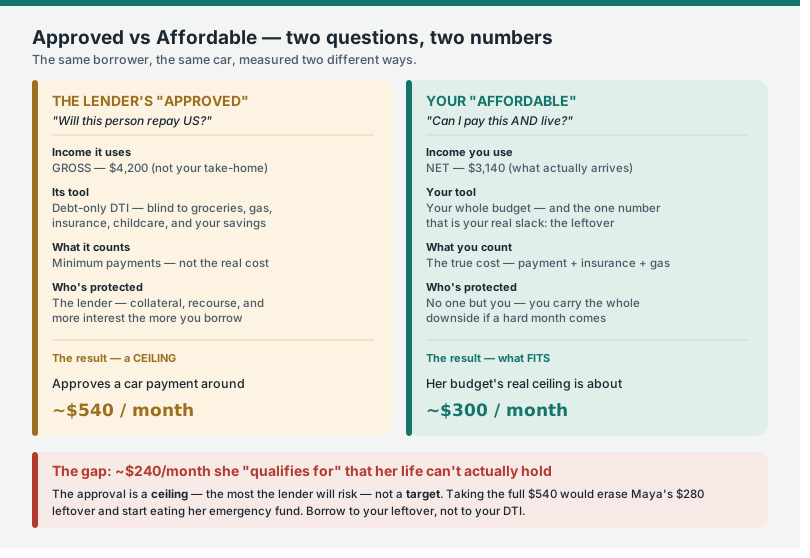
The gap isn’t a trick or a sign of a bad lender — it’s structural, baked into how the two sides measure. Five things pull the lender’s number above Maya’s, and naming them is what makes the gap predictable instead of surprising.
The lender starts from her gross ($4,200) while she lives on her net ($3,140) — a 25% head start before anything else. Its DTI tool is debt-only, so her groceries, gas, insurance, and savings are simply invisible to it; the formula literally cannot see the $2,500 of monthly life that her budget revealed. It counts minimum payments, not real costs — her card’s $25 minimum, not the $304-plus-$130-plus-$120 true cost of actually running her car (§8). The lender is protected where she isn’t — it holds the car as collateral, it has the recourse ladder, and critically, the loan is profitable for it right up to the edge of her strain, because more borrowed means more interest earned. And so its incentive points the opposite way from hers: the lender does better when she borrows more, while she does better when she borrows less. None of this is malice. It’s just that the lender’s instrument was built to answer “will she pay us?”, and it does that job honestly — it was never designed to answer “will she be okay?”
The cost of mistaking the approval for the answer has a name: house poor or car poor. It’s the state of being perfectly current on a payment you genuinely qualified for, while everything else in your life gets quietly strangled — no savings going in, no slack in the month, one transmission or one slow paycheck away from the credit card. This is the crucial distinction the whole lesson turns on: technically affording something — being able to make the payment — is not the same as actually affording it. Maya could make a $540 car payment for a while. She’d just have no emergency fund, no buffer, and no margin, which means the first surprise turns a “successful” purchase into a spiral. The payment that looks fine in isolation is the one that crowds out everything that isn’t on the loan application.
Which gives the single rule this lesson exists to deliver: let your budget set the number, not the approval. Treat the approved amount as a ceiling — useful to know, the most a lender will risk on you — and never as a target to spend up to. The number that matters is the one Maya already has: her leftover. She borrows to that, not to her DTI.
Her two recurring counterparts show both sides of this. Sofia, super-prime, gets approved for far more than she’d ever spend — her clean credit and high income flatter her with enormous ceilings — and her whole financial discipline is the refusal to take the bait; she buys to her budget and lets the approval sit unused. Darnell, rebuilding and stretched thin, did the opposite at some point: he bought near his approved max, and now he’s the cautionary version — current on his obligations but with no room, no cushion, and no margin for the next bad week. Same gap, two outcomes, decided entirely by which number each one let do the deciding.
That gap — between a lender that profits from approving the maximum and a borrower who needs to choose less — is also where a specific predator lives: the salesperson or lender who pushes you to the top of your approval, because their interest is the size of the loan. That’s the next section.
The true cost of a payment — the ripple through your whole budget
The affordability gap (§11) said that the approved number runs ahead of the livable one. This section shows how — the mechanics of what actually happens when a new payment lands in a real budget. Because here’s the thing people miss: a new monthly payment doesn’t come from nowhere. Every dollar of it is subtracted from somewhere else Maya’s money was already going. So the honest question is never “can I make this payment?” — she almost always can, for a while — it’s “what does making it cost me everywhere else?”
Watch what a modest $250-a-month payment does to her actual budget:
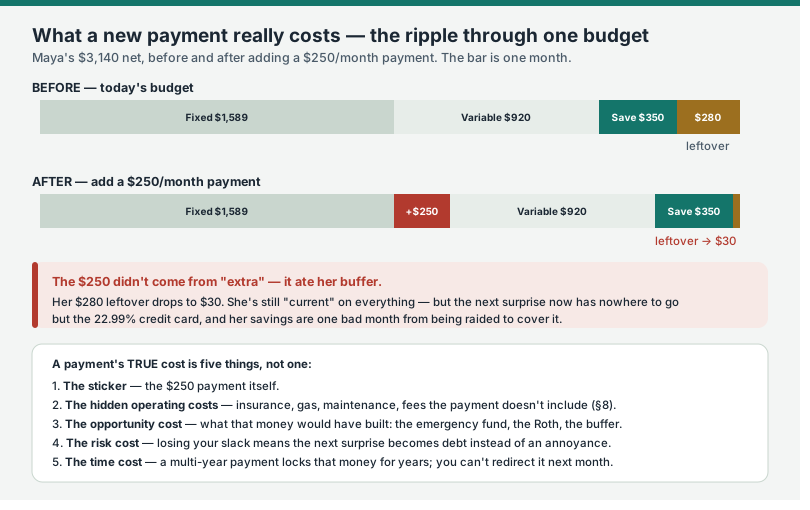
The picture makes the central deception visible: the $250 payment didn’t come out of some pool of “extra.” It came almost entirely out of Maya’s $280 buffer, dropping her real monthly slack to $30. On paper, nothing looks wrong — she’s current on every bill, her savings line still reads $350. But that $350 is now propped up by a $30 cushion, which means the first time a month runs even slightly over, the savings get raided to cover it, and the first genuine surprise — the $800 repair from §9 — goes straight onto the 22.99% card, because the wall that was supposed to stop it has been spent on the payment. One modest payment quietly converted her from “building a cushion” to “one bad week from debt,” without a single missed bill to warn her.
That’s why a payment’s true cost is five things, not one, and pricing only the first is how people end up house- or car-poor. There’s the sticker — the $250 itself. There are the hidden operating costs — for a car, the insurance, gas, and maintenance that the loan payment never mentions (the §8 lesson that her car’s real cost is $554, not $304). There’s the opportunity cost — the most invisible and often the largest — which is everything that $250 would have done: the emergency fund it would have grown, the Roth contribution it would have made, the high-interest debt it would have killed. There’s the risk cost — losing her slack means she’s traded a buffer for a payment, so the next surprise is now a debt instead of an inconvenience. And there’s the time cost — unlike groceries, which she can trim next month, a multi-year loan locks that $250 for years; she’s not deciding about one month, she’s committing dozens of future months she hasn’t lived yet.
This reframes the entire affordability question into the form that’s actually safe to use. “Can I afford the payment?” is the wrong test, because the answer is almost always a deceptive yes. The right test is: “Can I afford this payment and still fund my savings and still keep my buffer?” If adding it zeroes out the leftover or eats the emergency-fund contribution, then the honest answer is that she can’t afford it — even though she could make it — because “affording” something that erases her financial safety isn’t affording it at all.
And the quiet truth underneath all of it: even when nothing goes wrong, the payment still costs her. Staying perfectly current on a too-big payment isn’t a happy ending — it’s a slow leak. It’s the emergency fund that never gets built, the retirement that compounds on a smaller base for decades, the vacation not taken, the constant low hum of having no margin. The damage of an unaffordable payment isn’t only the dramatic missed-payment spiral; it’s the invisible, year-after-year crowding-out of every good thing the money could have done instead. That’s the real reason the leftover, not the approval, has to be the number that decides.
This is also exactly the pressure point a certain kind of seller leans on — the one whose paycheck grows with the size of your loan, and who is therefore highly motivated to talk you up to the approved ceiling and past your real budget. That predator is next.
Predator Watch
Sections §11 and §12 both pointed at the same vulnerable moment: the instant Maya is approved, someone whose paycheck grows with the size of her loan has every incentive to talk her up to that ceiling — and past her real budget. This is Lesson 3’s predator, and it’s a different animal from the last two. It’s usually not fraud; it’s a sales mindset, engineered to turn her maximum into her target. She meets it the moment her car financing comes back approved.
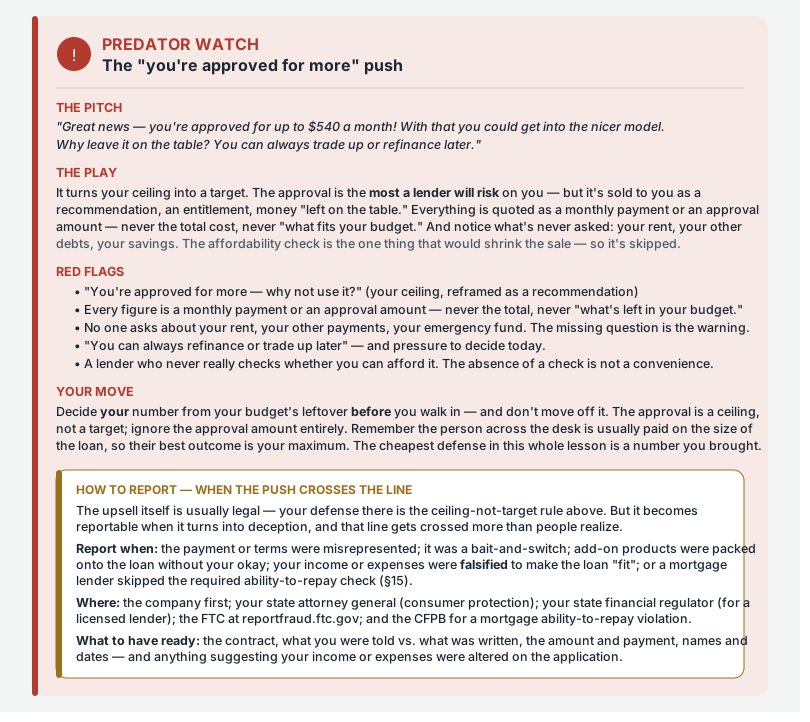
The reason this predator is harder to spot than the last two is that it’s wearing the costume of good news. “You’re approved for more” sounds like a gift, an unlocked level, a compliment to your creditworthiness — which is exactly why it works. But the approval amount is not a recommendation and it is not money you’re “leaving on the table”; it’s the ceiling from §11, the most a lender is willing to risk, calculated on your gross income with your real life invisible to it. Treating that ceiling as a target is precisely the move that produces the house- and car-poor outcomes of §12. The whole play depends on one substitution — ceiling swapped for target — and the entire defense is refusing that swap.
The tell that separates this from honest help is what’s never asked. A salesperson genuinely trying to find what fits Maya would ask about her rent, her other payments, her savings, her emergency fund — the affordability picture this whole lesson has built. The max-approval pusher asks none of that, because every one of those questions would shrink the sale. He quotes monthly payments and approval amounts, never totals and never budgets, because the monthly payment is the number designed to feel small (Lesson 2) and the approval amount is the number designed to feel like permission. And the reason the incentive runs that way is structural and worth saying plainly: the person across the desk is very often paid on the size of the loan — a finance manager’s commission, a loan officer’s bonus, a dealer’s markup — so his best outcome is, by design, her maximum. That doesn’t make him a villain; it makes him someone whose interests are opposite to hers in the one decision that matters most.
Which is why Maya’s move is almost embarrassingly cheap: bring her own number. Before she walks onto the lot or opens the loan portal, she decides — from her budget’s leftover, the way §11 and §12 taught — the payment she can actually carry while keeping her savings and her buffer, and she does not move off it. She ignores the approval amount entirely; it’s information about the lender’s risk appetite, not about her life. A number decided in advance, in the calm of her own kitchen, is immune to a pitch delivered in the pressure of a sales office. The defense isn’t willpower in the moment — it’s a decision made before the moment, when no one is selling.
The How-to-report block carries an honesty the other two predators didn’t need: most of this push is legal, and the right response to legal-but-aggressive sales is the ceiling-not-target rule, not a complaint. But it crosses into reportable territory more often than people realize — when the payment or terms are misrepresented, when it’s a bait-and-switch, when add-on products are packed onto the loan without consent, when a lender falsifies the borrower’s income or expenses to make the loan “fit” the rules (a genuine fraud that happens to push exactly these unaffordable loans), or when a mortgage lender skips the legally required affordability check. The block routes those to the company, the state AG, the state financial regulator, the FTC, and — for the mortgage ability-to-repay violation specifically — the CFPB. And there’s a civic point under it: the Ability-to-Repay rule, which §15 covers, exists because lenders once pushed millions of people into loans they couldn’t afford. Reporting the version that crosses the line is part of how that protection stays real.
For anyone reading this who recognizes it after the fact — who already took the nicer car, the bigger house, the bigger loan, and now feels the squeeze — the next beat is the calm one, and it’s for you.
If This Already Happened to You
Plenty of people reading §13 didn’t recognize a pitch they’re about to face — they recognized the one they already took. They’re in the nicer car, the bigger house, the larger loan, and they can feel the squeeze that §12 described: current on everything, with no room anywhere. Darnell is one of them. This beat is for them, and it’s deliberately calm:
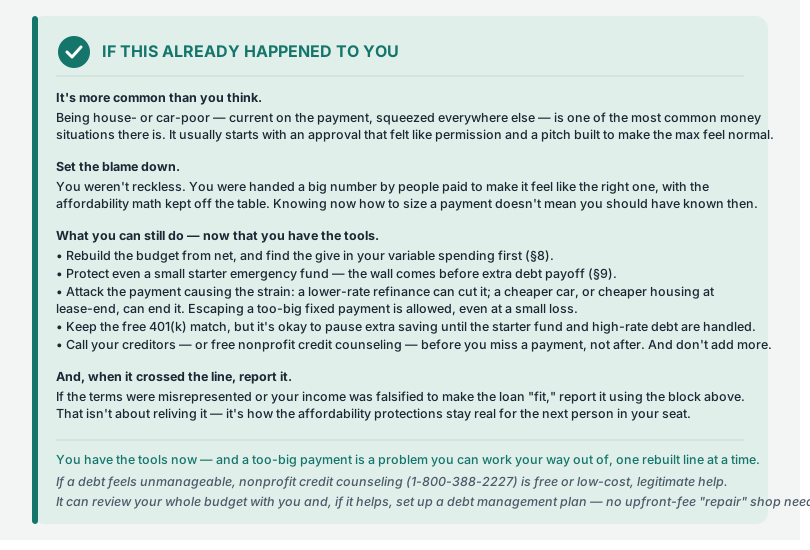
The beat does its four jobs deliberately. It names being house- or car-poor as ordinary and engineered rather than a private failure — it’s one of the most common money situations there is, and it nearly always begins with an approval dressed up as permission. It sets the self-blame down explicitly, because “you should have known better” is both the wrong lesson and the wrong feeling: the number was sold as the right one by people paid to make it feel normal, with the affordability math kept off the table on purpose. It points to what’s genuinely actionable from right where someone is — rebuilding the budget with the tools this lesson just gave them, finding the give in variable spending, protecting even a tiny emergency fund, and, crucially, attacking the fixed payment itself: a lower-rate refinance can shrink it, and trading down to a cheaper car or cheaper housing to escape it is allowed, even at a small loss, because ending the strain is worth more than saving face. And it reframes reporting — for the versions that crossed into deception — as a civic act rather than a reopening of the wound.
Two things in that “what you can still do” list deserve emphasis, because they’re where people get stuck. First, escaping a too-big payment is permitted. There’s a powerful instinct to feel locked in — to white-knuckle a payment for years out of a sense that backing out is failure. It isn’t. Selling the car, breaking even or taking a modest loss to get into something affordable, downsizing at lease-end — these are competent moves, not defeats, and they often end the bleeding faster than any amount of budgeting around the edges. Second, help exists that is free and legitimate, and it’s the opposite of Lesson 1’s predator: nonprofit credit counseling will sit down with a whole budget, and if it helps, set up a debt-management plan — without the upfront “repair” fee that marks a scam. Calling before a missed payment, while there’s still room to negotiate, is far more powerful than calling after.
The throughline of the whole lesson lands here: the skill it taught — telling approved from affordable, sizing a payment to a budget instead of a ceiling — isn’t only protection going forward. It’s also the way out for anyone already caught, and naming that is the kindest and most useful thing this section can do. A too-big payment is a problem with an exit, worked one rebuilt line at a time.
One structural piece remains: the rule that exists because lenders once pushed people into loans they couldn’t repay — the Ability-to-Repay rule — which is both Maya’s protection and the legal backbone behind the recourse in §13. That’s the next turn.
The Ability-to-Repay rule — and why you’re the one who has to use it
There’s a federal rule that exists because of exactly the predator in §13 — and understanding both what it does and what it doesn’t do is what ties this whole lesson together.
In the years before the 2008 crash, lenders made mortgages without seriously checking whether borrowers could repay them — “no-doc” and “stated-income” loans, teaser rates that reset to payments people could never have afforded, approvals that ignored the borrower’s actual budget entirely. When those loans failed at scale, they helped trigger the foreclosure crisis. The Ability-to-Repay (ATR) rule, created by the Dodd-Frank Act and written into Regulation Z under the Truth in Lending Act, is the law’s direct answer: before making most home loans, a lender must make a reasonable, good-faith determination that the borrower can actually repay. The affordability check that §13’s salesperson skipped is, on a mortgage, legally the lender’s job. But notice precisely how far that protection reaches:
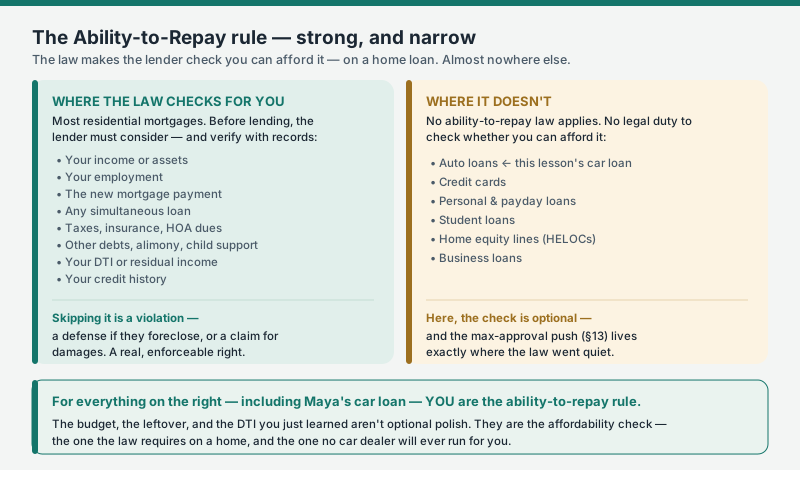
What the rule requires is genuinely strong. A mortgage lender can’t just glance at a credit score; it must consider eight specific things — income or assets, employment, the new mortgage payment, any simultaneous loan, the taxes and insurance and dues that ride along with a home, other debts and obligations, the DTI or residual income, and credit history — and it must verify them against real third-party records rather than taking the borrower’s word. Loans that meet certain standards (Qualified Mortgages) earn the lender legal protection for having done this correctly, and as §10 covered, the General QM now leans on price-based thresholds rather than the old 43% DTI cap. The throughline is that, on a home loan, the affordability determination this entire lesson teaches is legally mandatory for the lender to perform.
And what it protects is the legal backbone under §13’s recourse. Because the lender is required to verify repayment ability, “they put me in a mortgage they should have known I couldn’t afford” stops being a private regret and becomes an enforceable wrong — it can be raised as a defense if the lender tries to foreclose, or pursued as a claim for damages. The 2008 era’s lesson was written directly into law as a borrower’s right.
But the limit is the part Maya most needs to internalize, because it’s counterintuitive: the rule is powerful and narrow. It covers most residential mortgages and essentially nothing else — not auto loans, not credit cards, not personal or payday loans, not student loans, not home-equity lines, not business loans. Which means the very loan at the center of this lesson, her car loan, has no ability-to-repay protection whatsoever. The dealer and the auto lender are under no legal duty to check whether she can afford it, and as a rule, they won’t — checking is the one thing that would shrink the sale.
Step back and the pattern is striking, and it’s the heart of the section. The law checks hardest where the stakes are highest — your home — and goes nearly silent on the everyday loans where the max-approval push is most common. For the large majority of her borrowing life — every car, every card, every personal loan — no one is legally required to ask whether she can afford it. That isn’t a gap to be frightened of; it’s the entire reason this lesson exists. For every loan the law leaves unguarded, she is the ability-to-repay rule. The budget, the leftover, the DTI she just learned aren’t financial-literacy decoration — they are the affordability check itself, the one the law demands on a house and the one a car dealer will never run on her behalf. She has to run it herself, every time, because she’s the only party in the room whose job is to.
The recourse follows the coverage. If a mortgage lender violated ATR, she climbs the familiar stack from Lesson 2 — the lender first, then her state attorney general, the state financial regulator, and the CFPB (which handles mortgage matters, though with the reduced capacity noted there). For a car, card, or personal loan, there’s no ATR claim to bring — but deception, misrepresentation, or falsified income is still reportable through the §13 block. Knowing which protection attaches to which loan is what lets her reach for the right lever instead of the wrong one.
That closes the lesson’s substance: she can read her real income, build a budget, size her DTI, tell approved from affordable, see what a payment truly costs, recognize the push toward her ceiling, find her way back if she’s already stretched, and know precisely where the law will and won’t catch her. What remains is to gather the loose questions people always ask and let her check herself — the final turn.
Most Common Questions
The questions people actually ask once they start wrestling with affordability — paraphrased from the kinds of things that fill personal-finance forums.
“How much of my income should go to rent, and to a car?”
For housing, a common benchmark keeps rent at or under ~30% of income — Maya’s $950 sits right at that. For a car, the smarter test isn’t a percentage but the true cost: payment plus insurance plus gas plus maintenance (hers is ~$554 all-in, not the $304 payment). Some people cap total transportation around 15–20% of take-home, but the honest answer is the lesson’s: size it to your budget’s leftover, not a rule of thumb. If it won’t fit alongside your savings and buffer, it’s too much — whatever the percentage says.
“I got approved for way more than I expected. Is it safe to spend that much?”
No, and this is the heart of the lesson. The approval is a ceiling — the most a lender will risk on you, calculated on your gross with your real expenses invisible to it — not a target or a recommendation, and the person who approved it often profits from a bigger loan. Decide your number from your own budget’s leftover before you shop, and treat the approval as trivia. Being approved for $540 doesn’t mean $540 fits your life.
“Should I pay off debt first or build my emergency fund first?”
Both, in a specific order: a ~$1,000 starter fund first, so the next surprise doesn’t land on a credit card and erase your progress; then capture any employer 401(k) match (free money); then attack high-interest debt (the 22.99% card); then build the full 3–6 month fund. The starter comes first precisely because, without it, aggressively paying down a card just gets reversed by the first flat tire.
“My income is different every month — tips, commission, gig work. How do I budget?”
Budget from a conservative average, ideally your typical low month, so a slow stretch doesn’t break you — and build a larger buffer than someone with steady pay (toward the 6-month end of the range). In good months, route the extra straight to savings rather than lifestyle. Lenders will average your income too, often over two years, so steady documentation helps when you go to borrow.
“What actually counts in my DTI? Does rent count? Utilities?”
DTI counts debt and housing: rent or mortgage, car loan, credit-card minimums, student loans, personal loans, child support/alimony. It does not count utilities, groceries, gas, standalone insurance, phone, subscriptions, or savings. That’s exactly why DTI isn’t your budget — it’s a narrow, debt-only ratio that can look healthy while your real monthly slack is thin.
“Is 50/30/20 realistic? My ‘needs’ are way more than 50%.”
It’s a guideline, not a law, and in a high-cost area needs routinely run past 50% — Maya’s are about two-thirds. The point isn’t hitting the exact percentages; it’s budgeting on purpose, funding savings as a line item rather than a leftover, and knowing where your money goes. If needs are 65%, your wants and savings simply have less room — a reason to be extra careful adding new fixed payments, not a sign you’ve failed.
“Gross or net — which do I use?”
Depends who’s asking. For your budget, use net (take-home) — the money that actually arrives. For a lender’s calculation, they use gross. That mismatch is the whole reason “approved” runs ahead of “affordable”: you’re sized on a number about 25% bigger than the one you live on.
Check yourself
Six questions across the lesson — tap an answer to see how you did:
Check yourself — can you afford it?
Six questions across the lesson — tap an answer to see how you did.
1. Maya earns $4,200/month gross. Which number should she BUILD HER BUDGET from?
2. Maya is paid biweekly ($1,938.46/check). Her monthly gross is closest to…
3. Which belongs in her back-end DTI?
4. A lender approves a $540 car payment; her budget leftover is $280. The approval is…
5. The FIRST emergency-fund milestone to hit is…
6. Maya's CAR loan is protected by the federal Ability-to-Repay rule.
That closes Lesson 3. Maya now carries the full affordability toolkit — she can find her real income behind the headline salary, build a budget from net, size her DTI the way a lender does, tell approved from affordable, price what a payment truly costs across her whole life, recognize the push toward her ceiling and recover if she’s already past it, and know exactly where the law will and won’t catch her. Her counterparts carried the two edges of it: Sofia’s discipline in ignoring a flattering approval, and Darnell’s harder lesson and the way back from it. The single transferable instinct, the one that survives even if she forgets every number: let your budget’s leftover, not the lender’s approval, decide the amount.
Key takeaways
- Budget from net. The money that actually lands in your account — not your gross salary — is the only honest number to plan spending against.
- A lender’s “approved” and your “affordable” are answers to two different questions, and they routinely produce two different numbers.
- DTI is a debt-only ratio. It cannot see your groceries, your gas, your savings, or your emergency fund — which is why a healthy DTI can coexist with a dangerously tight real budget.
- The emergency fund is the wall between a surprise and debt. Build the ~$1,000 starter first; without it, every other financial goal is one flat tire from being erased.
- The true cost of a payment is five things: sticker price, hidden operating costs, opportunity cost, risk cost, and time cost. Pricing only the first is how people end up house- or car-poor.
- The Ability-to-Repay rule covers home mortgages and almost nothing else. For every other loan — car, card, personal — you are the ATR rule.
- The single transferable instinct: let your budget’s leftover, not the lender’s approval, decide the amount.
Knowledge check
6 questions
Maya’s gross monthly income is $4,200 and her take-home pay is $3,140. Which figure should she use as the foundation of her monthly budget?