In this lesson
- Opening
- 1. What a lease actually is — renting the use, not buying the car
- 2. The three numbers that set your lease payment
- 3. The money factor — the interest rate hiding in plain sight
- 4. Mileage caps and the overage trap
- 5. "Due at signing" — why the advertised payment is a mirage
- 6. The end of the lease — your three choices, and the buyout decision
- 7. Returning the car — the charges that turn a clean return into a bill
- 8. Lease vs buy — the decision, over time
- 9. Who should lease, and who should buy
- 10. Document Walkthrough — the lease agreement
- 11. Document Walkthrough — the lease-end disposition statement (the turn-in bill)
- 12. Predator Watch — the lease traps
- 13. Where to turn — the recourse stack for leases
- 14. Most common questions
- 15. Check yourself
Auto Leasing & Lease vs. Buy
Money factor, residual value, capitalized cost reduction, and the full lease-vs-buy math — when leasing costs less and when it doesn't.
What you'll learn
- Define a lease as a payment for the depreciation during the term rather than ownership of the vehicle, and explain why the lower monthly payment comes with a no-equity trade.
- Calculate a lease payment from its three components — cap cost, residual value, and money factor — and explain how each lever changes the payment.
- Convert a money factor to an approximate APR (multiply by 2,400) and identify how a marked-up money factor inflates the rent charge without appearing in the advertised payment.
- Explain the mileage overage trap: how the excess-mileage penalty is calculated, why buying extra miles upfront costs less than paying overage, and when a high-mileage driver should buy instead.
- Identify the due-at-signing trap and the financial risk of a lease down payment, and apply the 1%-of-MSRP benchmark to evaluate any lease quote.
- Evaluate the lease-end buyout decision by comparing the contract residual to real market value, and distinguish the three lease-end options: return, buy at residual, or trade in.
- Read the Consumer Leasing Act disclosure box on a lease agreement — identifying what each line measures and how to verify the negotiated numbers made it into the contract.
- Read a lease-end disposition statement — separating the fixed charges from the contestable charges and acting on the dispute window.
Opening
In Lesson 8, Maya bought her car — she borrowed, she's paying it down, and at the end she'll own an asset. This lesson is about the other path: leasing, which looks similar on the surface (a dealer, monthly payments, a car in the driveway) but is a fundamentally different transaction underneath. Leasing is frequently pitched as "the smart way to drive a nicer car for less," and sometimes it genuinely is the right call — but only if you understand what you're actually paying for, because a lease hides its costs in places a loan doesn't. We'll follow Sofia as she weighs a lease against buying, with Maya as the buyer's contrast, and we'll build the whole thing up from the one idea everything depends on: a lease is a rental, not a purchase.
1. What a lease actually is — renting the use, not buying the car
When you lease a car, you are not buying it — you're paying to use it for a fixed term, usually two or three years, and then handing it back. Here's the mechanism that makes this different from a loan, because it's the key to everything else in the lesson. A car loses value over time (the depreciation from Lesson 8). When you buy, you eventually pay for the whole car. When you lease, you pay only for the depreciation that happens during your term — the slice of the car's value that gets used up while you have it — plus a finance charge for borrowing the rest. That's why the monthly payment is lower than a loan payment on the same car: you're financing a slice, not the whole thing.
But that lower payment comes with a trade most people don't fully register: at the end of the lease, you return the car and own nothing. With a loan, every payment built a little equity — a little ownership — until the car was yours. With a lease, the payments bought you use, and when the term ends you hand back the keys with no asset to show for it. Lease again, and you're in a cycle of permanent car payments. That's the core trade, and understanding it is what separates a smart lease from an expensive habit:
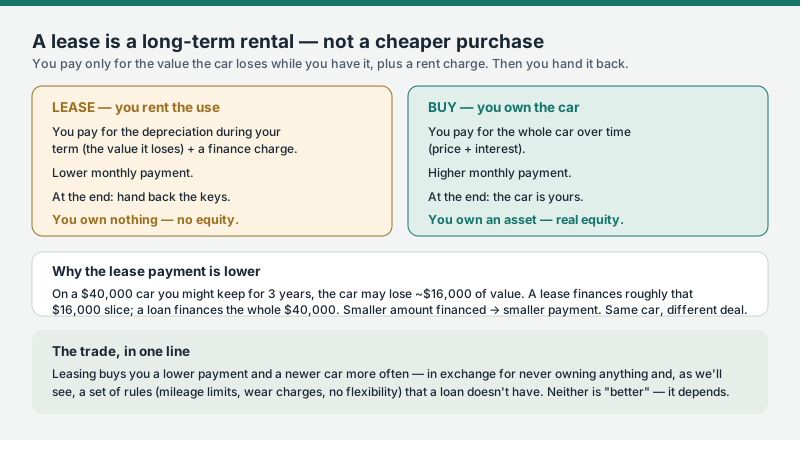
The reason a lease payment is lower than a loan payment on the same car is now concrete: on a $40,000 car Sofia might keep for three years, the vehicle could lose around $16,000 in value, and a lease essentially finances that ~$16,000 slice of depreciation rather than the whole $40,000 — a smaller amount financed produces a smaller monthly payment. That's the genuine appeal, and it's real. But the trade is equally real: at the end of those three years, a buyer like Maya would own a car worth ~$24,000, while a leaser like Sofia would own nothing and be choosing whether to start another payment cycle. Neither path is automatically "better" — leasing suits some drivers and buying suits others, which is the whole second half of this lesson — but you can't evaluate a lease at all without seeing how that lower payment is actually built.
And it's built from exactly three numbers.
2. The three numbers that set your lease payment
Every lease payment comes from three figures, and unlike a loan (where you mainly watch the APR), a leaser needs to understand all three because each is a different lever — and one of them is negotiable in ways dealers hope you won't notice. They are the capitalized cost, the residual value, and the money factor.
The capitalized cost (or "cap cost") is the agreed-upon price of the car for the lease — essentially the selling price. Lower is better, and crucially, this is negotiable, exactly like a car's price when buying. The residual value is the car's projected worth at the end of the lease, expressed as a percentage of its sticker price (MSRP) and set by the manufacturer's finance arm — it is not negotiable. A higher residual means the car holds its value better, so less of it depreciates during your term, which means a lower payment. The money factor is the lease's version of an interest rate — it's the finance charge, written as a tiny decimal (like 0.00125), and you convert it to an approximate APR by multiplying by 2,400. Like the dealer rate markup from Lesson 8, the money factor can be marked up by the dealer, and most leasers never even see it. The payment is then built as the depreciation (cap cost minus residual, spread over the term) plus a rent charge based on the money factor. Sofia's lease sits at the default — work the levers:
Lease calculator — monthly payment breakdown
Depreciation/mo
$361
Rent charge/mo
$76
Monthly payment
$437
Depreciation covers the $13,000 you "use up" over 36 months. Rent charge is the financing cost — MF × 2,400 converts to APR.
Sofia's lease breaks down into its two parts clearly: about $361/month of depreciation (the $40,000 car's value dropping toward its $24,000 residual, spread over 36 months) plus about $76/month of rent charge (the money factor applied to the cap cost and residual), for roughly $437/month before tax. Watch what each lever does, because this is where a leaser either saves or overpays. Dragging the cap cost down — by negotiating the price, exactly as a buyer would — lowers the payment directly; this is the number most people forget is negotiable on a lease. Raising the residual lowers the payment too (the car holds more value, so less depreciates on your watch), but it's manufacturer-set, which is why some cars simply lease better than others. And the money factor is the sneaky one: nudge it up and the rent charge climbs, which is exactly how a marked-up money factor inflates a payment without the leaser realizing it's happening. That's why the 1% rule is such a useful sniff test — a competitive lease payment is roughly 1% of MSRP per month, so a quote well above that signals a high cap cost, a low residual, or a marked-up money factor. That hidden money factor, and how to catch it, is the next section.
3. The money factor — the interest rate hiding in plain sight
Of the three numbers, the money factor is the one dealers most hope you won't examine, because it's deliberately written in a form that doesn't look like an interest rate. Instead of "5% APR," a lease quotes a money factor like 0.00208 — a tiny decimal that means nothing to most people. But it is the interest rate of the lease, just dressed differently, and there's a simple conversion: multiply the money factor by 2,400 to get the approximate APR. So 0.00208 × 2,400 ≈ 5%. Learning that one trick instantly de-mystifies the number — and that matters, because just like the dealer rate markup from Lesson 8, the money factor can be marked up. The lender sets a base ("buy") money factor based on your credit; the dealer is allowed to quote you a higher one and keep the difference as profit. Because almost no leaser knows to convert it or ask whether it's the base rate, it's one of the easiest places to pad a deal:
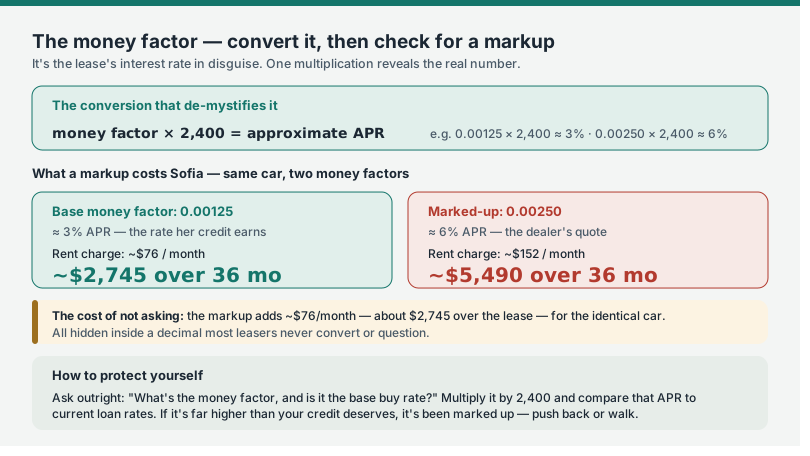
The cost of leaving the money factor unexamined is concrete: for Sofia's identical $40,000 car, a base money factor of 0.00125 (~3% APR, the rate her super-prime credit earns) produces about $76/month in rent charge, while a marked-up 0.00250 (~6%) produces about $152/month — roughly $76 a month more, or about $2,745 over a 36-month lease, for the exact same car. The entire difference is buried in a decimal that most leasers never convert and never question. The defense is two simple habits: ask outright "what's the money factor, and is it the base buy rate?", and multiply whatever number they give you by 2,400 to turn it back into an APR you can actually judge against current loan rates. If that APR is much higher than your credit deserves, it's been marked up, and that's the moment to push back. The money factor is the lease's hidden rate trap; the other major trap is hidden in the miles, and it lands at the end instead of the beginning.
4. Mileage caps and the overage trap
Every lease comes with an annual mileage cap — a limit on how many miles you can drive per year, typically offered as 10,000, 12,000, or 15,000 miles (sometimes 7,500). This exists because the residual value (§2) assumes the car will have a certain mileage when returned; drive more than the cap and the car is worth less than projected, so the lease charges you for the gap. Here's the mechanism that catches people: if you exceed your cap, you pay an excess-mileage penalty — usually $0.15 to $0.30 per mile — and it's billed all at once at lease-end, when it's far too late to do anything about it. There's a trade buried in the cap, too: a lower mileage cap gives a higher residual (the car's projected to be worth more) and thus a slightly lower payment — which tempts people to pick a cap below what they actually drive. Darnell is the cautionary case; see what his real mileage does to a lease:
Mileage overage calculator
Excess miles (total)
18,000
Overage bill at turn-in
$4,500
Overage is billed as a lump sum at return — not spread over the lease. If you expect to go over, buy extra miles upfront (usually cheaper per mile).
Darnell's case shows how badly the mileage trap can bite: he drives about 18,000 miles a year but is tempted by the lower payment of a 12,000-mile cap, which means 6,000 excess miles a year — 18,000 over a three-year lease — and a roughly $4,500 bill dropped on him all at once at turn-in. That lump sum doesn't just sting; it erases the lower-payment advantage that made the lease attractive in the first place. There are two real lessons here. The smaller one: if you know you'll drive over the cap, buying the extra miles upfront is cheaper than paying the overage penalty at the end (the upfront rate is lower). The bigger one: a genuinely high-mileage driver like Darnell is usually better off buying than leasing, because the overage charges wipe out the lease economics — leasing rewards people whose driving fits comfortably under the cap.
The mileage trap lands at the end of the lease, but there's another trap that lands at the beginning, in the form of a tempting low advertised payment — and that's the next section.
5. "Due at signing" — why the advertised payment is a mirage
Lease advertising is built around a single seductive number — "$299/month!" — and that number is frequently a mirage, because of a line most people skim past: "due at signing." This is the cash you have to hand over upfront to get that low payment, and it bundles together a down payment (called a "cap cost reduction"), the first month's payment, an acquisition fee, taxes, and registration. A "$299/month" lease might require $4,000 due at signing — and when you spread that $4,000 across the 36 months, the real monthly cost is closer to $410. The advertised payment was only low because thousands were paid in advance.
But there's a deeper reason to be wary of putting money down on a lease, and it's a genuine financial risk most people never hear: if the car is totaled or stolen early in the lease, you lose that down payment entirely. Here's why. When a leased car is destroyed, the insurance (and gap coverage) settles up with the leasing company for the car's value — but your down payment was a prepayment of depreciation on a car that no longer exists, and there's nothing to refund it from. You essentially pre-paid to use a car you can no longer use. With a loan, a large down payment builds equity you could recover; with a lease, a large down payment is money at risk for no ownership benefit. This is why the expert practice is the opposite of the advertising: put as little down as possible (look for "sign and drive" or low-due-at-signing leases) and instead negotiate the cap cost down, which lowers your payment without putting cash at risk. It's also why the 1% rule from §2 specifically assumes minimal money down — a payment that's only 1% of MSRP because you fronted $5,000 isn't actually a good deal.
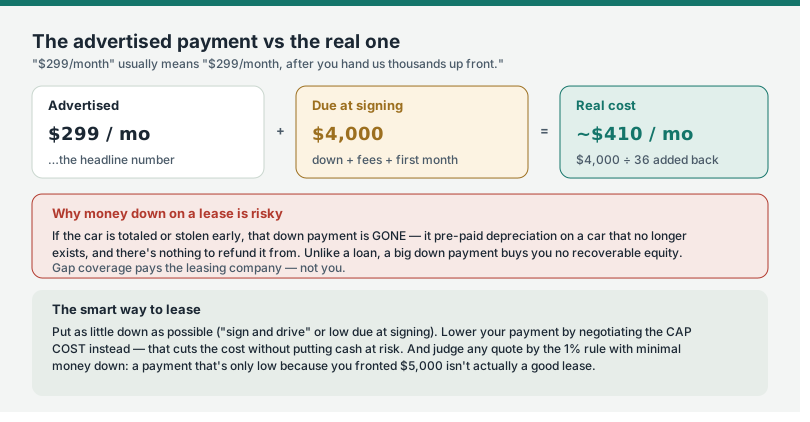
The takeaway reframes how to read every lease ad: the real monthly cost is the advertised payment plus the due-at-signing amount spread across the term, so "$299/month with $4,000 down" is really about $410/month, and comparing it against another lease quoted with zero down is comparing two different things. And the money-down decision isn't just about the monthly number — it's about risk, because unlike a loan down payment (which builds recoverable equity), a lease down payment is pure exposure: lose the car early and you lose the cash with nothing to show for it. So the disciplined approach inverts the dealer's pitch — minimize the cash down, negotiate the cap cost instead, and judge every quote with minimal money down using the 1% rule. That handles the start of the lease; the other decision point that catches people off guard is the end, where leasers are often surprised to learn they have three distinct choices.
6. The end of the lease — your three choices, and the buyout decision
When a lease term ends, a leaser isn't simply handing back keys and walking away — they have three distinct options, and knowing them in advance turns the lease-end from a stressful surprise into a decision. The first is to return the car and walk away: this is the classic "walk-away" feature of a standard (closed-end) lease, where you hand it back and owe only the disposition fee plus any excess-mileage or wear charges (§7). The second is to buy the car at its residual value — the lease contract spells out, upfront, the exact price you can purchase it for at the end, and this is called the buyout or purchase option. The third is to trade it in toward a new lease or purchase, letting the dealer handle the return paperwork for you.
The second option — the buyout — is the one that requires real judgment, and it can be quietly lucrative or a clear mistake depending on one comparison: the residual value (your fixed buyout price) versus the car's actual market value at lease-end. Drag the market value and watch the decision flip:
Lease-end buyout decision
Buy it — capture $2,000 in equity
Market value exceeds your residual. You're buying below market — that gap is instant equity.
Check market value on CarMax, Carvana, or KBB before deciding. The residual was set at contract signing — market moves since then are yours to exploit.
The buyout decision comes down to a clean comparison that the contract sets up for you years in advance. Sofia's residual — her guaranteed buyout price — is locked at $24,000. If the car turns out to be worth more than that at lease-end (say $26,000, because the model held its value well), buying it captures that gap: she gets a $24,000 car worth $26,000, an instant ~$2,000 in equity she could keep or realize by reselling. If the car is worth less than the residual (say $22,000), the smart move is the opposite — return it and walk away, letting the leasing company eat the loss, which is precisely the protective advantage of a closed-end lease. This is one of the few places where a lease can actually work in the leaser's favor, and it's only visible to someone who knows to compare the residual against the real market value rather than reflexively returning the car or reflexively buying it. The buyout aside, most lease-ends involve returning the car — and that's where a different set of charges waits, the ones that turn a clean return into an unexpected bill.
7. Returning the car — the charges that turn a clean return into a bill
Handing back a leased car isn't free, and the charges that hit at turn-in surprise people precisely because they arrive all at once, at the end, when there's no chance to plan for them. There are three. The disposition fee is a flat charge — typically $300 to $595 — that the leasing company bills simply for processing the return and preparing the car for resale; it's stated in the contract, and it's sometimes waived if you lease or buy another car from the same brand. The excess-mileage charge is the per-mile penalty from §4, applied to every mile over the cap. And the excess wear-and-tear charge covers damage beyond what the contract defines as "normal" wear — door dings, scrapes, curb-rashed wheels, bald tires, stained or torn upholstery — and this is the one most prone to abuse, because some lessors are known for inflated "reconditioning" estimates. Hector returns his lease and gets the bill:
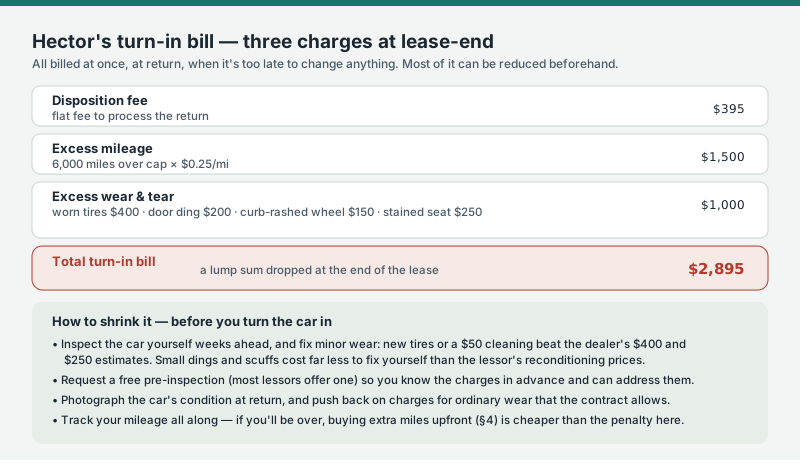
Hector's $2,895 turn-in bill captures why lease-end charges sting: they arrive as a single lump sum at the moment of return, when the mileage is already driven and the wear is already there. But most of it is reducible if you act before turn-in. Inspecting the car yourself weeks ahead lets you fix minor wear at your cost rather than the lessor's — replacing tires or paying $50 to clean a seat beats the dealer's $400 and $250 estimates, and small dings are far cheaper to address yourself than at reconditioning prices. Most lessors offer a free pre-inspection a month or two before lease-end, which tells you the charges in advance so nothing is a surprise and you can decide what's worth fixing. And because excess-wear charges are the most prone to padding, photographing the car's condition at return and knowing what the contract counts as normal wear lets you push back on inflated reconditioning. The disposition fee is essentially fixed, the mileage charge is best managed by buying miles upfront (§4), but the wear charges are where preparation saves real money. All of which feeds the question this whole lesson has been building toward: for any given person, does it actually make more sense to lease or to buy?
8. Lease vs buy — the decision, over time
The core difference between leasing and buying is equity, and it changes everything about the long-run math. A lease gives a lower monthly payment but builds no ownership, so leasing repeatedly means perpetual payments — you're always making a car payment, forever. Buying costs more per month, but the payments end when the loan is paid off, and you're left owning a car you can keep driving "for free" (just maintenance) or sell for cash. That difference is invisible in a short snapshot and decisive over time. Sofia can lease her $40,000 car for ~$437/month indefinitely, or buy it (roughly $734/month for five years, then nothing). Drag the time horizon and watch the two paths cross:
Lease vs. buy — net cost over time
Same $40K car: lease at $437/mo vs. buy at $734/mo ($2K down, 60-mo loan).
Lease net cost
$26,220
own nothing at end
Buy net cost
$29,312
car worth ~$16,728
Crossover is around 6.2 years: before that the lease looks cheaper (lower cash out); after that buying wins because payments stop and you hold an asset.
The crossover tells the real story. Over a short horizon, leasing's lower payment keeps its cash outlay below buying's — which is why leasing genuinely suits someone who wants a new car every two or three years and won't keep one long. But the moment you measure net cost (cash paid minus the value of what you still own) — and especially as the horizon lengthens — buying pulls decisively ahead, because the buyer's payments stop after the loan is paid while the leaser's continue forever, and the buyer is left holding a car worth thousands. Keep a bought car five, eight, ten years and the gap becomes large: you're driving for only maintenance costs while a leaser is still writing a check every month with nothing to show for it. Two 2026 facts tilt the scale further toward buying for the right car: the OBBBA $10,000 interest deduction applies only to buying a new U.S.-assembled vehicle, not leasing, and the old EV-credit advantage of leasing vanished when the federal EV credit ended in September 2025. None of this makes leasing wrong — it makes it situational, which is exactly the decision the next section lays out as a clear guide.
9. Who should lease, and who should buy
With the mechanics and the long-run math in hand, the decision becomes a matter of matching the tool to the person. Neither leasing nor buying is universally smarter — each fits a different set of habits and priorities, and seeing them side by side makes the choice clear:
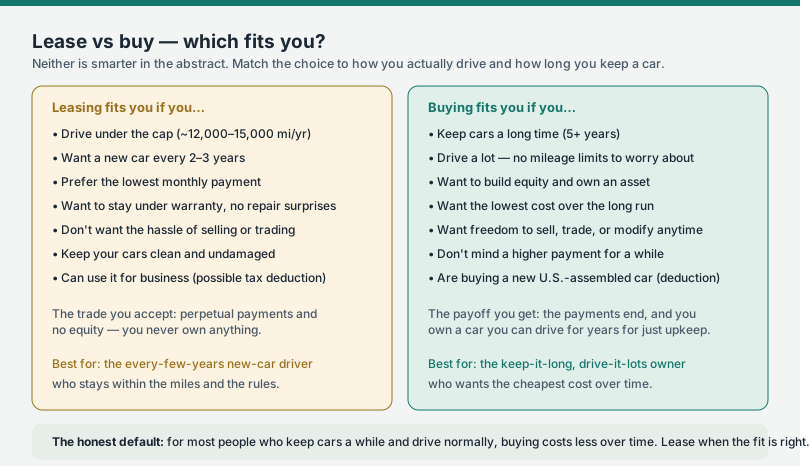
The decision really does come down to a handful of honest questions about how you live with a car. Leasing fits the driver who stays comfortably under the mileage cap, genuinely wants a new car every two or three years, values the lowest payment and continuous warranty coverage, doesn't want the hassle of eventually selling, and keeps their cars in good condition — accepting, knowingly, the trade of perpetual payments and no equity. Buying fits the owner who keeps cars a long time, drives enough that mileage limits would bite, wants to build equity and eventually stop paying, values the freedom to sell or modify whenever, and — for a new U.S.-assembled car in 2026 — can use the OBBBA interest deduction. The honest default is that for most people, who keep cars a while and drive normally, buying costs less over time, which is why it's the better fit more often than not — but leasing is a legitimate, sometimes superior choice when the profile genuinely matches. Whichever path someone takes, if they lease, the document that binds them is the lease agreement — and like the loan contract, it has a federally mandated disclosure box at its heart.
10. Document Walkthrough — the lease agreement
Where Sofia meets it, and how (venue and mode). When she leases, the dealer's F&I office produces the lease agreement — the binding contract she signs, governed by the federal Consumer Leasing Act, which (just as the Truth in Lending Act does for loans) requires a standardized disclosure box spelling out the cost of the lease in a fixed format. This is the legal document, not an estimate, and its heart is the section showing how the monthly payment is determined — where the cap cost, residual, and rent charge from §2 appear in writing. Reading it confirms the lease matches what she negotiated. The full agreement:
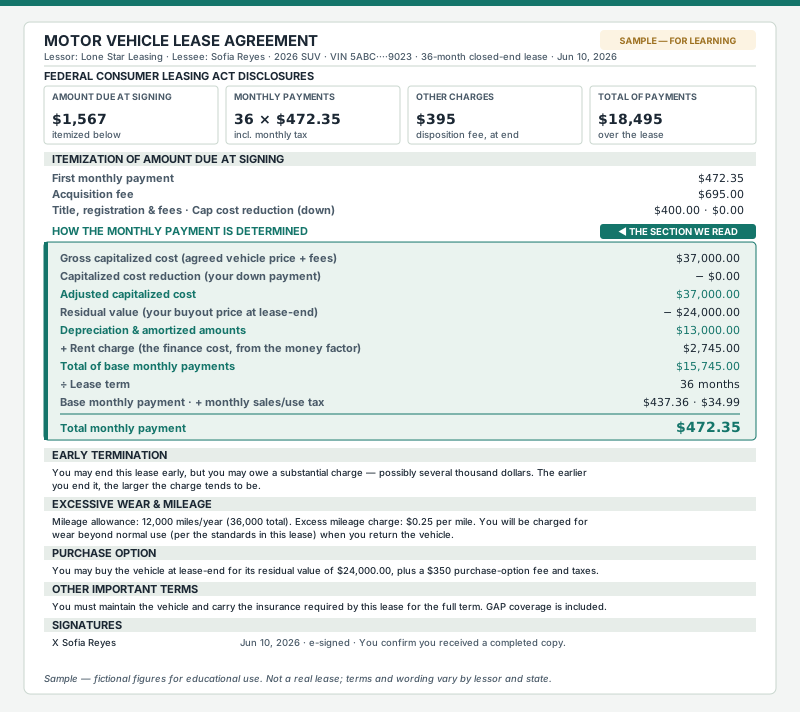
Complete total-coverage breakdown, in reading order — every line explained as what it is, what it does for Sofia, and why it matters.
The document — "Motor Vehicle Lease Agreement": this is the binding contract to lease the car, and it's governed by the federal Consumer Leasing Act, which is why it carries a standardized disclosure box much like the TILA box on a loan. What it does for Sofia is convert her negotiated deal into an enforceable obligation with every cost laid out in a fixed, comparable format. Why it matters: because the disclosure format is federally mandated, she can read it the same way on any lessor's contract — and confirm the numbers match what she was quoted before she signs.
Lessor, Lessee, vehicle, VIN, "36-month closed-end lease," date: the header names the lessor (the leasing company that owns the car), Sofia as lessee, the exact vehicle by VIN, and the lease type. What "closed-end" does for her is important: it's the standard "walk-away" lease, meaning at the end she can simply return the car and owe nothing for any unexpected drop in its value below the residual — the lessor bears that risk, not her. Why it matters: an open-end lease (mostly for businesses) would make her pay if the car were worth less than the residual; confirming "closed-end" confirms she has the walk-away protection from §6.
The Consumer Leasing Act summary (the four boxes): federal law requires these four headline figures up top so the cost is visible at a glance:
Amount Due at Signing — $1,567: the cash she pays upfront, itemized just below. What it does: it's her out-of-pocket cost to start the lease. Why it matters: this is the §5 "due at signing" number — the thing that makes advertised payments misleading — and seeing it stated plainly lets her judge the real cost.
Monthly Payments — 36 × $472.35: how many payments, and how much each (tax included). What it does: it's the recurring commitment. Why it matters: this is the number that has to fit her budget for three years.
Other Charges — $395: charges beyond the monthly payments — here the disposition fee billed at the end. Why it matters: it's a cost that doesn't show up monthly but will arrive at turn-in, so she should expect it.
Total of Payments — $18,495: everything she'll have paid by the end of the lease — due-at-signing plus all monthlies plus other charges. What it does: it's the all-in cost of the lease. Why it matters: it's the honest "what will this lease cost me" figure, and the number to compare against another lease or against buying.
Itemization of Amount Due at Signing: breaks the $1,567 into parts — first monthly payment ($472.35), acquisition fee ($695), title/registration/fees ($400), and a $0 cap cost reduction. What it does: it shows exactly what the upfront money buys. Why it matters: the acquisition fee is a standard lessor charge for setting up the lease (worth knowing it's normal but not always negotiable), and the $0 cap cost reduction is the good sign from §5 — Sofia put no risky money down, lowering her payment instead by negotiating the cap cost.
How the Monthly Payment Is Determined (the tinted focus): this is the heart of the lease — the §2 mechanics in writing — and reading it confirms she wasn't overcharged:
Gross capitalized cost — $37,000: the agreed price of the car for the lease (the §2 "cap cost"), including fees. Why it matters: this is the number she negotiated down, exactly as a buyer negotiates price; a high cap cost here would mean she left money on the table.
Capitalized cost reduction — $0: her down payment, here zero. Why it matters: confirms the §5 best practice — no cash at risk.
Adjusted capitalized cost — $37,000: the cap cost after any reduction; the figure the lease is actually built on.
Residual value — $24,000: the car's projected worth at lease-end, and her guaranteed buyout price (§6). What it does: subtracting it from the adjusted cap cost gives the depreciation she pays for. Why it matters: it's both the driver of her payment (a higher residual would lower it) and the fixed price for the §6 buyout decision.
Depreciation & amortized amounts — $13,000: adjusted cap cost minus residual — the chunk of the car's value used up during her term. What it does: this is the largest part of what she's actually paying for. Why it matters: it's the concrete proof that she's financing the depreciation slice, not the whole car (§1).
Rent charge — $2,745: the finance cost of the lease, generated by the money factor (§3). What it does: it's the lease's equivalent of total interest. Why it matters: this is where a marked-up money factor would inflate the number — she can sanity-check it against the §3 conversion.
Total of base monthly payments — $15,745: depreciation plus rent charge — the total she pays in base payments over the lease.
÷ Lease term — 36 months: divides that total across the term.
Base monthly payment ($437.36) + monthly tax ($34.99) = Total monthly payment ($472.35): the final payment, with tax broken out. Why it matters: seeing the base and tax separately lets her confirm the base matches the §2 math (it does), so no padding slipped in.
Early Termination: "you may owe a substantial charge — possibly several thousand dollars." What it is: the penalty for ending the lease before the term is up. What it does: it warns her, in the contract, that a lease is a firm commitment. Why it matters concretely: unlike selling a car she owns, getting out of a lease early is genuinely expensive and difficult — so she should only lease for a term she's confident she can complete, because life changes (a move, a job change, a new baby) can't easily be accommodated mid-lease.
Excessive Wear & Mileage: mileage allowance 12,000/year (36,000 total), excess $0.25/mile, plus charges for wear beyond normal use. What it does: it sets the §4 and §7 limits in writing. Why it matters: this is where she confirms the cap matches her actual driving — if she drives more, this is the line that tells her to buy extra miles upfront or reconsider leasing entirely.
Purchase Option: buy at lease-end for the $24,000 residual plus a $350 purchase-option fee and taxes. What it does: it locks in her §6 buyout price. Why it matters: it's the exact figure she'll compare against market value at the end — and the small purchase-option fee is a cost to factor into that buyout decision.
Other Important Terms: maintenance and insurance requirements, and GAP coverage included. What it does: it spells out her ongoing obligations. Why it matters: the note that GAP is included is genuinely useful — it means the §7-style "owe-vs-worth" gap if the car is totaled is already covered (a real advantage of many leases), so she doesn't need to buy it separately.
Signatures & "you received a completed copy": her signature binds her to the lease, and the completed-copy affirmation matters for the same reason it did on the loan — ↳ a completed contract has no blank spaces. Why it matters: she should confirm every figure is filled in before signing and keep her copy as proof of the agreed terms.
Read in full, the lease agreement is the §1–§7 mechanics made binding — the disclosure box proving the true cost, the determination section showing the cap cost and residual she can verify, and the early-termination, mileage, and purchase-option terms spelling out the commitment and her end-of-lease choices. The single habit that makes it safe is checking that the "how the monthly payment is determined" section matches the cap cost and money factor she negotiated, because that's where any padding would hide.
11. Document Walkthrough — the lease-end disposition statement (the turn-in bill)
Where Hector meets it, and how (venue and mode). A few weeks after he returns the leased car, the lessor mails (or emails) the disposition statement — also called the final lease invoice or vehicle return statement. This is the itemized bill of everything he owes for the return: the §7 charges, made real and final. Unlike the agreement he signed at the start, this document arrives at the end, after the driving and the wear are already done — which is exactly why reading it carefully, and knowing what's disputable, is where money is saved. Hector's statement:
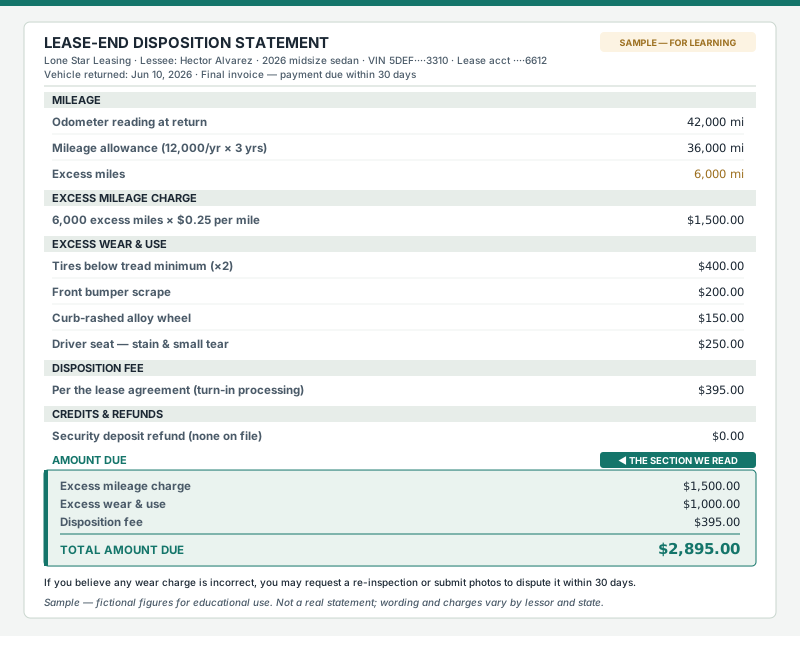
Complete total-coverage breakdown, in reading order — every line explained as what it is, what it does for Hector, and why it matters, including where he can fight back.
The document — "Lease-End Disposition Statement": this is the final bill for returning the leased car — the lessor's accounting of what Hector owes now that the lease is over. What it does for him is convert the abstract "you'll be charged for excess mileage and wear" warnings from the agreement into specific, itemized dollar amounts. Why it matters: this is the moment the lease's true total cost becomes clear, and — crucially — it's a bill he can partially contest, so reading it line by line rather than just paying it can save real money.
Lessor, lessee, vehicle, VIN, lease account, return date: identifies the leasing company, Hector, the exact car, his account, and the date he handed it back. What it does: ties the charges to his specific lease. Why it matters: the return date starts the clock — the statement notes payment is due within 30 days, and (as the dispute line shows) that same window governs his right to contest charges, so the date is the deadline he's working against.
Mileage section:
Odometer at return — 42,000 mi: the actual miles on the car when he handed it back. What it does: it's the measured figure the excess-mileage charge is calculated from. Why it matters: he should confirm it matches what the dashboard actually read at turn-in, because an error here directly inflates the charge.
Mileage allowance — 36,000 mi: the total miles his lease permitted (12,000/year × 3 years, from §4 and the agreement). What it does: it's the threshold he was allowed before penalties. Why it matters: it's the baseline that determines whether — and by how much — he went over.
Excess miles — 6,000: the gap between what he drove and what he was allowed. What it does: it's the quantity the per-mile charge is applied to. Why it matters: this is the concrete result of driving more than his cap, and the number he can't change now — only learn from for next time.
Excess Mileage Charge — $1,500: the 6,000 excess miles × $0.25 per mile, the rate set in his lease. What it does: it bills him for the extra depreciation those miles caused. Why it matters: this is the §4 trap realized — and ↳ a charge he largely couldn't dispute, since it's simple arithmetic from the odometer, which is exactly why the defense had to happen during the lease (driving less, or buying miles upfront), not here.
Excess Wear & Use (itemized) — $1,000 total: Tires below tread minimum — $400; bumper scrape — $200; curb-rashed wheel — $150; seat stain & tear — $250. What this section is: charges for damage the lessor judges to be beyond normal wear, itemized item by item. What it does: it bills Hector to recondition the car for resale. Why it matters, and where the leverage is: ↳ this is the most disputable part of the bill. Lessors are known for aggressive reconditioning estimates, and "excess" wear is partly a judgment call — so several of these are contestable. The tires he might have replaced himself for less; the seat stain he might have cleaned; and any item he believes falls within normal wear (which the lease defines) he can challenge. This is the line where reading the statement instead of just paying it pays off.
Disposition Fee — $395: the flat fee, set in the lease agreement, for processing the return and preparing the car for resale. What it does: it's the lessor's administrative charge for taking the car back. Why it matters: ↳ this one is essentially fixed and not disputable (it's in the contract he signed) — though it can sometimes be avoided entirely by leasing or buying another car from the same brand, which is worth knowing if he's getting another vehicle anyway.
Credits & Refunds — $0: any money owed back to Hector — typically a refundable security deposit. What it does: it offsets the charges. Why it matters: here it's zero because he paid no security deposit, but on leases that do require one, this is where that money returns (or gets applied against the charges), so it's worth checking that any deposit he paid is correctly credited.
Amount Due (the tinted focus) — $2,895: the bottom line — excess mileage ($1,500) + excess wear ($1,000) + disposition fee ($395), minus any credits. What it does: it states the single number he owes. Why it matters — and this is the lesson of the document: a "lower payment" lease ended with a $2,895 surprise bill, which retroactively raises the true cost of the whole lease. Seeing it itemized is what lets him separate the unavoidable parts (the disposition fee, the simple-math mileage charge) from the contestable parts (the wear items) — and act on the difference before paying.
Dispute notice — "request a re-inspection or submit photos within 30 days": the statement's own disclosure of his right to challenge wear charges. What it does: it gives him a formal path to contest. Why it matters: this is his concrete leverage — photographs taken at return, a requested re-inspection, and a reference to the lease's definition of normal wear can get questionable charges reduced or removed, but only within the 30-day window, so the dispute line is also a deadline he must act on.
Read in full, the disposition statement is the lease's hidden final cost made visible — and made negotiable in part. The mileage charge and disposition fee are largely fixed, but the wear charges are a judgment call Hector can push back on, which is why the right response to this document is to read it, separate the fixed from the contestable, and dispute the latter within the window rather than simply paying the total.
12. Predator Watch — the lease traps
Leasing's traps are quieter than the buying traps from Lesson 8 — there's no yo-yo scam or buy-here-pay-here lot — but they're effective precisely because so few people understand how a lease is built. The predator here is the deal structured to exploit that confusion, hiding its costs in a decimal at the start and a bill at the end.
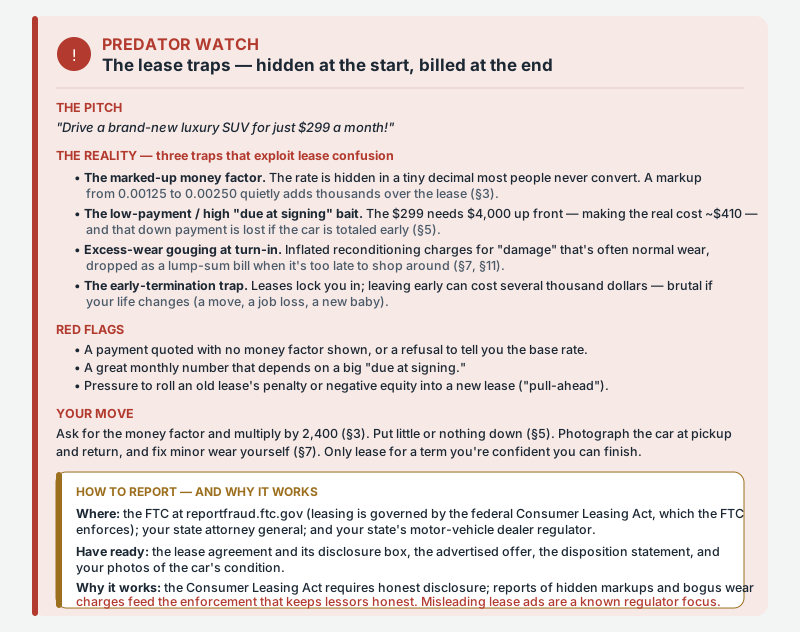
The four lease traps share a common design: they all exploit the fact that most leasers don't understand the mechanics. The marked-up money factor hides the real interest rate in a decimal nobody converts (§3). The low-payment/high-due-at-signing bait makes a deal look cheap by front-loading thousands you can't recover if the car is totaled (§5). The excess-wear gouging drops inflated reconditioning charges at the end, when you can no longer shop around (§7, §11). And the early-termination trap locks you into a multi-year commitment that's punishingly expensive to escape — which is genuinely dangerous, because a lease can't flex around a job loss, a move, or a new baby the way owning a car (which you can simply sell) can. The defenses are all things you do before and during the lease, not after: convert the money factor, put little down, photograph the car at pickup and return, fix minor wear yourself, and — critically — only lease for a term you're confident you can finish. For the person already caught in one of these:
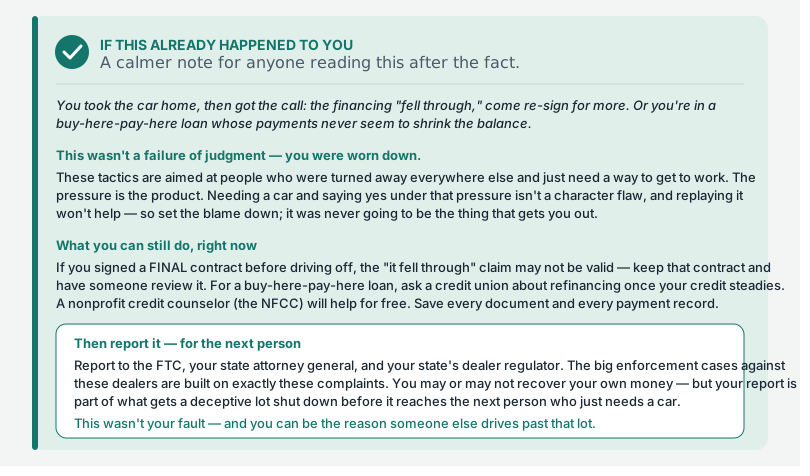
The reassurance beat speaks to the person who's realized, too late, that their lease costs more than they thought — a payment that ballooned once the upfront cash was spread out, or a turn-in bill that blindsided them. The honest truth is that a lease's costs are deliberately split across a hidden money factor, an upfront lump, and end-of-term charges, precisely so the monthly number looks small — so not seeing through that structure isn't a personal failing when almost no one is ever taught how a lease is built. And there are real moves available: an unaffordable lease can often be escaped through a lease transfer (a "lease swap," where someone else takes over the payments, frequently cheaper than the early-termination penalty); a surprise wear bill can be fought by disputing the questionable charges with photos within the window (§11); and a nonprofit counselor will help sort the numbers for free. Reporting a misrepresented lease isn't futile either — the Consumer Leasing Act exists because leases were once even murkier, and complaints are what keep its disclosures honest. Which leads to exactly where to take those complaints.
13. Where to turn — the recourse stack for leases
A lease dispute has its own ladder of recourse, and one of its rungs is specific to leasing — the federal law written to make leases readable in the first place.
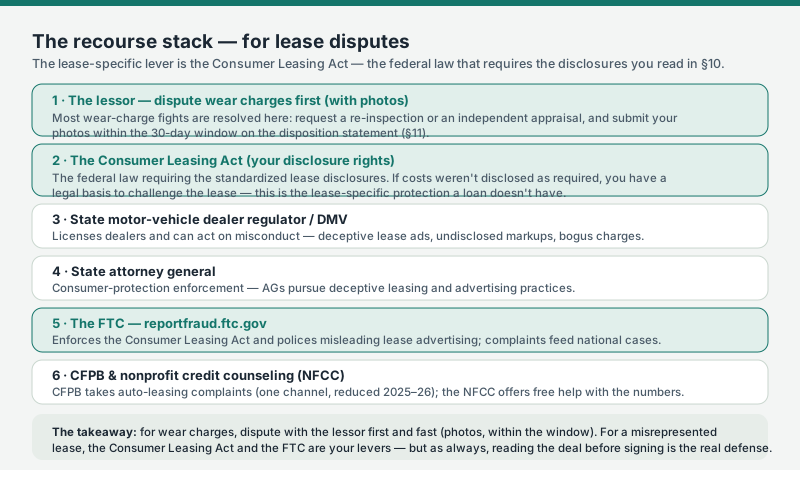
Two rungs on this ladder matter most for leases. The first is disputing wear charges directly with the lessor, fast — most of these fights never need a regulator, because requesting a re-inspection or an independent appraisal and submitting your own photos within the 30-day window (§11) resolves them, and the lessor would often rather reduce a charge than fight it. The second is the Consumer Leasing Act itself — the federal law behind the standardized disclosure box you read in §10. It exists specifically to make leases readable, and if a cost wasn't disclosed the way the law requires, that's a genuine legal basis to challenge the lease, which is a lease-specific protection a loan doesn't carry; the FTC enforces that law and polices misleading lease advertising, so a complaint there has real teeth. But the through-line of this entire lesson holds here too: recourse is a backstop, and the actual defense is understanding the deal — the money factor, the due-at-signing, the mileage cap, the wear standard — before you sign, because a lease, like a car purchase, is far easier to get right at the start than to fix at the end.
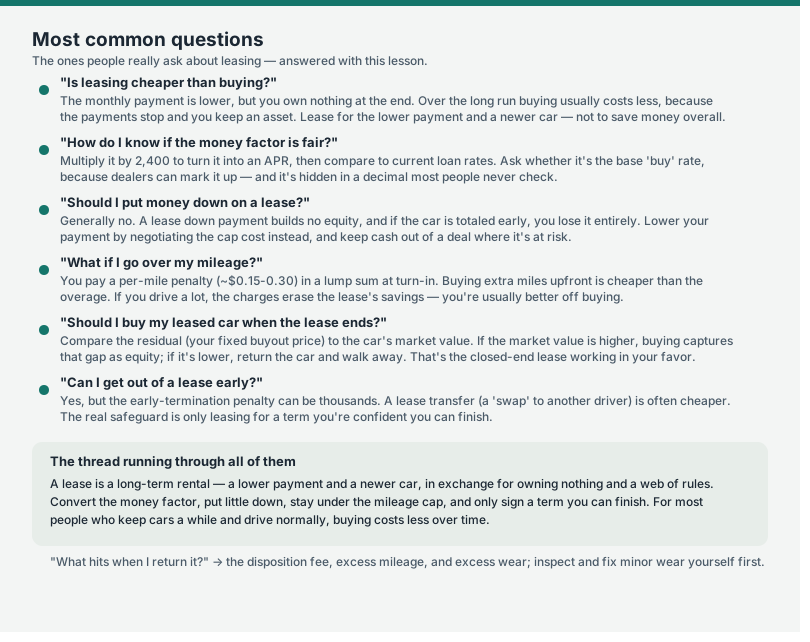
14. Most common questions
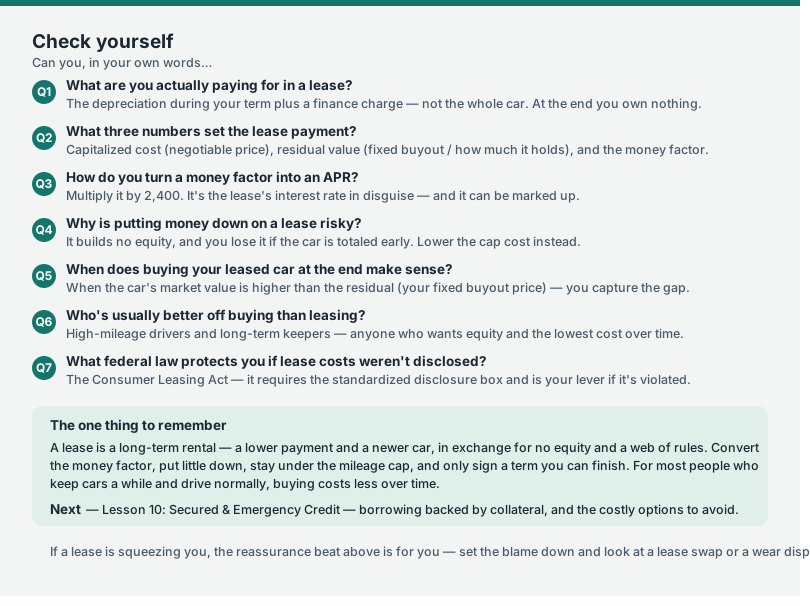
15. Check yourself
Key takeaways
- A lease is not a cheaper purchase — it's a rental. The lower monthly payment is real, but it comes with a no-equity trade: at the end, you own nothing and face the choice of starting another payment cycle.
- Money factor × 2,400 = approximate APR. Ask for the base buy rate and convert it before you sign — a marked-up money factor costs thousands over the lease with no change to the advertised payment.
- Never put significant money down on a lease. A lease down payment is at risk: if the car is totaled, the cash disappears with nothing to show for it. Minimize the down payment and negotiate the cap cost instead.
- Know your real mileage before choosing a cap. If you'll exceed the cap, buy extra miles upfront (the upfront rate is lower than the overage penalty) — or consider buying instead if you're a genuinely high-mileage driver.
- At lease-end, compare the residual to real market value before deciding. If the car is worth more than the residual, the buyout captures that gap; if less, walk away and let the leasing company absorb the loss.
- Lease-end wear charges are partly disputable. Photograph the car at pickup and return, request a free pre-inspection a month before turn-in, and dispute charges you believe fall within normal wear in writing within the 30-day window.
Knowledge check
6 questions
Sofia is quoted a money factor of 0.00250 on a lease. What is the approximate APR?