In this lesson
- Opening
- What “credit invisible” actually means — missing information, not bad information
- What a blank file needs — the five factors, and where to start
- The starter toolkit — six ways onto the ladder
- The credit-builder loan — your first Document Walkthrough
- Reading the cost disclosure — the Truth-in-Lending box
- How the credit-builder loan actually works
- The revolving half — a secured card, and riding someone else’s history
- Rent and utility reporting — credit for what you already pay
- Your first credit report — the scoreboard for the build
- Reading your report — identity, score, and inquiries
- Reading your report — the accounts building your score
- The timeline — from invisible to scored to good
- The habits that build — the whole job, mostly on autopilot
- Predator Watch — the guaranteed-approval fee-harvester
- If This Already Happened to You
- Your protections as a builder — accuracy is your right
- Most Common Questions
Building Credit from Scratch
From credit invisible to first score — the starter toolkit, two key documents, and the habits that carry you from a blank file to good credit.
What you'll learn
- Explain the difference between credit invisible and bad credit, and why a blank file is faster to fill in than a damaged one is to repair.
- Name the five credit score factors, state their weights, and identify which two are immediately controllable and can be satisfied with a single account.
- Describe six ways to start a credit file — secured card, credit-builder loan, authorized user, student card, rent and utility reporting, co-signer — and match each to the right situation.
- Read a credit-builder loan agreement field by field, including the Truth-in-Lending box and the inverted “How This Loan Works” structure.
- Read a thin-file credit report, understand what a first tradeline and an early VantageScore look like, and explain why a FICO score may not yet appear.
- State the realistic timeline from invisible to a first score to “good,” name the habits that keep the build on track, and recognize the fee-harvester predator that targets new builders.
- Know the FCRA, CARD Act, and ECOA protections that apply specifically to a builder, and describe how to dispute a credit report error.
Opening
And that word — starting line — points at the single most important reframe in this lesson: “no credit” is not “bad credit,” and the difference is everything. Bad credit is a record of trouble: missed payments, defaults, collections, the negative history Lesson 1 covered. No credit is a blank page. Priya hasn’t failed at anything; there’s simply nothing written yet. This matters emotionally — she has nothing to feel bad about, and the lenders declining her aren’t judging her character, just the absence of data — and it matters practically, because a blank page is faster and easier to fill in than a damaged one is to repair. Someone rebuilding from a rough history is fighting their record; Priya is just writing hers, and she gets to write it cleanly from the first line.
So the work of this lesson is concrete and genuinely doable: a clear, safe path from invisible to scored to good, using a handful of starter tools that exist for exactly this purpose — most of them free or cheap enough for a student’s budget — while steering clear of the products that prey on people who are anxious to start. The encouraging truth underneath it all is that this is one of the most winnable situations in personal finance. With the right first account and a couple of steady habits, Priya can have her first score in about six months and a genuinely good one within a year or two, built entirely from scratch.
It begins by understanding precisely what that locked door is made of — what “credit invisible” really means, and why it’s a wall of missing information rather than bad information. That’s the next turn.
What “credit invisible” actually means — missing information, not bad information
Priya’s locked door has a precise mechanical explanation, and understanding it is what turns the problem from mysterious to solvable. A credit file can be in one of three states, and where you sit determines what the system can do with you:
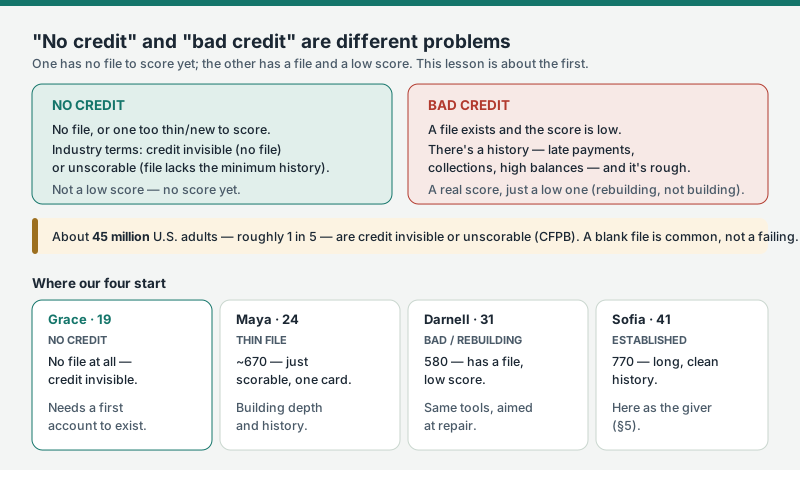
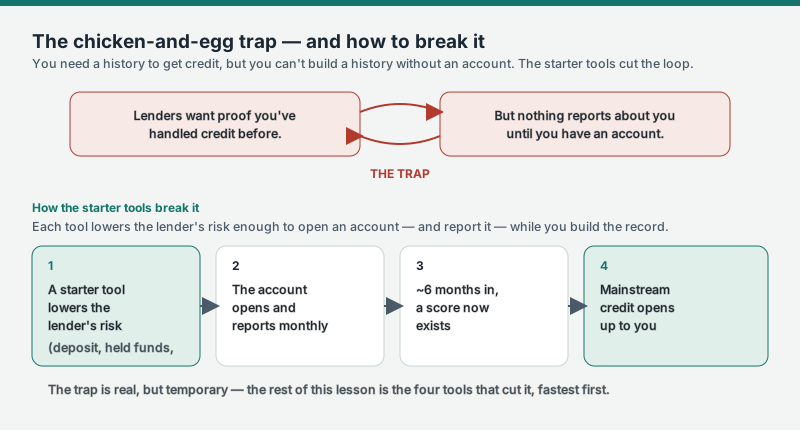
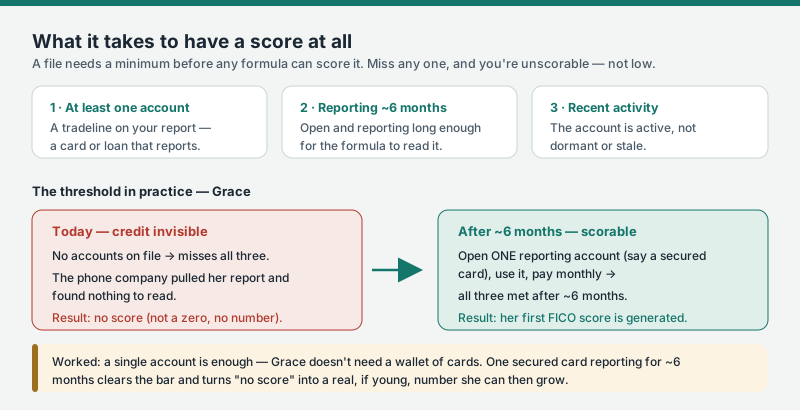
The mechanism behind the locked door is now visible, and it’s almost reassuringly dumb. A credit score is the output of a model, and a model needs input — a minimum amount of recent history, generally at least one account reporting for about six months — before it can compute anything at all. Priya is credit invisible: there’s no file, so there’s no input, so there’s no score, so the automated system that reviews her application has nothing to run the numbers on and defaults to a decline. Roughly 32 million American adults are estimated to be “unscoreable,” including about 7 million who are credit invisible with no credit history and about 25 million with a thin file — so this is not a rare malfunction; it’s the ordinary state of tens of millions of people, and the on-ramp everyone with credit once stood on.
The single most important thing to internalize — the reframe the whole lesson rests on — is right there in the teal line: what blocks Priya is missing information, not bad information. This is not a subtle distinction. A person with bad credit has a file full of data the model reads as risky — late payments, defaults, collections — and the model is actively scoring them down. Priya’s file isn’t being read as risky; it isn’t being read at all, because it’s empty. The lender declining her isn’t judging her as untrustworthy; it’s shrugging because there’s nothing to judge. And that completely changes the nature of the fix: you don’t repair a blank page, you write on it. The entire job is to generate the missing data — get one account that reports to the bureaus, handle it well, and let the required months accumulate until a score can be computed. (The path differs slightly by starting point: a truly invisible person like Priya needs to open any reporting account to create a file, while someone with a thin file just needs to add active, recent history to thicken what’s already there.)
It’s also worth being honest about why this matters so much, because the stakes run far past loans and credit cards. As the bottom of the widget lays out, a no-score quietly taxes ordinary life: landlords run credit checks, so Priya may be asked for a co-signer or turned down for an apartment; phone and utility companies often demand a deposit when there’s no credit to vouch for her (the exact wall she already hit); many states let auto insurers set her premium partly on a credit-based insurance score; and some employers run a credit check during hiring. Building credit, for her, isn’t really about wanting to borrow — it’s about removing friction from renting, connecting, insuring, and sometimes working. That’s why even a student with no interest in debt has a real reason to start a file.
Finally, who ends up here is worth naming plainly and without judgment, because it cuts against the instinct to read “no credit” as a personal failing. The credit-invisible are, by default, young adults like Priya; they’re new immigrants, whose perfectly responsible history in another country simply doesn’t transfer across the border; they’re the long-time cash-only; and they’re people emerging from a marriage that held every account in a spouse’s name. The barrier also falls unevenly — about 28% of Black and 26% of Hispanic adults are credit invisible or thin-file, compared with roughly 16% of White and Asian consumers — which is a structural feature of how the system collects data, not a statement about any individual standing at the starting line. Priya hasn’t done anything wrong by being here. She’s just early, and the rest of this lesson is the map out.
The way out begins with understanding what, specifically, a brand-new file needs in order to become a score — which factors a blank page has to start filling in. That’s the next turn.
What a blank file needs — the five factors, and where to start
If the fix for being credit invisible is “add data” (§1), the natural next question is which data, and in what order. A credit score is built from five ingredients, each weighted differently — and seeing them through a builder’s eyes, rather than an established borrower’s, tells Priya exactly where to spend her effort:
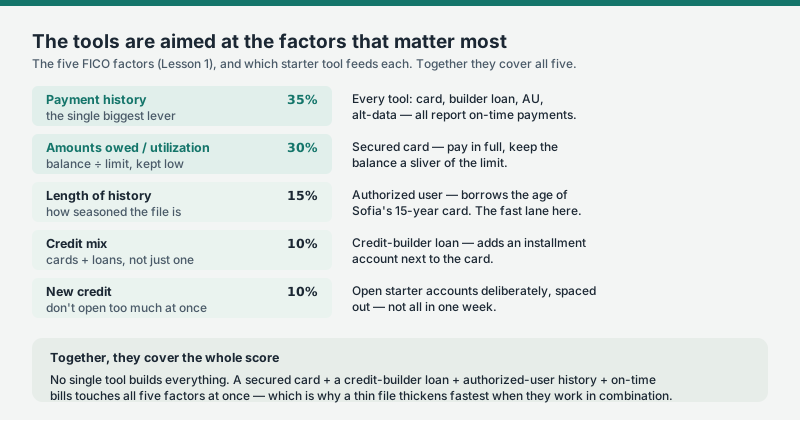
Read as a builder’s to-do list rather than a static pie chart, these five factors collapse into a remarkably simple plan, and the key insight is the highlighted one: the two heaviest factors are the two Priya controls immediately, and a single account satisfies both.
Payment history (35%) is the largest piece, and for a builder it’s almost embarrassingly straightforward — pay one account on time, every single month. There’s no trick to it beyond not missing, and the cleanest way to never miss is to put it on autopay. Amounts owed (30%), usually called utilization, is the share of her available credit she’s actually using, and the rule is to keep it low — under 30% of her limit, and ideally under 10%. On a card with a $300 limit, that means carrying a reported balance under ~$90, comfortably under ~$30 if she wants to optimize. Together these two factors are 65% of the entire score, and the beautiful thing is that one account — used lightly and paid on time — starts building both from the first month. Priya does not need a wallet full of cards; she needs a single account she handles well.
The third factor, length of credit history (15%), is the one that reshapes the whole timeline, because it’s the one she cannot rush. Age only accrues by waiting, which means the clock starts the day she opens her first account and never a moment sooner. This is the entire argument for starting now, even if she has no immediate need to borrow: every month she delays is a month of history she’ll never get back, and the best possible version of her future credit is the one where today’s account has been quietly aging for years. The old line fits exactly — the best time to plant the tree was years ago; the second-best time is today.
The last two factors matter least at the start and mostly serve as cautions. Credit mix (10%) rewards having both revolving credit (cards) and installment credit (loans), but a brand-new file with just one card is completely fine — mix is something to improve later, not a reason to take on a loan she doesn’t need now (though, as the next sections show, a credit-builder loan can add that second type cheaply and on purpose). And new credit (10%) is really a “don’t overdo it” signal: each application triggers a small hard inquiry that dings the score slightly, and a flurry of applications in a short window reads as risky and desperate. The builder’s move is to open one or two accounts deliberately and then be patient, not to apply for everything in sight hoping something sticks.
Two nuances complete the picture and shape how she should start. The first is in the gold panel: on a thin file, every data point carries outsized weight. With a thick file, one late payment is diluted by years of good history; with Priya’s near-empty file, that same late payment has almost nothing to average against, so it swings the score violently — and likewise, one maxed-out card can tank her utilization number all by itself. This cuts both ways, and it’s the defining feature of the early months: the upside is fast (a real score can appear in about six months), but the downside of a single slip is amplified too. That asymmetry is precisely why the right first move is small and safe — a low-limit secured card used for one small recurring charge on autopay, where it’s nearly impossible to miss a payment or run up utilization by accident.
The second nuance is about which score and how fast. There are two main scoring systems — FICO and VantageScore — and they treat thin files differently: VantageScore can often generate a score with as little as one to two months of history, while FICO typically wants around six months of an account reporting before it will produce one. So Priya may see a VantageScore (the kind many free apps display) appear before the FICO score that most lenders actually use — which is encouraging, as long as she knows the lender’s number may lag the app’s by a few months. The scoring world is also evolving toward thin files: newer models are beginning to fold in alternative data like rent and even buy-now-pay-later activity, which §8 returns to.
So the blank page fills in a clear priority order: open one safe, reporting account; pay it on time and keep it nearly empty (the 65%); let it age starting today (the 15%); and resist the urge to over-apply (the 10%). The next question is which account to open first — the starter toolkit — which is the next turn.
The starter toolkit — six ways onto the ladder
There isn’t one “best” way to start a credit file; there are several purpose-built tools, and the right one depends on Priya’s situation — how much cash she can spare, whether she has a trustworthy relative willing to help, whether she’s a student, whether she pays rent. Here’s the whole toolkit at a glance, with what each one quietly costs you:
Each tool earns a closer look, because the differences between them are exactly what make one right for Priya and wrong for someone else.
The secured card is the default starter for almost everyone, and the mechanics are the key to why it’s safe: Priya puts down a refundable deposit — often $200, sometimes as low as $49 — and that deposit becomes her credit limit. It then behaves like an ordinary credit card (a revolving account), reporting her on-time payments and low utilization to the bureaus, and after six months to a year of good behavior many issuers “graduate” her to a regular unsecured card and return the deposit. The deposit isn’t a fee; it’s her own money held as collateral, which is what lets the issuer say yes to someone with no history. The only real cost is that the cash is tied up while the card is open — a genuine consideration on a student’s budget, but a recoverable one.
The credit-builder loan is the secured card’s mirror image, and it’s the most counterintuitive product in the toolkit. Instead of getting money and paying it back, Priya makes the payments first, and the lender holds the “loan” amount in a locked savings account, releasing it to her only after she’s finished. She is, in effect, paying herself on a schedule while the bureaus watch — it reports as an installment account, the second account type from §2, and it doubles as forced savings, since she ends with a lump sum she’s accumulated. The catch is modest interest or a small fee and the fact that the money is locked until the end. This is DW#1, so its full mechanics get a proper walkthrough shortly. Pair it with a secured card and Priya has both account types from the very beginning, which is exactly why those two are the “workhorses” in the banner.
The authorized user route is the fastest and cheapest of all if she has the right person. A parent or trusted relative adds her to their established, well-managed card, and that card’s history — its age and its on-time payments — can report to her file, sometimes giving her years of seasoning overnight. It costs nothing and requires no approval of her own. But it’s a two-way wire: if the primary cardholder pays late or runs the balance high, that lands on Priya’s file too, so it only works when the primary is genuinely responsible. It’s leverage borrowed from someone else’s discipline, which makes their discipline the whole risk.
The student card is a real unsecured card built for exactly Priya’s situation — issuers expect thin or no credit from enrolled students and approve accordingly, often with modest limits and sometimes small rewards. For a student, it can be a cleaner start than a secured card because no deposit is required. The catch is the flip side of its being a real line of credit: real available money is real temptation, and the §2 warning about a maxed card on a thin file applies in full. Used like a secured card — one small recurring charge, autopay, paid in full — it’s excellent.
Rent and utility reporting is the newest idea and the only one that requires no borrowing at all. Services exist that report the rent, utility, or phone payments Priya already makes to the credit bureaus, converting bills she’s paying anyway into credit history — turning responsibility she’s already demonstrating into data the system can finally see. The catch, which §8 examines with current specifics, is that not every lender or score model counts this alternative data yet, so it’s a strong supplement rather than a sole foundation. For a renter, though, it’s close to free credit-building.
The co-signer is the most powerful and the most dangerous, which is why its tag is red. Someone with good credit guarantees a loan or card Priya couldn’t qualify for alone, and she builds history on it. But a co-signer isn’t a character reference — they are fully, legally on the hook: if she misses, their credit takes the hit and they owe the debt, and few things strain a relationship like a parent’s score dropping over a child’s missed payment. It can be the right move with deep mutual trust and clear communication, but it should be a considered last resort, not a casual ask, because the thing on the line isn’t only credit — it’s the relationship.
Two closing notes. There’s a seventh option the widget leaves out on purpose: the retail or store card. It’s genuinely easy to get with no credit, which is its appeal, but it usually carries a steep APR, works only at that one store, and dangles discounts designed to make Priya spend — so it’s acceptable as a minor addition once she’s underway, never as her foundation. And the overall takeaway is the banner’s: there’s no single right answer, but the secured card plus credit-builder loan combination is the safe, deliberate core for almost anyone, because together they’re cheap, hard to misuse, and cover both account types from day one. For Priya specifically, the likely path is a secured or student card on autopay as the anchor, a small credit-builder loan to add installment history and savings, rent reporting if her lease allows it, and an authorized-user spot on a parent’s card if one is genuinely available — a handful of small, safe accounts, all reporting, all aging from today.
The first of those documents — the credit-builder loan, the one most people have never actually seen — is the lesson’s first Document Walkthrough, and it gets its own turns next.
The credit-builder loan — your first Document Walkthrough
What it is, where Priya meets it, and how she encounters it. This is the contract for the §3 product almost no one has actually seen: the loan where she pays first and receives the money after. Formally it’s a credit-builder loan agreement bundled with a Truth-in-Lending disclosure — the same federal disclosure format from Lessons 1 and 2, now attached to her very first installment account. She’d open it at a credit union, a community bank, a CDFI (a community-development financial institution), or a fintech that offers these, either online or at a branch.
Unlike the paystub she merely received, this is a document she reads and signs — a binding contract — so reading it actually matters. And it matters for specific reasons: it’s her first installment tradeline and her first TILA disclosure as the borrower; it shows the true price of building credit this way (the interest she pays); it spells out the inverted structure, so she isn’t alarmed when the $1,000 doesn’t land in her account on day one; and it contains the single line that makes the whole exercise worthwhile — the promise to report her payments to all three bureaus. Here is her agreement:
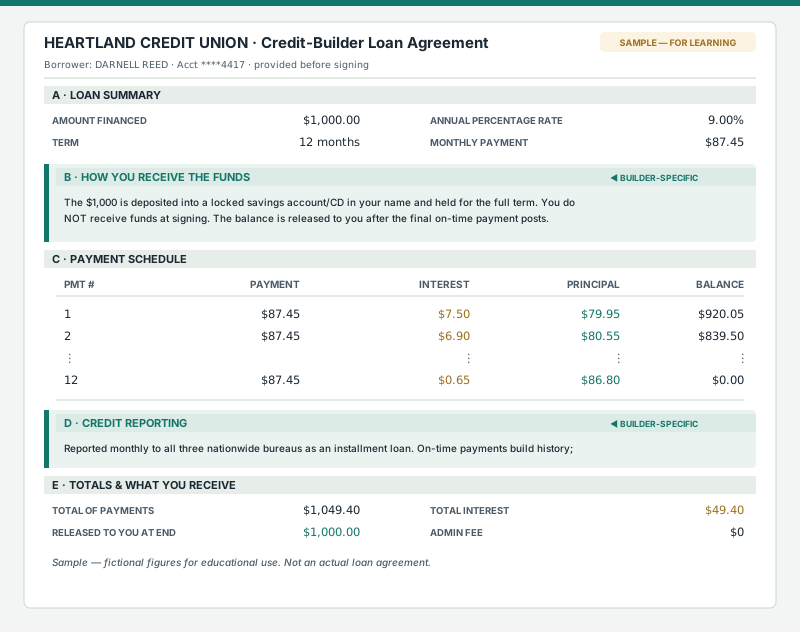
That’s the whole agreement, not a fragment — six sections, and we’ll read it across the next two turns. The shape of what’s there: the federal Truth-in-Lending box (the four standardized cost figures and the payment schedule, the same disclosure format from Lessons 1 and 2); the tinted How This Loan Works section (the three-step inverted structure that is the heart of the product and the part that confuses everyone); Security (what backs the loan); Credit Reporting (the all-important promise to report to all three bureaus); Late Payment & Default (what happens if she slips); and the Acknowledgment she signs.
The reason the How This Loan Works block is tinted as the section we read — rather than the TILA box that led the last two lessons — is that the cost disclosure here is familiar territory, while the structure is the genuinely new thing: a loan where the money is held hostage by design and released only at the finish. Getting that mechanic clear is what keeps Priya from panicking when her $1,000 doesn’t appear, and what lets her see why a product that charges her $66 is still worth doing.
Holding to the separation rule, the breakdown gets two turns: the Truth-in-Lending box and payment schedule first — the true cost of building credit this way — then the tinted How It Works structure plus Security, Reporting, and Default, with the credit-builder mechanic taught at full depth as the heart of the document.
Reading the cost disclosure — the Truth-in-Lending box
The masthead frames the contract, and two of its details carry weight.
Lender, borrower, loan number, date — Golden State Credit Union · Priya Nair · Loan #CB-40192 · 09/25/2026.
What it is: who’s lending, to whom, under what account number, on what date. What it does: it identifies the binding agreement and gives her the reference number for payments and any future dispute. Why it matters: two quiet things. ↳ it’s a credit union, and that’s a feature, not a detail — member-owned institutions and CDFIs are usually the best home for a credit-builder loan, with lower rates and products designed specifically to help members build credit, which is why Priya looked there rather than at a payday storefront. ↳ the date starts her clock — the §2 length-of-history factor begins accruing the day this loan opens, so this date is, quite literally, the first day of her credit life.
The Truth-in-Lending box is the cost layer — the same four-field federal disclosure from Lessons 1 and 2, now describing her first installment loan.
Annual Percentage Rate — 12.00%.
What it is: the cost of her credit expressed as a standardized yearly rate — the comparison number. What it does: it lets her price this credit-builder loan against any other one on equal terms. Why it matters: 12% reads like a credit-card rate and might look alarming, but here it’s applied to a small, shrinking balance over a short term, so the actual dollar cost is tiny. ↳ the APR is the comparison tool, not the bite — for a credit-builder loan, the APR overstates how much this actually costs her, because she also gets the $1,000 back at the end, and some products even pay a small dividend on the held funds that offsets the interest further. The right way to shop these is on the finance charge, not the APR alone.
Finance Charge — $66.20.
What it is: the total dollar cost of the loan — every dollar of interest she’ll pay across the twelve months. What it does: it’s the real, felt price of the credit-building, the only money that doesn’t come back to her. Why it matters: this is the figure that matters most on a credit-builder loan, because it’s the actual tuition for going from invisible to scored while also being forced to save. ↳ $66.20 over a year is about $5.50 a month — a genuinely cheap price to start a credit file, and the honest yardstick for comparing products. A builder loan with a much larger finance charge, or one padded with admin fees, is a signal to look elsewhere; this one is reasonable.
Amount Financed — $1,000.00.
What it is: the loan amount — but with the credit-builder twist, it’s held for her in the locked savings account, not paid out now. What it does: it’s the principal she’s “borrowing,” sitting in the Credit Builder Savings account until she finishes. Why it matters: ↳ this is the single most confusing field on the whole document, because the familiar label describes an unfamiliar reality. On a normal loan, “amount financed” is money you receive up front; here it’s money you do not receive until you’ve made every payment. The TILA box is legally required to use the standard label, which is exactly why the §4 “How This Loan Works” section exists — to translate it. Priya is not getting $1,000 today; she’s getting it at the end, and reading this field without that context is how people misunderstand the entire product.
Total of Payments — $1,066.20.
What it is: everything she’ll pay over the twelve months — the principal plus the finance charge. What it does: it’s the sum of all twelve payments, her full cash outflow. Why it matters: ↳ it carries the cross-check from Lesson 2 — total of payments should equal amount financed plus finance charge ($1,000 + $66.20 = $1,066.20), and if those don’t reconcile, something is wrong with the deal. ↳ and it reveals the true economics — she pays $1,066.20 out and gets $1,000 back, so her real net cost is just the $66.20 finance charge. The other thousand dollars isn’t a cost at all; it’s her own savings being cycled back to her with a credit history attached.
The payment schedule is the rhythm that does the building.
12 monthly payments of $88.85, beginning 10/25/2026. No prepayment penalty.
What it is: the when and how-much — twelve equal installments of $88.85, the first due a month after signing. What it does: it’s the schedule she must hit, and each on-time payment is a positive mark reported to all three bureaus (the §4 step-2 promise in action). Why it matters: ↳ this schedule is the 35% payment-history factor being built — twelve separate chances to demonstrate on-time behavior, which is the heaviest ingredient in her future score. The move is to put it on autopay so she never misses, because a single late payment on her thin file is amplified the way §2 warned. ↳ and “no prepayment penalty” comes with a counterintuitive caution — she could pay it off early, but on a credit-builder loan, finishing early can shorten the run of reported on-time payments she’s trying to accumulate. Unlike a normal loan, where escaping early saves interest, here the schedule isn’t a debt to flee; it’s the history she’s buying, so the goal is to complete the full run of payments, not to rush it.
Read this far, the cost layer has told Priya the honest economics: she’s paying about $66 — roughly five dollars a month — to manufacture twelve months of on-time installment history and end up with $1,000 she was forced to save, and the one field that looks confusing (the “amount financed” she never receives up front) is confusing only because a standard label is wrapped around a deliberately inverted structure. That inverted structure — how the money is held and released, and what secures and reports it — is the tinted heart of the document, and it’s the next turn.
How the credit-builder loan actually works
The tinted How This Loan Works section is the heart of the document — the inverted structure that makes a credit-builder loan possible, read step by step.
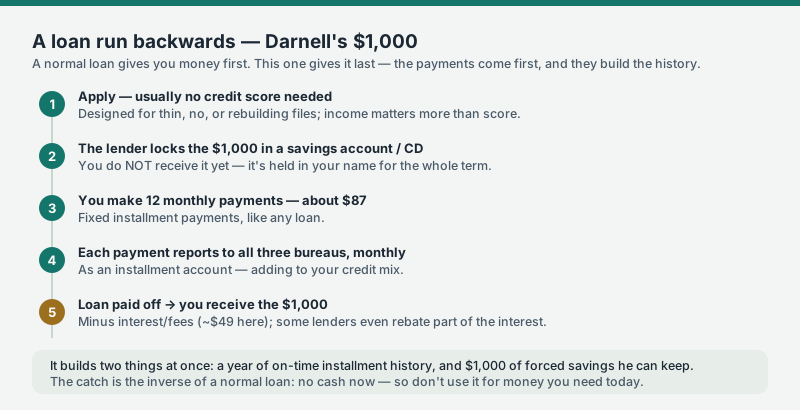
Step 1 — “We deposit your $1,000 loan into a locked Credit Builder Savings account. You don’t receive it yet.”
What it is: the loan amount is created and parked in a locked savings account in Priya’s name rather than handed to her. What it does: it sets up the whole inverted mechanic — the lender’s money never actually leaves the building, so the lender is never really at risk. Why it matters: ↳ this is precisely why an invisible person can be approved — there’s no risk to underwrite, because the loan is fully secured by its own held funds from the first day, so the lender doesn’t need to see a credit history it knows she doesn’t have. ↳ and it’s why the product is safe for her — she can’t overspend it, can’t get underwater, can’t end up owing money she didn’t already set aside; the structure that looks strange is the structure that protects her.
Step 2 — “You make 12 monthly payments of $88.85. Each on-time payment is reported to all three bureaus.”
What it is: her monthly obligation, with each payment furnished to the bureaus. What it does: every payment writes a fresh positive data point to her blank file — building payment history (the 35% factor), establishing an installment tradeline (the mix factor), and aging the account (the length factor) all at once. Why it matters: ↳ this step is the product doing its job — the loan isn’t really about the money, it’s about manufacturing twelve months of reported, on-time installment history where there was none. ↳ the reporting is the entire point, which is why it’s the field she must verify before signing; a “credit builder” that doesn’t actually report is just a savings account with a fee.
Step 3 — “After your final payment, the $1,000 is released to you. You’ve built credit and saved $1,000.”
What it is: at the finish, the held $1,000 is released to her. What it does: she receives the forced savings she’s accumulated, and the loan closes on her report as paid in full. Why it matters: ↳ the payoff is dual, and that’s what makes the product elegant — she ends with a completed installment account marked “paid as agreed” (a strong positive that lingers on her report for years) and $1,000 in cash she was disciplined into saving. ↳ that $1,000 is an emergency-fund seed — the exact starter cushion Lesson 3 said to build first, arriving automatically as a side effect of building credit. One product quietly accomplishes two of the most important things a beginner can do.
The remaining sections govern what backs the loan, what makes it worthwhile, and what happens if she slips.
Security — “The $1,000 held secures the loan; if you stop paying, we apply those funds to the balance.”
What it is: the held savings is the collateral. What it does: it protects the lender and caps her downside. Why it matters: ↳ this is why a credit-builder loan is the gentlest possible first debt — she literally cannot lose more than she’s already paid in. If life forces her to stop, the lender simply applies her held funds to whatever’s left and returns any difference; there’s no collector chasing her for money she doesn’t have, no balance spiraling on a card. The worst realistic outcome is that she stops early and gets most of her money back, with a partial history built. For a nervous first-time borrower, that safety net is the whole appeal.
Credit Reporting — “We report your payment history every month to Equifax, Experian, and TransUnion.”
What it is: the lender furnishes her data to all three nationwide bureaus monthly. What it does: it creates the tradeline on each of her three reports. Why it matters: ↳ this is the single make-or-break line in the entire agreement. Building credit only happens if the account reports — and reporting to all three bureaus matters because different lenders pull different bureaus, so an account that reports to only one leaves her invisible to anyone who checks the others. ↳ before signing any credit-builder product, this is the field to confirm; the ones that report to one bureau, or none, are the gimmicks the next sections of this lesson warn about. A reasonable finance charge means nothing if the reporting isn’t there.
Late Payment & Default — “Late fee $5 over 10 days; a late payment is reported; default closes the loan, applies the funds, and reports the default.”
What it is: the consequences of slipping. What it does: it spells out both the small cash penalty and the larger reputational one. Why it matters: ↳ on her thin file, a reported late payment hurts disproportionately (the §2 amplification) — so the tool built to raise her score can dent it if she misses, which is exactly why autopay is non-negotiable on this account. ↳ but the default mechanics are mercifully gentle — because it’s secured by her own money, a default doesn’t create a chasing debt; they apply her held savings. The real cost of stopping isn’t a financial spiral, it’s the reported negative mark — meaningful, but survivable. The takeaway isn’t fear; it’s that on-time is the entire job, and the structure makes on-time easy.
Acknowledgment — her signature.
What it is: the signature line that binds the agreement. What it does: it makes the document a contract and confirms she received the federal disclosures. Why it matters: ↳ this is the field that separates this document from the paystub — the paystub she only received, but this she signs, which makes it binding and means the time to understand every section above is before the pen touches the paper, not after. ↳ her signature is also her confirmation she got the TILA disclosures, a federal right — so the honest sequence is always read first, sign second.
Read in full, the credit-builder loan turns out to be one of the most beginner-friendly instruments in all of consumer lending: it’s approvable by someone with no history (because it’s self-secured), nearly impossible to misuse (because the money is held), cheap (about $66 in real cost), and doubly productive (it builds an installment tradeline and forces a $1,000 cushion into existence). Paired with a secured card — the revolving account from §3 — it also hands Priya both account types from the start, quietly covering the credit-mix factor before she’s even finished. The one thing she must verify is the reporting line, and the one habit she must keep is autopay. With those two, this single document carries her a remarkable distance from invisible.
The next thing to see is the other half of the starter combination — secured cards and the authorized-user route — as builders in their own right, which is the next turn.
The revolving half — a secured card, and riding someone else’s history
The credit-builder loan handed Priya the installment half of her file. The revolving half — a credit card — is the other workhorse from §3, and there are two clean ways onto it: a secured card she opens herself, and an authorized-user spot on someone else’s card. The first she controls entirely; the second, if she has a willing relative, can hand her history she couldn’t otherwise buy at any price.
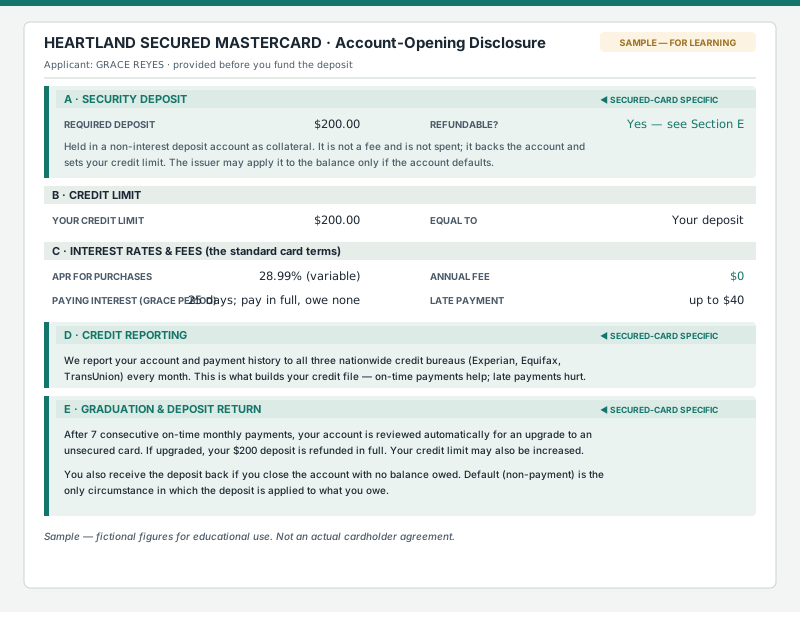
Start with the secured card, which works on the same self-securing logic as the loan — a refundable deposit stands in for the history she doesn’t have:
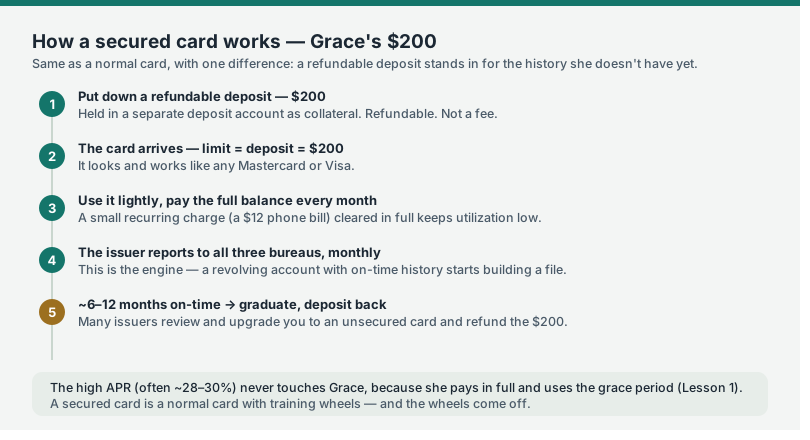
The mechanics reward a closer look, because the difference between a secured card that builds Priya up and one that bleeds her dry comes down to a few details.
The deposit is the whole trick, and it’s not a fee — it’s refundable collateral, her own money held to back the limit, exactly like the credit-builder loan’s held funds. It’s what lets an issuer approve someone with no history (the lender risks nothing it isn’t already holding), and she gets it back when she graduates or closes the account in good standing. A $200 deposit typically buys a $200 limit, and the goal of the card is not to spend but to generate reported activity: she puts one small recurring charge on it — a $10 streaming subscription is perfect — sets autopay to clear the statement balance in full, and then largely forgets it. That single move builds perfect payment history (the 35% factor), reports tiny utilization (the 30% factor — $10 on a $200 limit is 5%, well under the §2 target), and costs zero interest, because paying in full means she never carries a balance. It’s a credit-building machine that runs on ten dollars a month and a payment she never has to remember.
Two cautions complete it. First, utilization is reported even on a small limit, so she keeps the balance low — under 30%, ideally under 10% — which autopay-in-full handles automatically. Second, and this is the predator preview in the gold panel: the deposit is refundable, but fees are not. A good secured card charges little or no annual fee; a bad one — the fee-harvester of §14 — piles on monthly “maintenance” and “program” fees that quietly eat the deposit and the limit. The test is simple: is the deposit refundable and the fees minimal? If the fees are large and non-refundable, it isn’t a builder, it’s a trap. This is exactly the path Maya walked in Lesson 1 — she started with a no-frills secured card, used it lightly, graduated, and is now near-prime; living proof the route works when the card is honest.
The second way onto a revolving account requires no deposit and no approval of her own — it borrows someone else’s track record:
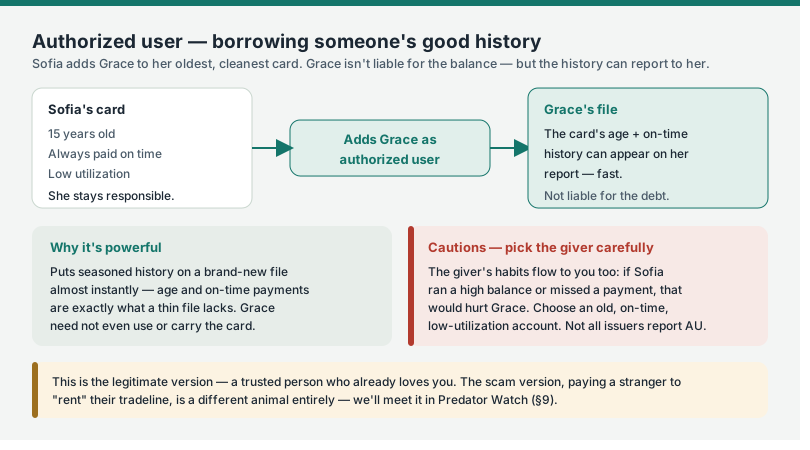
The authorized-user route is the fastest and cheapest tool in the entire kit when she has the right person, and the reason is the §2 factor she otherwise can’t touch. A parent or trusted relative adds Priya to their existing card, and the issuer can report that card’s history to her file — so a card that’s been open for ten years with a spotless payment record can hand her a decade of age and a flawless payment history overnight, directly feeding the length-of-history factor that no other tool can rush. Nothing else gives a beginner seasoning she didn’t have to wait for.
But the power comes entirely from whose history she’s borrowing, and that’s the whole risk. As the red bar says, it’s a two-way wire: if the primary pays late or runs the balance to the limit, that can land on Priya’s file too. So the rule is to ride only a long-held, always-on-time, low-utilization card — a responsible primary lifts her, an irresponsible one drags her down, and the wrong primary is worse than no primary at all. Two reassurances soften the picture, though. First, an authorized user is not liable for the debt — unlike a co-signer (§3), Priya owes nothing; the primary owes it all, so her exposure is to her credit, not her wallet, and she doesn’t even need to use or physically hold the card for the reporting to work. Second, she should verify two things before doing it: that the issuer actually reports authorized-user activity to the bureaus (not all do), and that it’s a real relationship — because some scoring models deliberately discount “rented” authorized-user tradelines, the residue of a scam where strangers pay to be added to a stranger’s card to fake a history. Used honestly, with a relative’s real card, it’s a legitimate and powerful shortcut.
Put together, the shape of Priya’s whole starter strategy comes into focus. The secured (or student) card gives her a revolving account she controls; the credit-builder loan from §4–§6 gives her an installment account and a forced $1,000 cushion; and an authorized-user spot on a parent’s clean card, if one’s available, layers instant age on top. That’s a handful of small, safe, reporting accounts — covering payment history, low utilization, both account types, and even seasoning — all aging from today. None of it requires real debt, and all of it is recoverable or refundable. It’s about as gentle an on-ramp as consumer finance offers.
One tool remains, and it’s the newest: turning the rent and bills she already pays into credit history, without borrowing at all. That gets the next turn — with a live check on which of those services actually work right now.
Rent and utility reporting — credit for what you already pay
Here’s the most appealing tool in the kit, because it asks Priya to do nothing new: she already pays rent and a phone bill on time every month, and since payment history is 35% of a score (§2), there’s a category of services that turn that existing, demonstrated responsibility into reported credit history — no borrowing, no deposit, no new account to manage. It’s the only tool that builds credit out of bills she’s paying anyway.
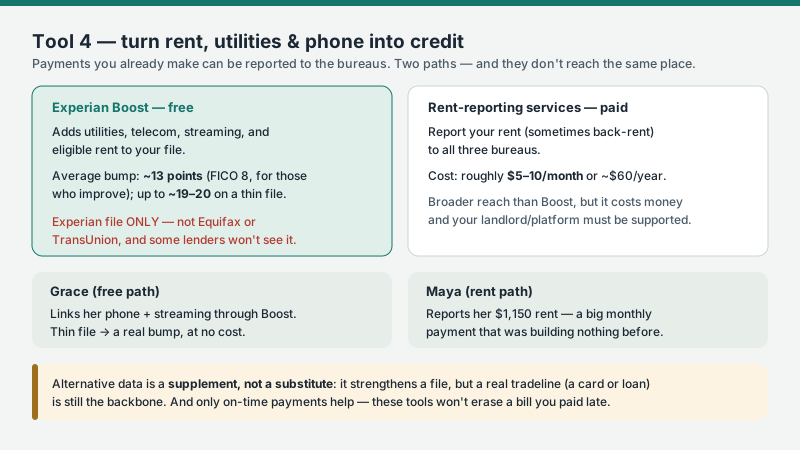
The tools come in two flavors, and the distinction is mostly about reach versus cost.
The free leader is Experian Boost. Priya links her bank account, and Boost scans her recent payment history — up to two years back — for qualifying utility, phone, streaming, and now rent payments, then adds them to her Experian file at no charge. These services are voluntary and you opt in to share the data, and they’re aimed precisely at people who are starting out, have a thin file, or are rebuilding. The trade-off is in the widget’s first column: Boost only affects her Experian report, so it lifts Experian-based scores and leaves her Equifax and TransUnion files untouched. The dedicated rent-reporting services — Self (free, reports to all three), and paid options like Boom, RentReporters, and Rental Kharma — go wider, reporting ongoing rent (and sometimes up to two years of past rent) to one or all three bureaus, often by linking her bank to verify payments so she doesn’t even need her landlord’s cooperation. The paid ones charge a one-time or monthly fee, which is worth weighing against the free tools that may accomplish much of the same thing.
The three caveats in the gold panel are what keep this honest, and they’re the reason it’s a supplement rather than a foundation. First, not every scoring model counts it: the newer models (FICO 9 and 10, VantageScore 3 and 4) factor in rent and utility data, but an older model that a particular lender still pulls may ignore it entirely — so Priya might watch the score in her free app rise nicely while a specific lender’s pull barely moves, because they’re reading different models. Second, late payments can flow through too, especially with landlord-linked services, so this only helps if she pays on time — the same on-time discipline that runs through the whole lesson. Third, and most important, it thickens a file but doesn’t anchor one: rent reporting adds valuable payment history, but a real tradeline — the secured card or builder loan — is still the backbone, because those report universally and to every model. The right move is to layer rent reporting on top of real accounts, not to lean on it alone.
With those caveats stated, the case for doing it is strong: it’s free or cheap, it rewards responsibility Priya is already demonstrating, and the upside is real — Experian reports that about 75% of consumers who add their rent see a score increase of 11 points or more. For a thin-file renter, that’s close to free upside for a few minutes of setup. So Priya’s full stack now writes itself: a secured or student card and a credit-builder loan as her real anchoring tradelines, an authorized-user spot if a relative offers one, and Experian Boost plus a free rent reporter layered on top to capture the rent and phone payments she’s already making. A handful of small, safe accounts plus the bills she already pays — all of it reporting, all of it aging from today.
What that stack actually produces, and how fast, is the natural next question — the timeline from invisible to scored to good — which is the next turn.
Your first credit report — the scoreboard for the build
What it is, where Priya meets it, and how she encounters it. A few months into the plan, Priya pulls her credit report — the bureaus’ file on her — to see whether everything is actually working. This is a very different document from the established report in Lesson 1: it’s a thin, freshly-started file, where most sections are nearly empty and her very first tradelines have just appeared. She gets it free at AnnualCreditReport.com (the official source for all three bureaus) or through free monitoring like Credit Karma or the bureaus’ own apps.
It’s a document she reads rather than fills out, but it’s one she should actively check, for three reasons that matter especially to a builder: to confirm her new accounts are actually reporting (the entire plan depends on it), to catch any errors (which happen even on brand-new files and which she has the legal right to dispute, per §16), and to watch her score form. It’s the scoreboard for everything the last few sections set up.
Here is hers, about three months in:
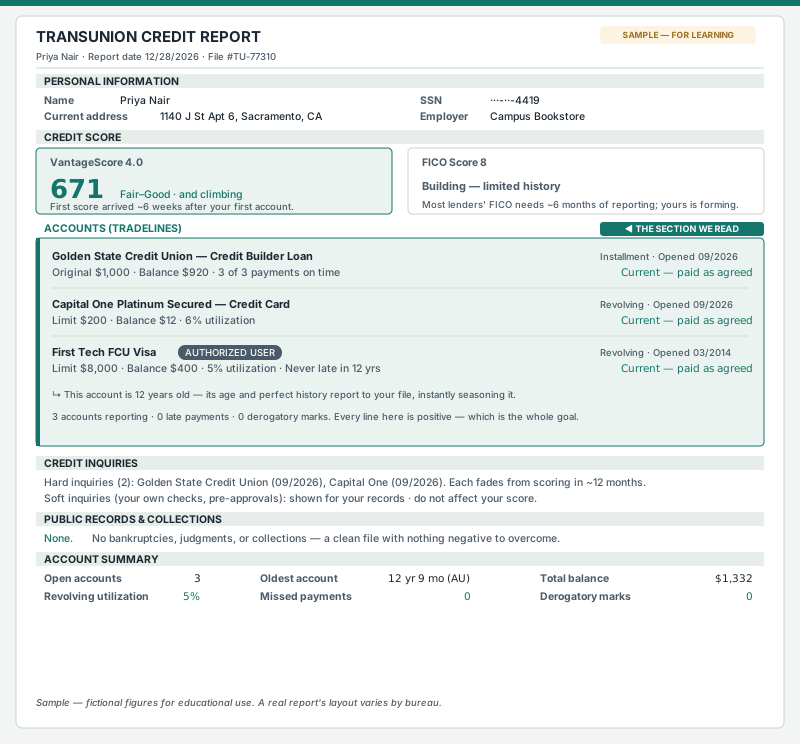
That’s the whole report, not a slice — six sections, most of them gratifyingly sparse because Priya is new, and we’ll read it top to bottom across the next two turns. The shape of what’s there: Personal Information (her identity on file); a Credit Score section showing the moment a number first appears (a VantageScore already, with FICO still forming); the tinted Accounts section, where the build becomes visible — her two brand-new tradelines plus the aged authorized-user account; Credit Inquiries (the small footprint of having applied); a Public Records & Collections section that reads, beautifully, None; and an Account Summary that totals it all up.
The reason the Accounts section is tinted as the section we read is that it’s where building from scratch actually happens — three lines of positive history where, a few months ago, there were zero. It’s also where the §7 authorized-user effect shows up dramatically: an account opened in 2014 now sitting on a file that’s only months old. That’s the heart of the document, and it gets full depth in the breakdown.
Holding to the separation rule, the breakdown gets two turns: the Personal Information, Credit Score, Inquiries, and Public Records sections first — including the all-important “why two different scores” teaching from §2 — then the tinted Accounts section and the Account Summary, where the three tradelines and what they’ve produced get read line by line.
Reading your report — identity, score, and inquiries
The masthead carries one detail worth flagging before the sections.
Bureau, name, date, file number — TransUnion · Priya Nair · 12/28/2026 · #TU-77310.
What it is: which of the three bureaus produced this report, for whom, as of when. What it does: it identifies one of her three files. Why it matters: ↳ this is one report, not the whole picture — she has three (TransUnion, Experian, Equifax), and they can differ because not every lender reports to all three. This is exactly why §4 and §6 stressed that her builder loan reports to all three: an account that lands on only one leaves her thinner on the other two. To see her full self, she pulls all three at AnnualCreditReport.com.
The Personal Information section is her identity on file.
Name, SSN, current address, employer.
What it is: the identifying details the bureau has attached to her file. What it does: it’s how the bureau matches incoming account data to the right person. Why it matters: ↳ this is the section to check for the wrong kind of surprise — an address she’s never lived at, a name variation that isn’t hers, or an unfamiliar employer can be the first sign of mixed files (someone else’s data merging into hers) or identity theft. On a thin file it’s easy to scan and easy to get wrong, since there’s little data to anchor the match — so confirming these few fields are hers is a two-minute habit that catches problems early. The SSN is shown masked, which is normal and protective.
The Credit Score section is the one Priya has been waiting for, and it teaches the §2 “which score, how fast” nuance in concrete form.
VantageScore 4.0 — 671 (Fair–Good), arrived ~6 weeks after her first account.
What it is: a credit score from the VantageScore model, already computed. What it does: it’s the first numeric proof her file is alive and being scored. Why it matters: ↳ this is the encouraging early signal — VantageScore can generate a score from as little as one to two months of history, so it’s typically the first number a new builder sees, and 671 is a genuinely solid starting point, lifted substantially by the aged authorized-user account doing its job. ↳ but she should read it as “fair–good and climbing,” not a finish line — it’s early, it’s thin, and it will move (up, with continued on-time payments and aging; down, if she slips), so the trend matters more than today’s exact number.
FICO Score 8 — “Building (limited history).”
What it is: the FICO score most lenders actually use — not yet produced. What it does: it tells her the lender-facing number is still forming. Why it matters: ↳ this is the single most important expectation-setter on the page, and it prevents a real disappointment. The free app showing her a 671 VantageScore and a lender telling her “you have no FICO score” are both true at once, because FICO typically needs about six months of an account reporting before it computes, while VantageScore moved faster (§2). ↳ so the score she sees and the score a lender pulls can differ for months — she shouldn’t apply for a real credit product the moment her app lights up, because the lender may pull a FICO that isn’t ready yet. The gap closes with time; the lesson is patience, and not to mistake the app’s early number for lender-readiness.
The Credit Inquiries section is the small footprint of having started.
Hard inquiries (2): Golden State CU and Capital One, 09/2026. Soft inquiries: shown, no effect.
What it is: the record of who checked her credit and why. What it does: it logs the hard inquiries from her two applications and the soft ones (her own checks, pre-approval screenings). Why it matters: ↳ the two-hard-inquiry footprint is exactly what §2 predicted, and it’s nothing to fear here — opening accounts requires applications, each leaves a hard inquiry that dings the score slightly, and these fade from scoring in about twelve months and drop off entirely after two years. Two, from deliberately opening her starter accounts, is healthy. ↳ the distinction that saves people anxiety is that soft inquiries — checking her own report, or a lender’s pre-approval offer — never affect her score, so she can (and should) check her own credit as often as she likes without penalty. The thing to avoid is a flurry of hard inquiries from over-applying; two intentional ones are fine.
The Public Records & Collections section reads the best possible way.
None — no bankruptcies, judgments, or collections.
What it is: the section that would list serious derogatory events. What it does: here, it confirms there’s nothing negative on her file. Why it matters: ↳ this empty section is the whole §1 reframe made visible — Priya’s file isn’t bad, it’s blank, and “None” here is the proof. Someone rebuilding from a rough past would see collections or a bankruptcy in this exact spot, fighting to outweigh them; Priya has nothing to overcome, only history to add. ↳ and it’s shown even though it’s empty on purpose — a complete report displays this section whether or not there’s anything in it, so she can confirm the absence rather than assume it. A clean “None” is one of the most valuable lines a builder can have.
Read this far, the framing sections tell a coherent and encouraging story: her identity is correctly on file, a score has begun (with the honest caveat that the lender-facing FICO trails the app’s VantageScore by months), her inquiry footprint is small and expected, and there is nothing negative to overcome. What remains is the section that’s actually doing the building — the three tradelines and the summary they roll up to — which is the next turn.
Reading your report — the accounts building your score
A word on what a tradeline is, since it’s the unit everything here is built from: a tradeline is simply one account as it appears on a credit report — its lender, type, age, balance, limit or original amount, and payment record. Each one Priya opens is a new line of evidence, and her score is essentially the bureaus reading all her tradelines together. Three of them now sit where there were none.
Tradeline 1 — Golden State Credit Union, Credit Builder Loan · Installment · opened 09/2026 · original $1,000, balance $920 · 3 of 3 on time · “Current — paid as agreed.”
What it is: the credit-builder loan from DW#1, now reporting as a live installment account. What it does: it’s furnishing exactly what §2 said it would — three on-time payments (payment history, 35%), an installment tradeline (mix), and an account that’s aging from its open date (length). Why it matters: ↳ “paid as agreed” is the phrase she’s manufacturing — that status, repeated every month, is the single most valuable string of words a credit file can carry, and here it’s appearing for the first time in her life. ↳ the falling balance ($1,000 → $920) is the loan working as designed — it’s not debt shrinking toward freedom, it’s her forced savings accumulating in the locked account (§6), so a smaller balance here means more of her own money waiting at the finish. Reading it as ordinary debt paydown misses that the “loan” is really a savings plan wearing a tradeline.
Tradeline 2 — Capital One Platinum Secured, Credit Card · Revolving · opened 09/2026 · limit $200, balance $12 · 6% utilization · “Current — paid as agreed.”
What it is: her secured card from §7, reporting as a revolving account. What it does: it adds the revolving account type (so she now has both, covering mix) and reports a low utilization figure. Why it matters: ↳ the $12 balance is the §7 strategy made visible — one small recurring charge, paid on time, producing a 6% utilization that sits comfortably under the §2 target without her ever carrying interest. ↳ this is the field a lender reads to judge her restraint — a card reporting 6% says “uses credit lightly and pays it,” which is exactly the signal she wants, and it’s the opposite of the maxed-card mistake that would tank a thin file. The small, boring balance is doing precise, valuable work.
Tradeline 3 — First Tech FCU Visa (Authorized User) · Revolving · opened 03/2014 · limit $8,000, balance $400 · 5% utilization · never late in 12 years.
What it is: the authorized-user account from §7 — a relative’s long-held card, now reporting to Priya’s file. What it does: it transplants twelve years of age and a flawless payment record onto a file that’s only months old. Why it matters: ↳ this single line is why authorized-user is the fastest tool there is — an account “opened 03/2014” on a file born in 2026 is exactly the instant seasoning §7 promised, and it’s the biggest reason her VantageScore is already 671 rather than a thin-file low. ↳ it also quietly fixes her utilization math — its $8,000 limit dwarfs her tiny secured limit, so across all her revolving credit she’s using about 5% of a much larger pool, which reads beautifully. ↳ and it carries the §7 warning in reverse — because this account’s health flows to her, the day the primary runs that balance to $7,000 or pays late, her file feels it; the line that’s helping her so much is the line she has the least control over.
The closing read inside the box — “3 accounts reporting · 0 late · 0 derogatory. Every line is positive.”
What it is: the one-glance summary of the tinted section. What it does: it confirms the build is uniformly clean. Why it matters: ↳ this is what “building from scratch, done right” looks like — not a high score yet, but a file where every single entry is positive, which is the foundation a strong score grows from. There’s nothing here to dispute, dilute, or outlast; it’s all working in her favor.
The Account Summary rolls the tradelines into the numbers a scoring model reads.
Open accounts: 3 · Oldest account: 12 yr 9 mo (via AU) · Total balance: $1,332 · Revolving utilization: 5% · Missed payments: 0 · Derogatory marks: 0.
What it is: the report’s aggregate view of her file. What it does: it expresses, in summary numbers, the §2 factors a model scores. Why it matters, line by line: ↳ “oldest account 12 yr 9 mo” is the authorized-user superpower in one figure — without it, her oldest account would be three months old; with it, the length-of-history factor reads as if she’s been at this for over a decade. ↳ “revolving utilization 5%” is her two cards’ low balances combined — the single cleanest number a lender wants to see, proving she uses little of what’s available. ↳ “missed payments 0” and “derogatory marks 0” are the payment-history factor at a perfect start — on a thin file every data point is amplified (§2), so a spotless record here counts for a lot. ↳ and “total balance $1,332” is mostly her own savings — $920 of it is the credit-builder loan’s held funds coming back to her, so her real debt is closer to $412, a point worth remembering before the number alarms her.
Read in full, DW#2 is the proof that the whole lesson’s plan works. A few months of deliberate, small moves — a builder loan, a secured card, an authorized-user spot, all reporting — turned a blank file into one with three positive tradelines, a 5% utilization, a perfect payment record, a decade of borrowed age, and a first score of 671 with the lender-facing FICO close behind. Nothing here is dramatic; that’s the point. Building credit from scratch isn’t a feat of financial heroism — it’s a handful of quiet, correct choices that the report faithfully records, month after month, until “credit invisible” is simply no longer true.
What turns this promising start into a genuinely good score is time plus a few habits, and how long that actually takes is the next turn.
The timeline — from invisible to scored to good
The most common question a builder asks is “how long until this works?” — and the honest answer is encouraging, because building credit from scratch is one of the faster wins in personal finance. But there are really two clocks running, and several milestones along the way:
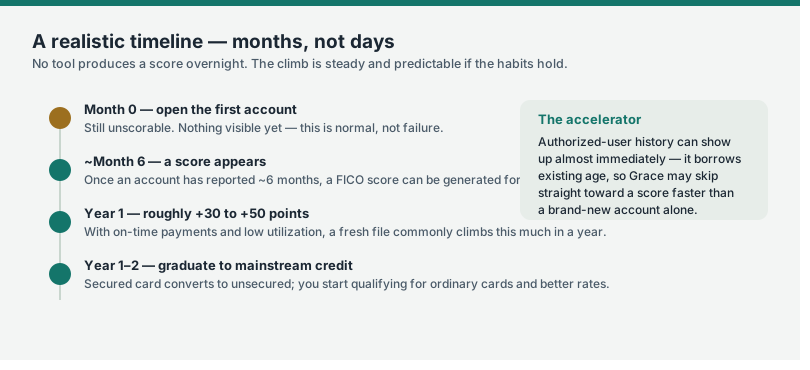
The two clocks are the first thing to understand, because they explain the confusing gap from §10. VantageScore can produce a score with as little as one month of history, while FICO typically takes at least six months — and FICO’s gate is specific: you need at least one account that’s been open for six months and has been reported to the bureaus within the last six months. That’s why Priya, three months in, already has a VantageScore but not yet a FICO. Her free app number arrived early; the number most lenders actually pull is still forming. The practical takeaway is one of patience — she shouldn’t apply for a real credit product the instant her app lights up, because the lender may reach for a FICO that isn’t ready. The clocks converge by around the six-month mark.
From there, the milestones to a genuinely good score are the encouraging part. From scratch, with the two habits that matter — on-time payments and low utilization — a “good” score of 670 or higher is reachable in about 12 to 18 months, “very good” (740+) takes roughly two to four years, and “excellent” (800+) generally takes five to seven or more years of clean history. So Priya’s realistic horizon is a good score within a year or so of where she is now, and the elite tiers as a multi-year project — which is exactly the right way to frame it: the foundational win is fast, and the polish is slow. It also helps to know the starting bar is modest. The average first credit score is about 645, according to the Federal Reserve — so a fair starter score is completely normal, and her 671, lifted by the authorized-user account, is already a touch ahead of average.
The gold panel carries the one caution that keeps a builder from getting hurt: early scores are volatile. Because her file is thin, every new data point swings it disproportionately (the §2 amplification, now on a timeline) — which is wonderful on the way up, as a few months of clean history move the number quickly, but dangerous on the way down, since a single missed payment after she reaches “good” can drop her sharply, with almost no history to cushion the fall. This is precisely why the early months reward consistency above all else, and why the autopay habit from §7 isn’t optional polish — it’s what protects a young score from its own fragility.
And the teal panel turns the whole thing into a short to-do list. What speeds the build is the same trio throughout: on-time payment every month, low utilization (under 10% is ideal), and age — which only accrues by waiting, the reason starting now is the entire game. What slows it is the mirror image: a late payment (the single biggest setback on a thin file), a maxed card, and a flurry of applications — each hard inquiry can cost roughly 5 to 10 points, so they’re best spaced about six months apart.
Put together, the timeline reframes the locked door of §1 as something with a clear, walkable path on the other side: a number in about a month, a lender’s number by six, a good score within a year or two, and the elite tiers as a patient long game — all of it driven by a couple of habits Priya already has the tools to keep. The score isn’t something that happens to her; it’s something her consistency produces, on a schedule she can largely predict. Those exact habits — stated as a short, durable checklist — are the next turn.
The habits that build — the whole job, mostly on autopilot
Everything in this lesson reduces, in the end, to a short set of habits — and the encouraging truth is that most of them run themselves. Priya doesn’t need to monitor her score daily or master the model; she needs to set up a few behaviors so the right thing happens automatically and the wrong thing becomes hard to do by accident. Here’s the entire job:
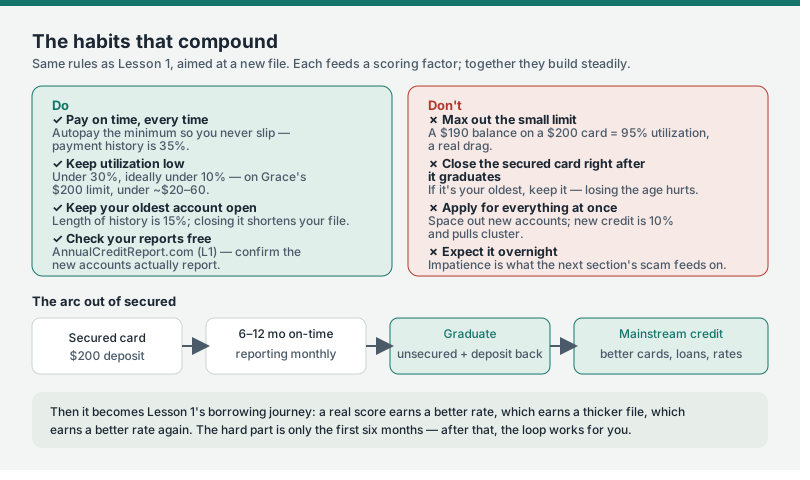
Each habit is worth a line on the behavioral mechanics — how to actually make it happen — because the scoring logic was settled in §2; what’s left is the doing.
Autopay, never miss. The move here isn’t “remember to pay” — it’s to make missing structurally impossible by setting autopay for at least the minimum on every account. That distinction matters: even if Priya plans to pay in full by hand, an autopay safety net set to the minimum means a forgotten due date, a travel week, or a distracted month can never produce the one event that hurts most. On her thin, volatile file (§12), a single late payment is the catastrophe; autopay removes the possibility rather than relying on her memory to dodge it.
Keep balances low. Two behavioral subtleties make this easier than it sounds. First, the number that gets reported is usually the statement balance, not everything she charged all month — so she can use the card normally and simply pay it down before the statement closes to make the reported utilization tiny, regardless of her spending. Second, utilization is a ratio, so a higher limit lowers it without spending a dollar less, which is why requesting a credit-limit increase after a year of good history (a soft pull at many issuers) is a quiet way to improve the number. And paying in full, always, keeps her out of interest entirely.
Keep your oldest account open. This is the habit people break by accident, usually as a “cleanup.” When Priya graduates to nicer cards, the instinct is to close the humble first one — but closing it shortens her average account age and removes its limit from her available credit, raising her utilization in one move; it hurts two factors at once. The behavioral fix is small: keep the oldest card open, put one tiny recurring charge on it (a single subscription), and let it quietly age forever. The first account she ever opened is often the most valuable one she has, precisely because it’s the oldest.
Apply rarely. The move is restraint with a rule of thumb: one account at a time, roughly six months apart, and only when there’s a genuine reason. Each application is a hard inquiry and drags down her average age, so the worst thing she can do early is chase every “you’re pre-approved” offer. Deliberate, spaced, reason-driven applications keep the new-credit factor working for her.
Let it age — patience is the strategy. This is the hardest habit, and it’s counterintuitive because it asks for inaction. Most months, the single best thing Priya can do for her credit is nothing at all — no new card, no closing, no shuffling, no app-checking-and-tweaking. Credit rewards a long, boring, unbroken track record, and the urge to “do something” to speed it up usually backfires (closing accounts, opening accounts, chasing offers). The skill being practiced here is trusting the process and waiting, which is genuinely difficult for someone eager to see progress — but time is the one factor that can’t be rushed, so letting it pass is the work.
Check your reports. The final habit is the one watchdog she keeps active. Pulling her free reports periodically — from AnnualCreditReport.com or a free monitoring app — lets her confirm her accounts are actually reporting (the whole plan depends on it), catch errors before they fester, and spot the early signs of fraud on a file too thin to absorb it. Checking her own credit is a soft inquiry that never costs a point, so there’s no reason not to, and disputing any error she finds is a federal right (the subject of §16).
Step back and the shape is reassuring: this is mostly a set-it-and-forget-it system. Autopay handles payment history, a small charge paid before the statement handles utilization, leaving the oldest account open and not over-applying handles the rest — and then the dominant activity is waiting, which costs nothing and asks nothing. The red panel is the mirror image: avoid the four mistakes — a missed payment, a maxed card, closing the oldest account, a flurry of applications — and there genuinely isn’t much else to manage. For Priya, the whole routine collapses to: set autopay on everything, keep her cards nearly empty, leave her oldest account alone, check her reports a few times a year, and otherwise let the months do the building.
That near-effortlessness is exactly what a certain predator exploits — the “guaranteed approval” card that promises a shortcut to people impatient to start, and charges dearly for it. That’s the next turn.
Predator Watch — the guaranteed-approval fee-harvester
Everything in this lesson points toward a person in Priya’s exact position: no credit, eager to start, and possibly already declined somewhere. That eagerness is the opening, and there’s a product built precisely to exploit it — the “guaranteed approval” card that sounds like the answer and is, in fact, a fee machine. It’s Lesson 4’s predator, distinct from the last three, and it preys specifically on the credit-invisible.
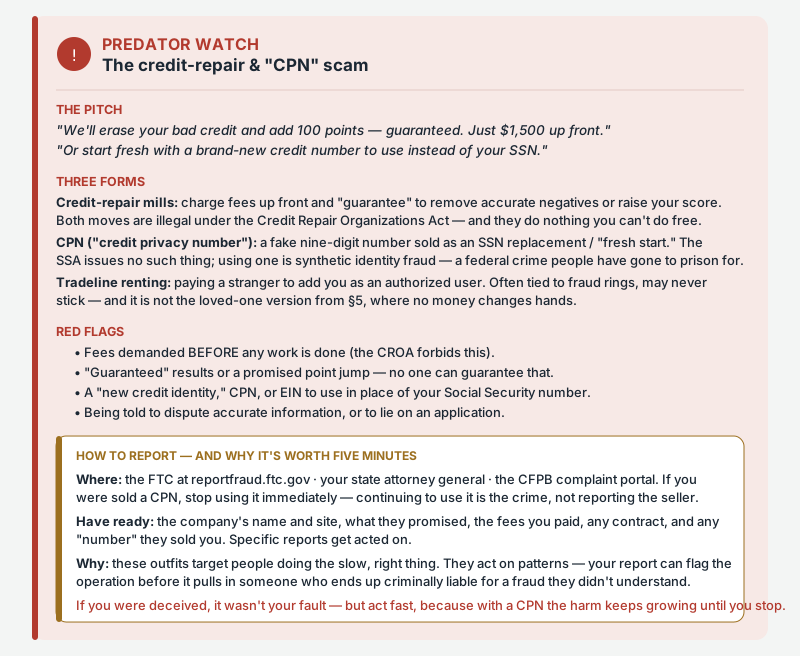
The cruelty of this one is that it dresses up as the solution to the exact problem the whole lesson is about. “Guaranteed approval, no credit check, build your credit today” is engineered to land on someone who’s just been declined and is starting to feel the door is locked for good — and Priya, fresh off a phone-deposit and a declined first card, is precisely the target. The pitch works because it names her pain and promises to end it instantly.
But the fee math in the white box is the whole story, and it’s worth sitting with, because it inverts the very thing she’s trying to do. A fee-harvester card hands her a small limit — say $300 — and then consumes it with fees before she’s bought anything: a $95 one-time program fee, a $75 annual fee charged to the card, and in year two a steady drip of monthly “maintenance” charges. The result is doubly damaging. First, she’s out real money for almost no usable credit — the fees leave maybe $130 she can actually spend. Second, and worse for her score, the fee charged to the card means she starts at 25% utilization before spending a cent, so the very account she opened to demonstrate low utilization is reporting high utilization from day one. It’s a credit-building tool that actively damages credit while charging her for the privilege.
The contrast in Your Move is the entire defense, and it’s clarifying: a good secured card asks for a refundable deposit and charges little or no fee; a fee-harvester asks for no deposit but stacks non-refundable fees. That difference is everything — the deposit is her own money, held and returned; the fees are gone forever. And critically, both report to the same three bureaus, so they build credit identically — which means a secured card or a credit-builder loan accomplishes the exact same thing for a fraction of the cost. There is simply no card that requires hundreds of dollars in fees to build credit; the requirement is the scam. So the move is concrete: before applying to any card, pull up the fee schedule — the Schumer box from Lesson 1 — and add every fee against the limit. If the fees approach the limit, it’s a fee-harvester, and the answer is the secured card she could have gotten instead.
The How-to-report block carries the same honesty as Lesson 3’s: much of this is legal, because the fees are disclosed somewhere in the fine print, so the first and best protection is the knowledge above rather than a complaint. But it crosses into reportable territory more often than people realize — when fees were hidden or misrepresented in the marketing, when the card didn’t report to the bureaus as promised (so she paid for “credit building” that never happened), or when the first-year fees exceeded the CARD Act’s cap of 25% of the credit limit. There’s a civic point under the block worth naming: that 25% cap exists because of these exact cards — Congress wrote it into the CARD Act specifically to rein in fee-harvesters — so reporting the deceptive ones to the issuer, the CFPB, the FTC, and the state AG is part of how that hard-won protection stays real for the next person standing where Priya stands.
For anyone reading this who already signed up for one of these — who paid the fees and is sitting on a maxed-out $300 card wondering why their score didn’t move — the next beat is the calm one, and it’s for you.
If This Already Happened to You
Some people reading §14 didn’t recognize a card they’re about to be offered — they recognized the one already in their wallet, the $300 limit half-eaten by fees, the score that hasn’t moved. This beat is for them, and there’s a genuinely freeing piece of news in it that’s specific to building from scratch:
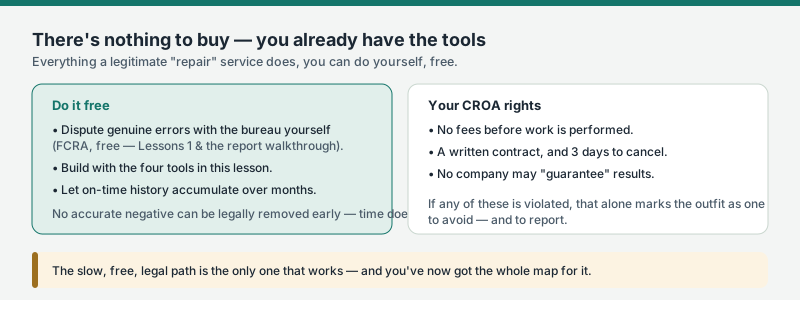
The beat does its four jobs, and one of them is unusually liberating in this particular case. It names the stumble as ordinary and engineered — these cards are aimed precisely at the moment someone’s been declined and wants a way in, so signing one is a sign of initiative, not carelessness. It sets the self-blame down, because “you should have read the fee schedule” is the wrong lesson when the pitch was built to name your pain and the fees were placed where you weren’t looking. It points to what’s actionable. And it reframes reporting as the civic act that keeps the CARD Act’s protections alive.
But the genuinely freeing piece — the part worth pulling out of the panel — is the first bullet, because it flips a rule the lesson just spent a whole section teaching. In §13, “never close your oldest account” was close to gospel, because closing an aged account costs you history and available credit. That rule does not trap someone holding a fee-harvester card they just opened, and the reason is exactly the §13 logic running in reverse: a brand-new account has almost no age to lose. So unlike a long-time cardholder who’d pay dearly to close, Priya — or anyone a few months into a fee-harvester — can walk away from it at minimal cost, switch to a real secured card, and barely dent her file. The instinct to feel stuck with a bad first card is the trap; on a thin file, you’re not stuck, because there’s nothing yet to lose by leaving.
The rest of the path is short and cheap: open a real builder (the secured card or credit-builder loan that does the identical bureau-reporting for a refundable deposit and little or no fee), pay the fee-harvester’s balance down before closing so it isn’t reporting maxed on the way out, pull a report to see what the card actually did, and dispute any fee that was hidden or misrepresented. None of it requires money she doesn’t have, and the help that exists is the opposite of the predator — a nonprofit credit counselor who’ll walk her through building, free, with no upfront-fee card or “repair” shop in sight.
The throughline of the whole lesson lands here, and it’s a hopeful one: the skill it taught — knowing what real building looks like, and what a fee actually buys — isn’t only protection going forward. It’s the exit for anyone a bad first card already caught, and on a file this young, that exit is wide open and nearly free. She’s still early; the damage is small; the real way up was always cheaper and is still right there.
One structural piece remains — the protections a builder can lean on (the right to dispute report errors, the rules that shield young borrowers, and the recourse stack) — which is the next turn.
Your protections as a builder — accuracy is your right
Building from scratch leans on a handful of laws that put accuracy and fairness on Priya’s side — and for a builder specifically, the right that matters most isn’t about borrowing terms, it’s about making sure her hard-won history is recorded correctly. Here’s the protective layer beneath the whole plan:
The first card is Priya’s main shield, and it’s the one a builder should lean on hardest. The Fair Credit Reporting Act gives her two things that matter enormously on a thin file. The first is free access: she’s entitled to free reports, and the bureaus now make them available weekly at AnnualCreditReport.com — the official site — so there’s no excuse not to watch her build. The second, and more powerful, is the right to accuracy: both the bureaus and the companies that furnish data to them are legally required to report correctly, and when something is wrong, she can dispute it — filing with the bureau and notifying the furnisher — after which the bureau must investigate, generally within about 30 days, and delete anything it can’t verify. This matters far more for a builder than for an established borrower, because of the §2 amplification: on a thin file, a single error has outsize weight. An account that isn’t reporting makes her hard work invisible; a wrong late mark can crater a young score; a mixed file (someone else’s data merging into hers) or fraud can do real damage before she notices. The right to a free report and a working dispute process is precisely how she keeps a fragile file clean — and she checks all three bureaus, because they can differ.
The same law gives her the third card’s protection: a free security freeze and free fraud alert at each bureau, which lock her file against someone opening accounts in her name. This is exactly the safeguard a new builder needs most, because a thin file is both an attractive and an easy target, and she’s not watching it as closely as a seasoned borrower would.
The second card is the CARD Act, and it shapes Priya’s experience directly because she’s 19. To curb the aggressive marketing of cards to students, the law requires that anyone under 21 generally show independent income (or have a co-signer) to be approved — which is why a student-card application asks about income, and why Priya will list her bookstore earnings. It’s a protection, not an obstacle: it exists so young people aren’t handed credit they can’t service. The CARD Act is also the source of the §14 25%-of-limit cap on first-year fees, the rule the fee-harvester skirts, plus the requirements for 45-day notice before rate hikes and the clearer statements (the Schumer box) she’ll read as she uses cards.
One adjacent protection is worth naming precisely, because it connects to the §1 equity point. Fair-lending law — the Equal Credit Opportunity Act — bars a lender from denying credit based on race, sex, religion, national origin, marital status, age (so long as she can legally contract), or receipt of public assistance. But here’s the careful distinction: being declined for having no credit history is legal, because that’s missing data, not a protected characteristic. ECOA protects Priya against discrimination; it doesn’t dissolve the chicken-and-egg itself — that’s what the toolkit is for. Knowing the difference keeps her from misreading a no-history decline as something it isn’t, while still knowing her rights if a decline ever crosses into actual discrimination.
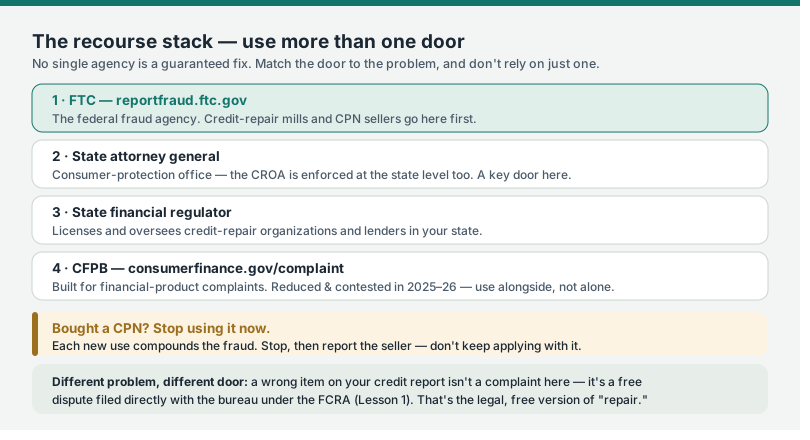
Finally, the recourse path turns “my report is wrong and no one will fix it” from a dead end into a process. She climbs it in order and in writing, keeping records: first the bureau and the furnisher (file the dispute with both); then the CFPB, which handles credit-reporting complaints and — for reporting errors specifically — is often one of the more effective venues, though with the reduced capacity noted in Lesson 2; then her state AG and the FTC to escalate or report a pattern. The 30-day investigation requirement is the lever that makes this work, and pairing the CFPB with her state AG (rather than relying on it alone) is the same redundancy the recourse stack has counseled throughout.
The thread tying all of these together is the §13 habit they enable: check your reports, and dispute errors, because a thin file can’t afford to carry someone else’s mistake. These protections are what make that habit enforceable — they put the law behind Priya’s right to a credit record that’s actually hers, and accurate.
That completes the lesson’s substance: she can see why no credit blocks her, choose the right starter tools, read the two documents that begin a file, build the habits and know the timeline, spot the predator and recover from it, and now lean on the rights that keep her record honest. What remains is to gather the questions builders always ask and let her check herself — the final turn.
Most Common Questions
The questions people actually ask when they’re starting a credit file from nothing — paraphrased from the kinds of things that fill personal-finance forums.
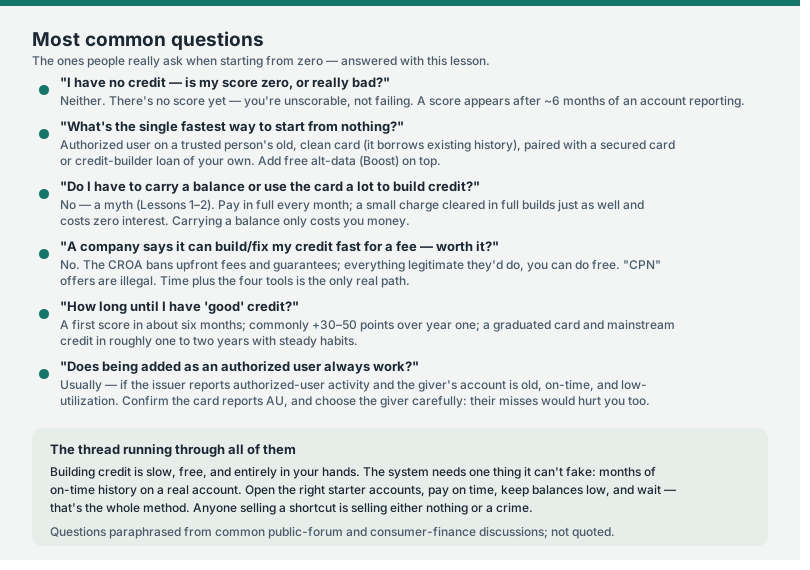
Two timelines. A VantageScore (the kind many free apps show) can appear with as little as one to two months of history; the FICO score most lenders use typically needs about six months of an account reporting. From there, a good score (670+) is realistic within 12–18 months of on-time payments and low balances. So: a number in a month or two, a lender’s number by six months, and good within a year or so.
Ideally both, because they do different jobs — a secured card is a revolving account and a builder loan is an installment account, so having both covers the credit-mix factor early. If you can only do one, a secured card is the more flexible starter (and the builder loan doubles as forced savings). Neither requires good credit, both report to the bureaus, and together they’re the safe core of building from scratch.
It can be the single fastest boost — it can transplant years of age and a perfect payment history onto your file overnight, addressing the one factor you can’t otherwise rush. Two conditions: the primary must be genuinely responsible (their late payment or high balance flows to you too), and the issuer must actually report authorized-user activity (not all do, and some scoring models discount “rented” tradelines). With a real, well-managed family card, it’s a powerful, free head start.
No — and the difference is everything. Bad credit is a record of trouble that the model scores you down for. No credit is a blank page: there’s nothing to evaluate, so you can’t be scored, which is why you’re declined. The fix isn’t to repair damage — there’s no damage — it’s to add data: open one reporting account and let it build. A blank page is faster to fill in than a damaged one is to repair.
Far fewer than you’d think. One well-managed account builds about 65% of your score (payment history plus utilization), and opening many at once actually hurts — each application is a hard inquiry and drags down your average account age. The move is one or two accounts, opened deliberately and spaced about six months apart, then patience. More accounts isn’t faster; consistency over time is.
No — this is the most common and most expensive myth in credit-building. You build credit by using an account and paying it off, not by carrying a balance. Charge a small amount, pay the statement in full every month, and you get perfect payment history and low utilization with zero interest. Carrying a balance just costs you money and can raise your utilization; it does nothing extra for your score.
No. Checking your own report or score is a soft inquiry, which never affects your score — so check as often as you like. Only hard inquiries (from applying for credit) ding it slightly, and even those fade within a year. Pulling your free reports regularly is a habit, not a risk.
Check yourself
Six questions across the lesson — tap an answer to see how you did:
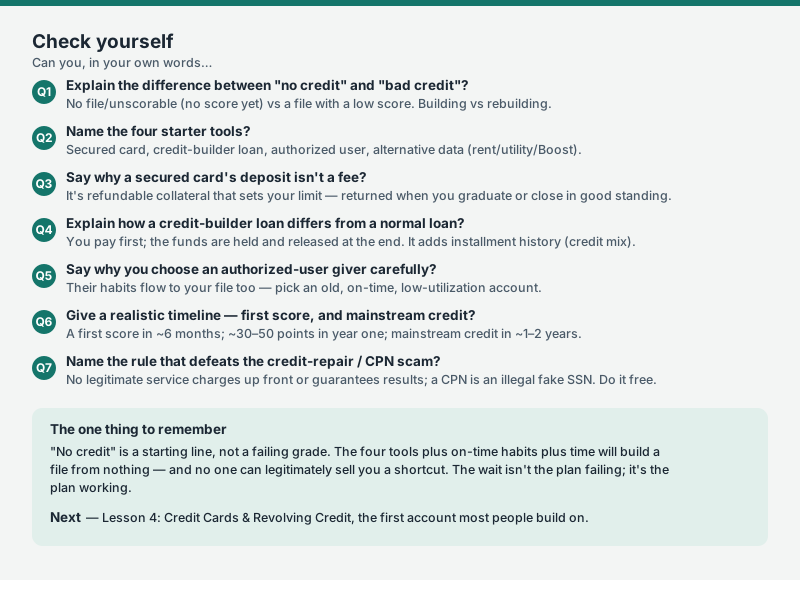
That closes Lesson 4. Priya started the lesson invisible — declined for a phone plan, locked out by the chicken-and-egg — and ends it with a clear, walkable plan: she understands that her blank file is missing information, not bad information; she knows the starter toolkit and which pieces fit her; she’s read the two documents that begin a file; she knows the habits and the timeline that carry her from a first score to a good one; she can spot the fee-harvester that preys on exactly her situation and escape it cheaply if it ever caught her; and she knows the rights that keep her record honest. The single transferable instinct, the one that survives even if she forgets every detail: open one safe, reporting account, pay it on time, keep it nearly empty, and let time do the rest.
Key takeaways
- No credit is a blank page, not a damaged one — the lender isn’t judging you, it’s shrugging because there’s nothing to read. The fix is to write on the page, not repair it.
- Payment history (35%) and utilization (30%) are the two factors you control from the first month. A single account used lightly and paid on time builds both.
- A credit-builder loan is self-secured and nearly impossible to misuse — the funds are held until you finish, so you can’t overspend them. Its tuition is roughly $66 for a $1,000 loan, and you end with a credit history and your savings.
- A good score (670+) is reachable within 12–18 months. The winning habits are autopay, low utilization (under 10%), keeping your oldest account open, and patience — most of the system runs itself.
- The fee-harvester “guaranteed approval” card targets exactly the credit-invisible. A secured card or credit-builder loan does the same bureau-reporting for a refundable deposit and little or no fee. If the fees approach the credit limit, walk away.
- The FCRA gives you free weekly reports and a working dispute process. On a thin file, one error has outsized weight — check all three bureaus regularly and dispute anything that’s wrong.
Knowledge check
6 questions
What is the key difference between having no credit and having bad credit?