In this lesson
- Opening
- 1. Secured vs unsecured — and why "secured" isn't a synonym for "safe"
- 2. The emergency-credit landscape — a map
- 3. Payday loans — how they work
- 4. The rollover trap — where the real damage lives
- 5. Auto title loans — how they work
- 6. When the title loan goes bad — repossession and the cascade
- 7. Pawn loans — costly, but the downside is bounded
- 8. Rent-to-own — where "$25 a week" becomes triple the price
- 9. Cash-advance apps and earned-wage access — payday in a friendlier wrapper
- 10. Card cash advance and overdraft — the emergency credit already in your wallet
- 11. Document Walkthrough: A payday loan agreement
- 12. Reading the payday agreement — field by field
- 13. Document Walkthrough: An auto title loan agreement
- 14. Reading the title agreement — field by field
- 15. The same $500, eight different prices
- 16. Medical debt — the biggest reason people reach for these products
- 17. The better alternatives — the heart of the lesson
- 17b. Document Walkthrough: A credit-union PAL agreement
- 17c. Reading the PAL agreement — field by field
- 18. The emergency playbook — and the honest answer to "is it ever okay?"
- 19. Predator Watch — when the trap is the business model
- 20. If this already happened to you
- 21. Protections and recourse — what the law actually gives you
- 22. Most common questions
Secured & Emergency Credit
Payday loans, title loans, pawn, rent-to-own, and cash-advance apps — how each trap is engineered, how to read their contracts, and the better alternatives in cheapest-first order.
What you'll learn
- Recognize every high-cost emergency-credit product on sight — payday, title, pawn, rent-to-own, and cash-advance apps — and price the same $500 need through each using the federal APR as the unit of comparison.
- Trace the two engineered traps: the payday rollover cycle (fees pile up, principal never shrinks) and the title-loan repossession cascade (self-help seizure, equity stripping, potential deficiency).
- Read three real loan agreements field by field — a payday agreement, a title loan agreement, and a credit-union PAL agreement — understanding what each clause does for the borrower and where the escape hatches are buried.
- Work the better-alternatives list in cheapest-first order — payment plan on the bill, emergency fund, employer advance, PAL, 211, nonprofit aid — and open the cheap doors that aren't yet available.
- Handle a medical bill correctly: request an itemized bill, apply for charity care, and keep the debt with the provider rather than rushing it onto a card.
- Know your 2026 rights: your state's rate cap, the EFTA off-switch on ACH debits, the FDCPA's ban on illegal collection tactics, and the Extended Payment Plan many states require payday lenders to offer.
Opening
Sooner or later, almost everyone faces a cash emergency — a car that won't start before a shift, a medical bill, a rent gap, a broken furnace in January. It's worth saying plainly at the outset, because this lesson touches a place where people are often made to feel ashamed: needing emergency credit is not a personal failure. Emergencies are universal; what differs is the options people have when one hits. And that difference is the whole subject of this lesson.
Here is the organizing idea — a cruel inversion that runs through every product we'll cover: the people with the fewest options are offered the worst terms. When Darnell needs $500 fast and his credit is 580, the loans marketed hardest to him — payday, title, the storefront with the bright sign — are precisely the most expensive and most dangerous in all of consumer credit. The easier and faster a loan is to get with bad or no credit, the more it tends to cost and the more it can hurt you. Speed and a low bar to qualify are not generosity; they're the price tag in disguise. Maya, with a small emergency buffer and a credit card, can absorb the same $500 car repair for almost nothing. Darnell, offered a payday loan, can pay hundreds for the same $500 — or, with a title loan, risk the car itself. Same emergency, opposite cost, decided almost entirely by which options each person had walking in.
The numbers make the inversion concrete, and they're worth seeing side by side. A payday loan typically charges around $15 per $100 borrowed, which on a two-week loan works out to roughly a 400% APR — and some run higher. An auto title loan, secured by your car, commonly runs 200–300% and puts your vehicle on the line. Compare that to the alternatives this lesson will map: a credit union's Payday Alternative Loan is capped at 28%, and even a credit card cash advance — itself an expensive option — is around 25–30%. The gap between the trap products and the better options isn't a few points; it's the difference between paying $20 and paying $200 for the same $500.
And the cost isn't even the worst part — the trap is. These products are engineered so that a single loan becomes a cycle. A payday loan you can't repay in full on payday gets rolled over, and the fees recur while the principal never shrinks — people borrow $375 and pay it for months. A title loan you can't repay ends with the lender repossessing your car — stripping the very asset you need to get to work, over a few hundred dollars. We'll take apart exactly how each trap is built, because understanding the mechanism is the first defense against it.
But the heart of this lesson — the reason it exists — is the counter-message, and it's a hopeful one: there is almost always a better option, even in an emergency, even with poor credit. A credit-union PAL, an employer paycheck advance, a hardship or payment plan on the bill itself, a regular card or loan, local emergency assistance, a community fund. Most people who end up in a payday or title loan didn't lack a better option — they didn't know one existed, or weren't shown it at the moment of panic. So a large part of this lesson is simply mapping those alternatives, in cheapest-first order, so that Darnell — and you — never have to take the worst product just because it was the most visible.
Two realities of 2026 shape the landscape. First, most of the protection here is state-level, so where you live matters enormously. Twenty states and the District of Columbia have effectively banned high-cost payday lending by capping rates at around 36%, while other states still permit the full 400%. The same loan that's illegal in New York is on every corner in another state. Second, the trap products keep evolving to dodge the caps — newer cash-advance apps, and "rent-a-bank" and tribal-lender arrangements that claim exemption from state rate limits, sometimes charging 800% or more. So the skill isn't memorizing one product; it's recognizing the pattern.
The "secured" thread runs alongside all of this. Borrowing against an asset — a car title, a pawned item, a savings account — spans a wide spectrum: secured can be the safest, cheapest credit there is (a savings-secured loan, Lesson 4) or among the most predatory (a title loan that can take your car). The lesson covers both ends, so the word "secured" never gets read as automatically safe.
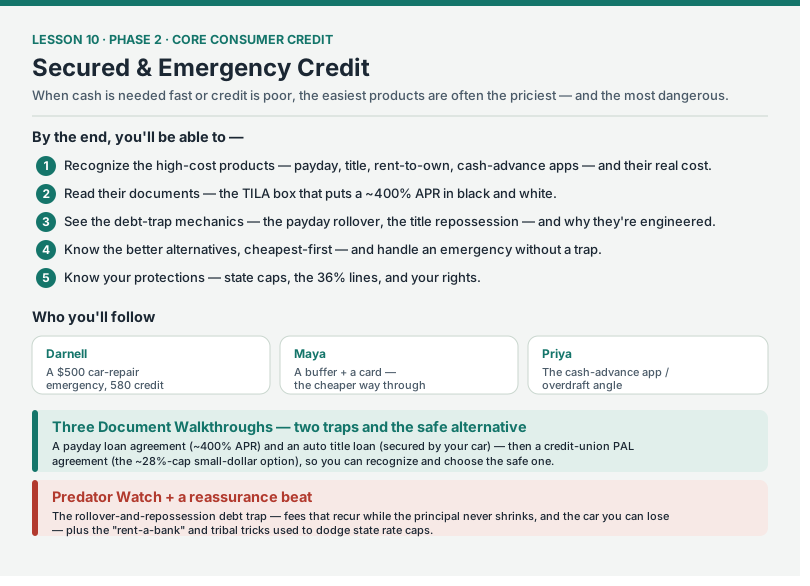
The goal by the end is concrete: recognize the high-cost products on sight, read their documents — including the TILA box that states a 400% APR in black and white — understand how the rollover and repossession traps are built, know the better alternatives in the order you should try them, and handle a real emergency without losing your car or stepping into a fee cycle. It starts with the distinction the lesson's title turns on — what "secured" actually means, and why it can cut either way. That's the next turn.
1. Secured vs unsecured — and why "secured" isn't a synonym for "safe"
The first distinction to get right is what backs a loan. Unsecured credit is backed only by your promise to repay and your creditworthiness — there's no collateral, so if you default the lender can pursue you (collections, a lawsuit, credit damage) but can't automatically seize a specific thing you own. Credit cards, most personal loans, and — importantly — payday loans are all unsecured. Secured credit is backed by collateral: a specific asset the lender can take if you don't pay. A mortgage is secured by the house, an auto loan by the car, a title loan by your car's title, a pawn loan by the pawned item, and a savings-secured loan by your own savings.
Why does collateral matter? To the lender, it lowers risk — if you default, they can recover by seizing the asset — so secured credit usually comes with a lower rate and easier approval. That's the appeal. But for the borrower, the trade is that you've put a real asset on the line. And here's the crucial point this lesson turns on: because the rate and the collateral are two independent things, "secured" can land anywhere from the safest, cheapest credit there is to the single most dangerous:
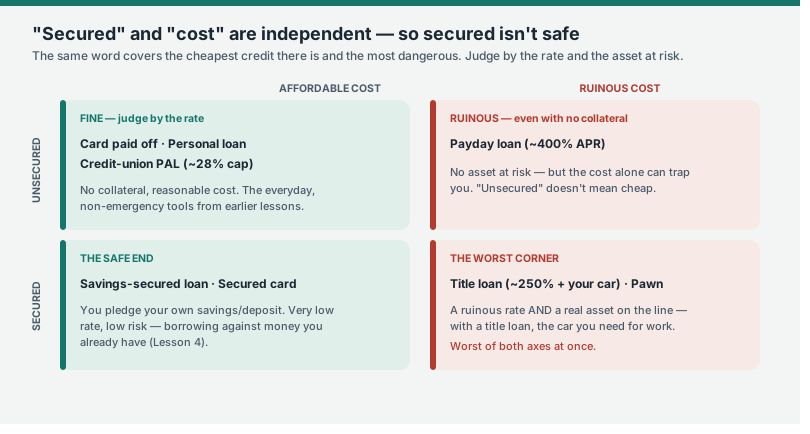
The map's whole point is that the two axes are independent, so you can't read safety off the word "secured" at all. The safe corner — secured and affordable — is the savings-secured loan or secured card from Lesson 4: Darnell pledges his own savings or a deposit, gets a very low rate, takes on very little real risk, and even builds credit, because he's borrowing against money he already has. The worst corner — secured and ruinous — is the title loan: a ~250% rate and the car he needs to get to work pledged as collateral. Same word, opposite product. And the diagonal makes the second half of the point: "unsecured" doesn't mean cheap either. A payday loan has no collateral, yet its ~400% cost alone can trap him, while a savings-secured loan has collateral and is nearly free. Security status and cost are simply different questions.
Two refinements sharpen the danger at the bottom-right corner. The first is what asset is at risk and how badly you need it. A title loan isn't dangerous merely because the rate is high — it's dangerous because the collateral is essential. Defaulting doesn't just ding Darnell's credit; it strips the car that gets him to his job, which can cost him the income he needs to recover, turning a $500 problem into a lost-job catastrophe. The collateral on a title loan is the very thing his stability depends on, which is exactly why pledging it for a small, short-term need is so reckless.
The second refinement is recourse vs. non-recourse, a sub-distinction that changes how bad a default gets. With a recourse loan — most secured loans, including title and auto — if seizing and selling the collateral doesn't cover the debt, the lender can still pursue you for the rest (the "deficiency"). So a title default can mean Darnell loses the car and gets sued for the shortfall — losing the asset doesn't even end the debt. With a non-recourse loan — and a pawn loan is the clean example — the lender's only remedy is the collateral: if Darnell doesn't repay, the pawnshop simply keeps the pawned item and has no further claim on him. That caps his downside at the item he chose to risk. It's why pawn, for all its high cost, is less catastrophic than a title loan — you forfeit a thing you decided you could lose, not the car you can't, and there's no deficiency chasing you afterward.
So the practical takeaways are clean. Judge a loan by its rate and the asset at risk, never by the "secured" label — secured can be the best credit or the worst. Never pledge an asset you can't afford to lose — your car, your home — for a small or short-term need; the asymmetry (a few hundred dollars borrowed against a job-critical asset) is the trap. Know whether it's recourse, because non-recourse caps your downside and recourse doesn't. And in an emergency, prefer affordable-unsecured (a card, a PAL) or safe-secured (your savings) over dangerous-secured (a title loan) every time. For the three borrowers: Darnell, offered a title loan against his car, is being steered into the worst corner; Maya, with a card and a possible savings-secured option, sits in the safe lanes; and Priya weighing a pawn (non-recourse, bounded) against a payday loan (unsecured, ruinous) is choosing between two bad options where at least the pawn caps her loss.
With the secured/unsecured axes clear, the next turn maps the full emergency-credit landscape — every product a person in a crunch might be offered, fast vs. costly — so the rest of the lesson can take them one at a time. That's §2.
2. The emergency-credit landscape — a map
When Darnell needs $500 fast, he isn't choosing from an orderly menu — he's being marketed to, and the loudest, fastest, easiest options are usually the worst. So before taking any single product apart, it helps to see the whole landscape at once, sorted by what actually matters: how dangerous each is. Three bands, and the cruel inversion from the opening is visible right in their order — the fastest, lowest-bar products sit at the top, in the danger zone:
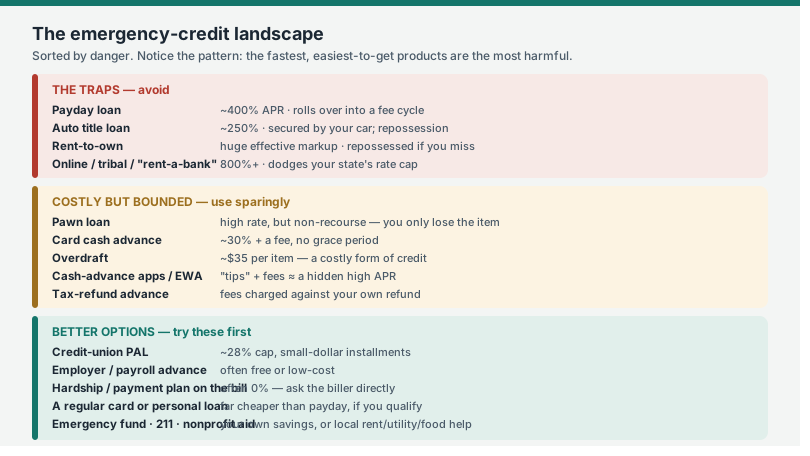
The map's ordering is the lesson in miniature: the products are sorted by danger, and that order is almost exactly the reverse of how fast and easy they are to get. The traps at the top require almost nothing — no credit check, minutes to fund — which is precisely why they're marketed to people in a panic, and precisely why they're the most harmful. The better options at the bottom take a little more effort or qualification, which is the only reason they're not the default. Nobody hands Darnell a leaflet for the cheap option in the parking lot; he has to know to look for it. That's what this map is for.
The traps — the top band — are products to avoid outright. The payday loan (~400% APR, the §3–4 subject) rolls a single short-term loan into a recurring fee cycle. The auto title loan (~250%, §5–6) is secured by the car Darnell needs and ends in repossession if he can't pay. Rent-to-own (§8) turns a $400 couch into a $1,200 obligation through a huge effective markup, with the furniture repossessed if he misses. And the online / tribal / "rent-a-bank" versions are the same predatory products dressed up to evade state rate caps — tribal lenders claiming sovereign immunity, or storefronts partnering with an out-of-state bank charter, sometimes charging 800% or more even in states that have banned 400% payday loans. The lesson's flag here is durable: if an online lender's rate is far above what your state allows, that's not a loophole working in your favor — it's a sign the lender is structured to dodge the protections meant for you.
The middle band — costly but bounded — are products to use only sparingly and knowingly. These cost real money but don't spring the same open-ended traps. A pawn loan carries a high rate yet is non-recourse (§1) — Darnell can only lose the item he chose to risk, with no deficiency chasing him. A credit card cash advance runs ~30% with a fee and no grace period (Lesson 5), but it's bounded and won't take his car. Overdraft is a ~$35-per-item fee that functions as expensive short-term credit. Cash-advance apps and earned-wage access (§9) advance a small amount against your next paycheck for "tips" and fees that work out to a hidden high APR despite the friendly framing. And a tax-refund advance charges fees against money that's already Darnell's. None of these is good, but each is survivable in a way the top band isn't — they're the "if you must" tier, not the "never" tier.
The bottom band — the better options — are where the lesson wants Darnell to start, and they're the heart of the whole thing. A credit-union Payday Alternative Loan is capped at ~28% and structured as small-dollar installments — built specifically to be the humane alternative to payday. An employer or payroll advance is often free or nearly so. A hardship or payment plan negotiated directly with the biller — the auto shop, the hospital, the utility — is frequently 0% and is the single most overlooked move. A regular credit card or personal loan, if he qualifies, is dramatically cheaper than payday. His own emergency fund is the cheapest "loan" there is. And 211 (the national hotline for local emergency assistance — rent, utilities, food) and nonprofit aid can cover the need without borrowing at all. We'll develop these in cheapest-first order in §15–17, because the practical skill is not just knowing they exist but knowing the order to try them in.
This map is the lesson's table of contents: each product gets its own close look ahead, the two worst get full Document Walkthroughs, and the better options get a section of their own. For the borrowers, the map already sorts their situations — Darnell is being pulled toward the top band (payday, title) when the bottom band is right there if he knows to reach for it; Maya, with an emergency fund and a card, lives in the bottom band by default; and Priya is weighing a middle-band cash-advance app against the better options. The next turn takes the most notorious product on the map and shows exactly how it works: payday loans. That's §3.
3. Payday loans — how they work
A payday loan is small, short, and brutally simple. Darnell walks into a storefront (or applies online) with a pay stub, a bank account, and an ID, and in minutes walks out with cash — no credit check, or barely one. He borrows a small amount (commonly $100–$500), and the entire balance plus a fee is due in one lump on his next payday, usually about two weeks out. It's unsecured — no collateral — and there are no installments: the whole thing comes back at once. The low bar and the speed are the appeal, and, per the opening's inversion, they're also the warning.
The cost is quoted as a flat fee per $100 borrowed — typically around $15 per $100. So Darnell's $400 loan toward his car repair costs $60 in fees, and he owes $460 in two weeks. And right there is the sleight of hand the entire product depends on: "$15 per $100" sounds like a 15% fee, which sounds almost reasonable. Annualize it, and it isn't. Run the numbers yourself:
Payday loan APR calculator — run the numbers yourself
Fee
$60
Total owed
$460
APR
391%
The reveal is the whole point of the section. Darnell's fee feels like 15% — and in a sense it is, for two weeks. But a year has roughly 26 two-week periods, so paying 15% every two weeks annualizes to about 391% APR. The flat fee isn't lying, exactly; it's just quoting the cost in the one unit — a short term — that makes an astronomical rate sound trivial. The lender says "just a $60 fee"; the federal TILA box on the same loan (which DW#1 will show) says ~400% APR. That gap between how it's quoted and what it is is the engine of the whole product. And notice what the slider does when you shorten the term: the APR climbs even higher, because the same fee is being earned over fewer days — a 7-day loan at $15/$100 is nearly 800% annualized. Shorter isn't cheaper; it's worse.
Two structural features turn that expensive loan into a trap, and both are worth naming now because the next section is built on them.
The first is the balloon, single-payment design. Darnell doesn't repay $460 in manageable installments — he owes the entire $460 at once, on payday, out of the same paycheck that was already too tight to cover a $400 car repair. Think about what that requires: he was short $400 this week, and two weeks from now he must produce $460 plus still cover his rent, food, and everything else. For most people who needed the loan in the first place, that's not difficult — it's impossible. And that impossibility isn't a flaw in the product; it's the feature, because a borrower who can't repay in full rolls the loan over and pays the fee again (the §4 trap). The lender doesn't profit from Darnell repaying cleanly — it profits from him not being able to.
The second is the ACH authorization (or, in some states, a post-dated check). To get the loan, Darnell signs over permission for the lender to automatically debit the full $460 from his bank account on payday. This matters in two ways. It hands the lender first claim on his next paycheck — they pull their $460 before he's decided how to cover his other bills, which can overdraft his account or bounce his rent (the same auto-debit dynamic as Lesson 6, but with a far worse loan behind it). And it's the mechanism that makes the rollover so smooth: when the full amount isn't there, the lender is positioned to offer a "renewal" rather than let the loan simply fail. We'll return to those ACH rights in the protections section (§19), because there's a real lever there.
Underneath both is the fact that ties straight back to the opening's cruel inversion: payday lenders have historically done little or no real check on whether Darnell can actually repay. A normal lender underwrites your capacity — income, debts, ability to handle the payment (Lesson 3). A payday lender largely doesn't; it relies on the ACH access and the rollover instead of on Darnell's ability to pay it back. The business model isn't "lend to people who can repay"; it's "lend to people who can't quite, and collect the recurring fee." That design — small fee quoted short, whole balance due at once, direct access to your account, no real capacity check — is exactly how a $400 emergency becomes a months-long obligation. How that rollover cycle actually unfolds, dollar by dollar, is the next turn. That's §4.
4. The rollover trap — where the real damage lives
The payday loan is expensive. The payday trap is what turns one expensive loan into months of payments, and it follows directly from §3's balloon design. Recall Darnell's position: he owes the full $460 on payday, out of the same paycheck that couldn't absorb a $400 repair two weeks ago. So when payday comes and he can't produce $460 and still pay rent, the lender offers him the easy way out — pay just the $60 fee to "roll over" the loan another two weeks. He pays the $60, walks away relieved, and the loan resets: principal still $400, due again in two weeks. Two weeks later, the same impossible choice, the same $60 fee. Watch what that does over time:
Rollover trap simulator — watch the fees climb while the principal doesn't move
Each $60 rollover fee buys only 2 more weeks — the $400 principal never shrinks until the full balance is repaid.
The simulator shows the defining cruelty of the trap: the gray bar never moves. Every $60 Darnell pays buys him exactly one thing — another two weeks — and buys down none of the $400. Slide it out and the red bar (fees) climbs past the gray one (principal): somewhere around the seventh rollover, roughly fourteen weeks in, he's paid over $420 in fees — more than he originally borrowed — and still owes the entire $400. A normal loan payment reduces what you owe and moves you toward an end; a rollover fee reduces nothing and moves you nowhere. It's less like repaying a loan than like paying rent on the $400, indefinitely, with no path to owning it.
In states that restrict rollovers, the trap doesn't disappear — it just changes costume. There, lenders rely on reborrowing: Darnell repays the full $460 on payday (draining the paycheck), and because that leaves him short again, he immediately takes out a new payday loan. Same $60 fee, same standstill, a different label on the same cycle. Rollover or reborrow, the result is identical — recurring fees, untouched principal.
This is not a rare bad outcome; it is the normal one, and the data is stark. The CFPB has found that around 80% of payday loans are rolled over or reborrowed within two weeks, that the median borrower takes out about 10 loans a year, and that the typical payday borrower is in debt roughly five months out of twelve. Most tellingly, the majority of payday lenders' revenue comes from borrowers stuck in 10 or more loans a year. That last fact is the whole story in one sentence: the trap isn't a side effect of the product — the trap is the business model. A payday lender doesn't make its money from Darnell borrowing once and repaying cleanly; it makes its money from Darnell not being able to, cycle after cycle.
And it's crucial to see why this happens, because the framing matters for everyone it's happened to: it is engineered, not a failure of willpower. The balloon design (§3) makes full repayment genuinely impossible for the target borrower; the lender then offers the rollover as the easy, available path; and paying "just $60" feels like responsibly handling it — "I only have to come up with $60, not $460" — when in fact it accomplishes nothing. Every incentive and every default option points toward the rollover. A person doing the locally-sensible thing at each step ends up in the trap; that's the design working, not the person failing.
The reason it's so hard to escape is the same reason it started: to get out, Darnell has to produce the full $460 in a single cycle — the very task that was impossible at the start and is no easier now. So the cycle tends to break only when something outside the loan intervenes: a tax refund, help from family, or — the move this lesson keeps pointing toward — paying it off with a cheaper alternative (a credit-union PAL, §15) and refusing to reborrow. There's also a protection most borrowers never hear about: many states now require payday lenders to offer an Extended Payment Plan (EPP) — a way to repay the balance in installments, with no new fees, once per year — but lenders rarely advertise it because it ends the fee stream. We'll return to the EPP and Darnell's other exits in the protections section (§19), because knowing it exists is itself a way out.
The contrast with a real loan is the cleanest summary of the whole trap. An installment loan's payments reduce the principal, so the balance shrinks and the loan ends. A rolled payday loan's fees reduce nothing, so the balance stands still and the loan doesn't end — not until Darnell breaks the cycle from the outside. Same word, "payment," doing opposite work. That difference is exactly why the lesson treats payday loans as a category apart, and why the next product — the auto title loan — is even more dangerous: it runs the same trap, but with Darnell's car as the stake. That's §5.
5. Auto title loans — how they work
An auto title loan is, in structure, a payday loan with collateral — and the collateral is the worst possible kind: the car Darnell needs to get to work. To get one, he brings his car, its clear title (he has to own it outright or nearly so), and an ID; there's no real credit check, because the car is the underwriting. He keeps driving the car, but he hands over the title, and the lender places a lien on it — a legal claim. The lender will only advance a fraction of the car's value (commonly 25–50%), the loan is larger than a payday loan because it's secured, and — like payday — the full balance comes due in one balloon payment, often in just 30 days. Here's what Darnell's looks like:
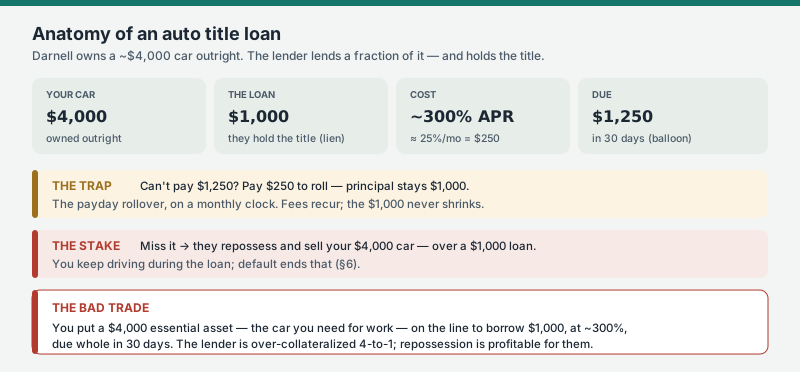
The anatomy makes the danger legible. Darnell owns a car worth about $4,000 outright, and the title lender advances him $1,000 — a fraction of its value — at roughly 25% per month, which annualizes to about 300% APR. That's $250 a month in interest, and the full $1,250 is due in 30 days as a single balloon. Note one thing already, before the trap even springs: the lender offered him $1,000 when his actual emergency — the car repair — was only $500. Title lenders routinely lend more than you need, because a bigger loan means bigger interest and the collateral easily covers it; taking the extra $500 "for a cushion" is a common, costly mistake, and the discipline is to borrow only what the emergency requires.
From there, two failures compound, and they're the bands on the right.
The trap is the payday rollover on a monthly clock. When the $1,250 comes due and Darnell — short to begin with — can't produce it, the lender offers the familiar relief: pay just the $250 interest to roll the loan another month. Principal stays $1,000; he pays $250 again next month; the $1,000 never shrinks. It's the §4 cycle exactly, only the cadence is monthly instead of biweekly, which can make it feel slower and more manageable even as the fees stack up the same way. Roll it for half a year and Darnell has paid $1,500 in interest on a $1,000 loan that's still entirely unpaid.
The stake is the part payday loans don't have: his car. Because the loan is secured by the title (the lien), defaulting doesn't just damage Darnell's credit — it lets the lender repossess and sell the car. And the math of that is grotesque: he risks a $4,000 asset to borrow $1,000. The lender is over-collateralized four-to-one, which means repossession isn't a last resort they reluctantly reach — it's profitable; they can seize a $4,000 car to settle a $1,000 debt, and in many states keep much of the surplus. The full mechanics of repossession, the surplus, and the deficiency are §6, but the seed is here: the collateral is worth far more than the loan, and the lender does fine either way.
Put together, the title loan is uniquely dangerous because it combines the worst of payday with asset loss. It has payday's ruinous rate, payday's balloon, and payday's rollover trap — and it stakes the one asset, per §1, that Darnell can least afford to lose, the car that gets him to the job that's his way out of the whole situation. A payday loan that goes bad costs him fees and his credit; a title loan that goes bad can cost him his transportation, and with it potentially his income. It sits in the worst corner of the §1 map — secured and ruinous — for exactly this reason: the rate is catastrophic and the collateral is essential. For a $500 repair, Darnell would be wagering the very thing he's trying to keep running.
What that wager actually looks like when it's lost — the repossession, the lost surplus, the possible deficiency, and the cascade of losing transportation — is the next turn. That's §6.
6. When the title loan goes bad — repossession and the cascade
Section 5 ended with Darnell holding a $1,000 title loan against his $4,000 car, due whole in 30 days. Now suppose what usually happens: he rolls it twice (another $500 in fees), then a bad month arrives and he can't produce the $1,250 or the next rollover fee. He defaults. Because the lender holds the lien (§5), default triggers a cascade that's far larger than the loan:
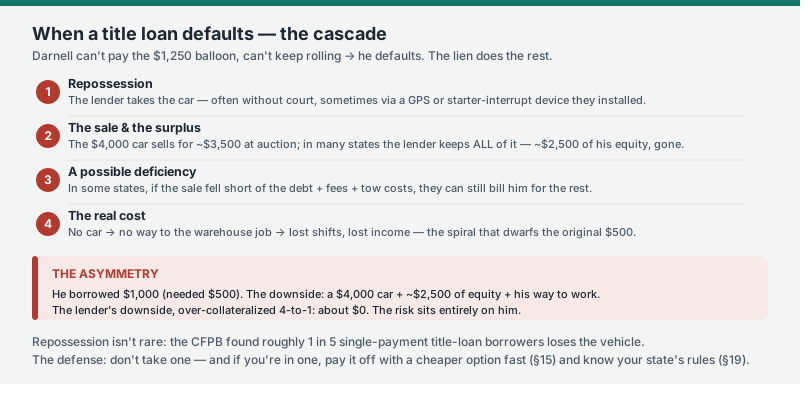
The cascade is worth walking step by step, because each stage compounds the last.
Repossession comes fast and often without a courtroom. Because the loan is secured and the lender holds the lien, most states permit self-help repossession — the lender can take the car without first suing, sometimes with little or no notice. Title lenders increasingly make this frictionless by installing a GPS tracker or a starter-interrupt device at origination, so they can locate the car or disable it remotely the moment Darnell defaults. One day the car simply won't start, or it's gone from the lot at his job. The speed is part of the design.
The sale is where Darnell's equity vanishes — and this is the part most people don't see coming. The lender sells the repossessed car, usually at auction and usually below market, say $3,500 for his $4,000 car. In a fair settlement, they'd take the $1,250 he owed and return the roughly $2,250–$2,750 surplus to him. But in many states, title lenders are allowed to keep the entire sale proceeds — they sell the $4,000 car, keep all of it, and Darnell gets nothing back. That isn't an accident of a bad deal; it's the over-collateralization from §5 cashing out. The lender lent $1,000 against a $4,000 asset specifically because, if it ever came to repossession, seizing and keeping the whole car would be enormously profitable. The 4-to-1 collateral ratio wasn't caution; it was the upside. Whether your state requires the surplus to be returned is one of the most consequential things to know before ever signing — and it's a §19 protection.
A deficiency can follow even after he's lost the car. In some states and structures, if the auction proceeds don't cover the debt plus fees plus repossession and tow costs, the loan is recourse (§1) and the lender can pursue Darnell for the shortfall — a deficiency judgment. So in the worst configuration he can lose the car and still owe money on it. (With 4-to-1 over-collateralization, the surplus-keeping harm is more common than a deficiency, but the recourse risk is real and varies by state.)
And the real cost isn't the car or the equity — it's the cascade. The car wasn't an investment Darnell could shrug off losing; it was his transportation to the warehouse job that is his entire means of recovery. Lose it, and in most of the car-dependent United States he can't get to work, which means lost shifts, then lost income, then an inability to cover rent and the other bills — a downward spiral that the original $500 emergency never remotely threatened. A payday loan gone bad costs fees and credit; a title loan gone bad can cost the very income stream he needs to climb out, which is what makes it categorically worse.
The asymmetry is the whole story, and it's the panel's red box. Darnell borrowed $1,000 (when he needed $500), and his downside is a $4,000 car, ~$2,500 of equity, and his access to work. The lender's downside, holding four-to-one collateral, is approximately zero. The risk sits entirely on the borrower; the lender is made whole — often more than whole — no matter what. That lopsidedness is not a quirk of Darnell's bad luck; it's structural to the product. And it's not rare: the CFPB found that roughly one in five single-payment title-loan borrowers ends up losing the vehicle. A trap that catches twenty percent of the people who enter it isn't an edge case — it's a core outcome.
So the defense is blunt and it's the lesson's throughline: don't take a title loan for a small or short-term need — the asymmetry can't be managed, only avoided. And if Darnell is already in one, the moves are to pay it off with a cheaper alternative as fast as possible (a credit-union PAL, help on the bill itself — §15) and to know his state's specific rules on notice, the right to cure, and surplus return (§19), because those rules sometimes give a real window to save the car. The car is almost never worth wagering on a few hundred dollars — and the better ways to handle that few hundred dollars are exactly what the back half of this lesson maps.
The next product on the landscape is the one that caps the borrower's downside where title loans don't — the pawn loan, non-recourse by design. That's §7.
7. Pawn loans — costly, but the downside is bounded
A pawn loan is the one high-cost product on the map whose worst case is known and limited, and understanding why teaches the single most useful distinction in the whole lesson. Priya brings an item of value — say an old gaming console worth about $300 — to a pawnshop. They appraise it, lend her a fraction of its resale value (commonly 25–60%), and hold the item as collateral while she has the cash. She gets, say, $120 on the spot, and a set window — often 30 days, varying by state — to repay the loan plus the fee and reclaim her console. No credit check, no income check, no bank account required: the item is the entire underwriting, which makes pawn accessible to literally anyone with something worth pawning.
The cost is real — a finance charge usually quoted monthly, commonly around 10–25% per month depending on state, which annualizes to roughly 120–300% APR — so Priya's $120 loan might cost ~$24 to reclaim the console in 30 days ($144 total). That's expensive. But the cost isn't what sets pawn apart:
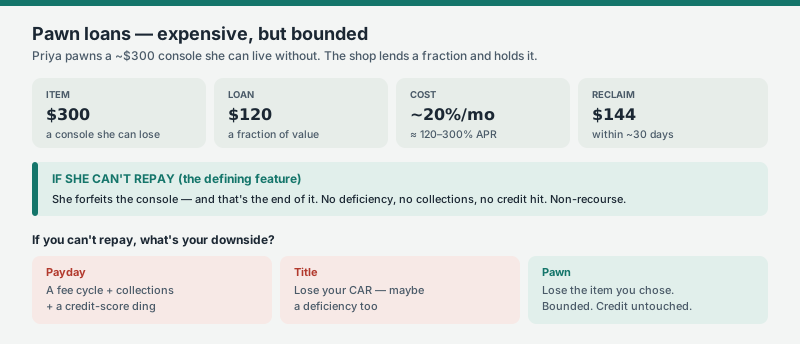
The defining feature — the teal band — is that a pawn loan is non-recourse (§1): if Priya can't repay, the pawnshop's only remedy is to keep and sell the console. That single fact changes everything about the risk. They cannot pursue her for more money (no deficiency), cannot send her to collections, and cannot report her to the credit bureaus — so her score is untouched. Her entire downside is capped at the item she walked in with. Compare that to the bottom row: a defaulted payday loan launches a fee cycle plus collections plus a credit ding; a defaulted title loan takes the car she needs and may chase her for a deficiency; a defaulted pawn loan costs her one console she'd already decided she could live without. Same "high-cost product" category, radically different worst case.
That bounded downside is also why pawn doesn't trap people the way payday and title do. Priya can extend the loan by paying just the fee — the same rollover mechanic — but she's never forced to, because she always has the clean exit of simply walking away and forfeiting the item. When that happens, the harm ends. There's no spiral, no recurring obligation chasing her, no debt that outlives the car. The choice to stop is always hers and always costs only the item. That structural off-ramp is the difference between an expensive transaction and a debt trap.
The tradeoffs follow cleanly. On the plus side: no credit check and no credit impact, a downside capped at an item Priya chose, no debt cycle if she forfeits, and accessibility to anyone with something of value. On the minus side: it's still genuinely expensive; she does lose the item if she can't repay; and the shop lends only a fraction of value, so she's risking a $300 console to borrow $120. That fraction-of-value math is worth seeing plainly — if she forfeits, she has effectively "sold" a $300 item for $120, a poor price, but a known, bounded one rather than an open-ended spiral.
Two pieces of discipline make pawn the least-bad high-cost option when one is unavoidable. First: pawn only what you can genuinely afford to lose. The whole safety of pawn depends on the item being expendable — Priya pawning an old console she rarely uses is fine; Priya pawning the tablet she needs for class, or an irreplaceable heirloom, converts a bounded loss into one she'll deeply regret. The non-recourse cap only protects you if the collateral is something you can walk away from. Second — and this is the insight most people miss: if you don't truly need the item back, selling it outright almost always nets more than pawning it and forfeiting. Selling the $300 console yourself gets close to $300; pawning it and forfeiting nets only the $120 loan. Pawn makes sense only when Priya wants to keep the option of reclaiming the item — when she values getting it back enough to pay the fee for that option. If she's resigned to losing it anyway, a straight sale is simply more money in her pocket.
So where pawn lands on the lesson's map: it's a costly product, firmly in the "use sparingly" middle band — but because the downside is bounded and her credit is untouched, it's structurally far safer than payday or title. If Priya must use a high-cost option, a pawn loan on something expendable is the kind of thing she can recover from; a title loan on her car is not. The next product, though, swings back toward the dangerous end of the map — rent-to-own, where the "purchase" can quietly cost three times the item's price. That's §8.
8. Rent-to-own — where "$25 a week" becomes triple the price
Rent-to-own (RTO) stores — the Rent-A-Centers and Aaron's of the world — let you walk out today with furniture, appliances, or electronics by making small weekly or monthly rental payments, with a path to own the item after you've made them all (typically 12–24 months). The word "rental" is doing enormous work there, and it's the key to the whole product: until the very last payment, you don't own the item — you're renting it. Darnell, whose refrigerator just died and who can't put $600 on a card he doesn't have, is exactly who this is built for: there's no credit check, just an ID, proof of income, and a couple of references, and he takes a fridge home the same afternoon. The low bar and the instant gratification are the appeal — and, by now the familiar pattern, the warning.
The damage hides inside the friendly weekly number:
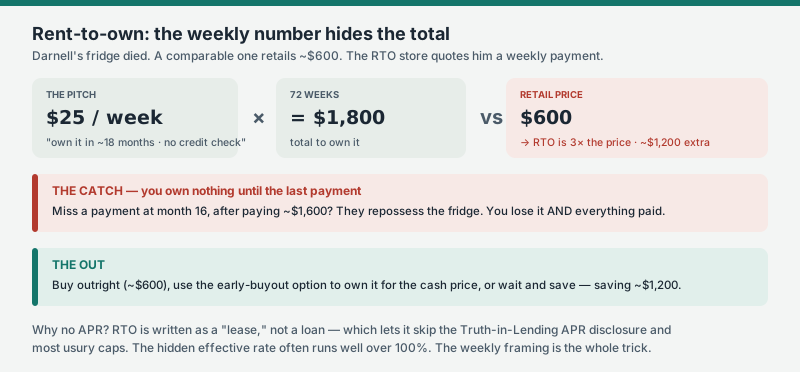
The arithmetic is the whole story, and it's arithmetic the store never does for you. "$25 a week" sounds trivial — less than a couple of takeout meals — and that's precisely why it works. Nobody multiplies $25 × 72 weeks in their head, so nobody sees the $1,800 total sitting at the end of it. This is the same "per-payment myopia" the course flagged with BNPL and with the low-monthly-payment trap (Lessons 2 and 6), but RTO weaponizes it hardest: the recurring number is small, the term is long and quoted in months while you pay weekly, and the total is never put in front of you. Set the $1,800 next to the fridge's real retail price of ~$600 and the markup is naked — Darnell pays three times the price, roughly $1,200 extra, for the convenience of "no credit check, take it today."
The reason there's no APR on the page — no rate to compare, nothing that looks like the 200%+ it effectively is — is a deliberate piece of legal structuring. RTO contracts are written as leases, not loans or credit sales. That single framing lets the product skip the Truth-in-Lending APR disclosure (which applies to credit, not rentals) and dodge most state usury caps (which cap interest, and a "rental" charges no "interest"). It's the same regulatory sidestep the course keeps surfacing — the title loan exempt from payday caps, BNPL outside Reg Z — just executed through a different doorway.
Some states do require RTO-specific disclosures of the total-of-payments and a cash price, which is worth looking for, but in most cases the effective rate stays hidden behind the word "lease," and it routinely runs well over 100%. The lesson's durable tell: when a product quotes you a per-week price and no total and no rate, that absence is not an oversight — it's the sell.
The "you're renting" structure also creates the cruelest failure mode: you own nothing until the final payment, so a late stumble erases everything. Because the fridge legally belongs to the store the entire time, missing a payment doesn't trigger a late fee on something you partly own — it triggers repossession of something you don't own at all. Imagine Darnell pays faithfully for sixteen months — roughly $1,600 — then hits one bad month at the finish line. The store takes the fridge back, and he gets nothing: not the appliance, not a cent of the $1,600, because he was never building equity, he was renting. A regular installment purchase builds ownership as you pay; an RTO contract builds none until the last dollar, which puts the maximum amount at risk at the worst possible moment.
What makes all of this avoidable is that there are real outs, and most RTO customers never use them. Almost every contract includes an early-buyout (early-purchase) option: pay the item's cash price — or a discounted early-payoff amount — at any point and own it outright, skipping the remaining rental payments and most of the markup. If Darnell ends up keeping the fridge, exercising that option early saves him a large chunk of the $1,200. Better still, if he can wait at all: the same fridge bought outright elsewhere is ~$600, a secondhand one less, and even putting it on a regular card at 25% and paying it off over a few months would cost a fraction of the RTO markup. The honest part is that the appeal is real — Darnell needs a working fridge now, has no credit, and can't produce $600 today — which is exactly the bind RTO is designed to exploit. But "I need it now and have no credit" is the setup for the §15 alternatives (a PAL, help from 211, a secondhand purchase, a hardship-priced option), not a reason the only answer is paying triple.
On the lesson's map, rent-to-own sits back up in the trap band with payday and title — not because it can take your car, but because the markup is enormous, the cost is hidden by design, and a late miss can cost you everything you've paid. The next product moves to the newest corner of the landscape, where the high cost wears a friendly, app-shaped face: cash-advance apps and earned-wage access. That's §9.
9. Cash-advance apps and earned-wage access — payday in a friendlier wrapper
Cash-advance apps advance you a small amount of money before payday and debit it back automatically when your paycheck lands — which, structurally, is a payday loan with a nicer interface. They come in two flavors worth separating. Employer-integrated earned-wage access (EWA) — DailyPay, Payactiv, and similar, offered through your employer's payroll — advances wages you've actually already earned this pay period. Direct-to-consumer apps — Earnin, Dave, Brigit, MoneyLion — aren't tied to your employer; you connect your bank account and they advance $20–$500 based on your income and deposits, repaid by auto-debit on payday. Priya, short on cash a few days before payday, opens one of the direct apps and pulls $100. The pitch is the hook: "0% interest, no mandatory fees." The cost is real anyway — it just comes through side doors:
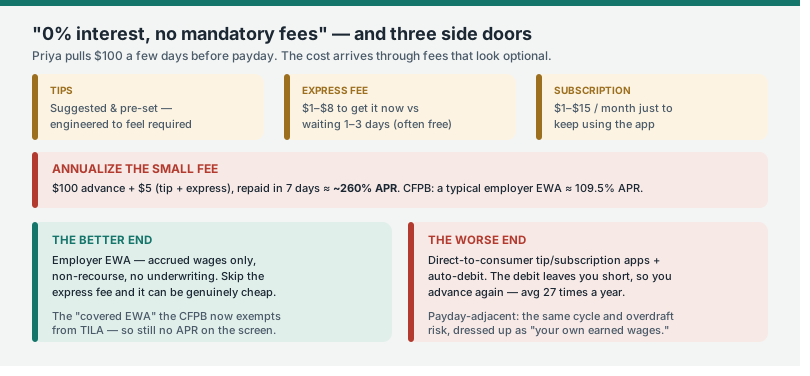
The "no fees" claim survives only because the fees are routed through three doors that each look optional. The tip is the cleverest: apps suggest an amount and often pre-select it, and consumer advocates have documented the design tricks used to make tipping feel obligatory — a sad-face if you tip $0, language about "supporting" the service, defaults you have to actively lower. The express fee charges $1–$8 to get the money instantly instead of waiting one to three days (the free option, which someone in a pinch rarely chooses). And many apps layer a monthly subscription of $1–$15 just to keep access. None of these is "interest," and that's the point — but annualize them and they're payday-priced. Priya's $100 advance with $5 in tip-plus-express, repaid in seven days, works out to roughly 260% APR. The CFPB's own research found the typical employer-partnered EWA advance runs about 109.5% APR — and the direct-to-consumer apps, with tips and subscriptions stacked on, run higher. The friendly framing doesn't lower the cost; it just hides it from the one comparison — the APR — that would make it obvious.
And the cycle is the same as payday's. The auto-debit pulls the advance back on payday, which leaves Priya short again, so she takes another advance — the CFPB found users average 27 advances a year, which is not occasional bridging but a standing dependency. Each debit also risks overdrafting her account if the timing is off, stacking a ~$35 bank fee on top. The product solves this week's shortfall by guaranteeing next week's, which is exactly the payday dynamic in a cleaner app.
Now the live regulatory question, because it directly shapes Priya's protections and it has been a genuine whipsaw. The fight is over one thing: are these advances "credit"? If they are, federal Truth-in-Lending rules apply and the cost must be disclosed as an APR; if they aren't, they escape that disclosure (and potentially state rate caps). The CFPB has now changed its answer three times. In 2020 it said certain free, employer-based programs weren't credit; in July 2024 it proposed the opposite — that many EWA products, including direct-to-consumer ones, are credit, with tips and expedited fees counting as finance charges; and then on December 23, 2025, the CFPB rescinded that proposal and issued a new advisory opinion declaring that "Covered EWA" products are not credit under TILA, and that voluntary tips and expedited-delivery fees are not finance charges. "Covered EWA" is defined narrowly — it must be employer-partnered, limited to wages already earned, non-recourse (no pursuit of the worker if the paycheck falls short), and involve no credit-risk assessment. Consumer advocates strongly dispute the move: the National Consumer Law Center argues these are simply "earned wage payday loans" that are loans, and warns the opinion will be used to pry open loopholes in state interest-rate laws. Two practical takeaways for Priya follow from this. First, for "covered" employer EWA, there's currently no federal APR disclosure — the cost won't be shown as a rate even though it's real. Second, the narrow carve-out leaves many direct-to-consumer apps still contested and litigated, and the meaningful protections are increasingly state-level, where a patchwork is forming fast — Missouri became the second state to enact an EWA-specific law, with bills pending in New York, Texas, and Georgia, covering licensing, fee caps, and non-recourse requirements. As with payday and title, where Priya lives increasingly determines what protection she has.
So the honest assessment splits the product in two, which is the panel's bottom row. At the better end, genuine employer EWA — accrued wages, non-recourse, and with the express fee skipped — can be a legitimately cheaper bridge than a payday loan, and the non-recourse structure means it can't chase her beyond the paycheck deduction. At the worse end, direct-to-consumer tip-and-subscription apps with auto-debit are payday-adjacent: triple-digit effective cost, the reborrowing cycle, and overdraft risk, all wearing the language of "your own money." The practical guidance for Priya is concrete: skip the tip and the express fee (wait the one to three days — that's usually free and cuts the cost dramatically), prefer an employer-offered EWA over a standalone app when she has the choice, watch the auto-debit timing so it doesn't overdraft her, and — most important — don't let it become a standing crutch for a paycheck that's chronically short, because that's the cycle, not a fix. The simplest defense is the one this whole stretch of the lesson keeps teaching: annualize the small fee. "$5 on $100 for a week" doesn't feel like 260%, but it is, and saying so out loud is what turns a friendly app back into the expensive loan it is.
The next product is the one many people reach for without thinking of it as emergency credit at all — the credit card cash advance and bank overdraft. That's §10.
10. Card cash advance and overdraft — the emergency credit already in your wallet
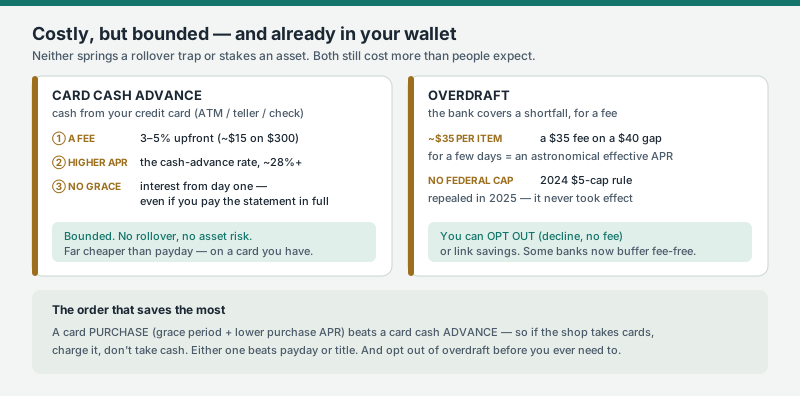
The last two products on the map are the ones people reach for without thinking of them as borrowing at all, because they're already attached to accounts you have. Both are genuinely expensive — but, crucially, both are bounded: no rollover-forever trap, no asset on the line, no collections beyond ordinary account debt. Knowing their real cost is what lets you use them deliberately instead of by accident.
Take the card cash advance first. It's using your credit card to get actual cash — at an ATM, a bank teller, or a "convenience check" the issuer mails you — and a handful of other transactions (crypto buys, gambling, wire transfers, sometimes peer-to-peer sends) get treated as cash advances too. It's pricier than a normal purchase in three distinct ways, which Lesson 5 introduced and are worth re-stating because people routinely meet only the first one. There's an upfront fee of 3–5% (so ~$15 on a $300 advance); the cash-advance APR is higher than your purchase APR, commonly ~28% or more; and — the one that surprises people — there's no grace period, so interest starts accruing the day you take the advance, even if you faithfully pay your statement in full every month. On a regular purchase, paying by the due date means you owe zero interest; on a cash advance, that escape hatch doesn't exist. Still, add it up — ~$15 plus roughly $7 of interest to carry $300 for a month, about $22 — and it's expensive but bounded: no rollover spiral, no car at risk, just ordinary card debt you can pay down at your own pace. Against a payday loan's ~$45 fee for two weeks, the card cash advance is dramatically cheaper.
That comparison sets up the single most useful move in this section, the gray band at the bottom: a card purchase beats a card cash advance. If Maya's mechanic takes cards, she should simply charge the $500 repair — that's a purchase, which keeps the grace period and the lower purchase APR, costing nothing if she clears it by the due date. The cash advance — with its fee, higher rate, and no grace — is only for when she genuinely needs cash in hand (a cash-only shop). Reaching for a cash advance when a purchase would do is a common, needless cost. And this is exactly where the lesson's cruel inversion shows itself again at the individual level: Maya has a card with room, so the bounded, cheap option is available to her; Darnell's card is near its limit (Lesson 5), so that option is closed to him — which is precisely what pushes him toward the payday and title loans at the top of the map. Same $500 emergency, opposite set of doors, decided by who had slack in the account.
Overdraft is the other one people use without naming it as borrowing. When Priya spends more than her checking balance, the bank can cover the transaction and charge an overdraft fee — historically about $35 per item. Think about what that is: a $35 charge to float, say, a $40 shortfall for the few days until her next deposit. Annualized, that's an effective APR in the thousands of percent — overdraft is, by APR, one of the most expensive forms of credit in existence, precisely because the fee is fixed and the amount and term are tiny. Worse, the fees can cascade: several small transactions in a day can each trigger a separate $35 fee, turning a brief shortfall into $100+ in charges.
The good news is that overdraft is the most avoidable product on the map, through a setting most people don't know exists. Under federal rules, Priya can opt out of overdraft coverage for one-time debit-card and ATM transactions — and if she opts out, an over-limit transaction is simply declined (no purchase, no fee) instead of covered-with-a-fee. She can also link a savings account so a shortfall pulls from her own savings for a small transfer fee instead of a $35 charge. The single best time to set both up is before an emergency, not during one. The broader landscape is genuinely in flux and worth a glance at your own bank: a 2024 CFPB rule that would have capped big banks' overdraft fees at about $5 was repealed by Congress and signed into law in May 2025 before it ever took effect, so there's currently no federal cap — but many banks, under earlier pressure, have voluntarily cut or eliminated overdraft fees or added fee-free buffers and grace periods, even as some began raising them again in 2026 and banks still collected over $12 billion in overdraft and related fees in 2025. The fee on Priya's specific account could be $0, $20, or $35 depending entirely on her bank — so the move is to check hers and opt out by default.
The throughline for both: these are real credit, used casually, and their costs are larger than they look — but they're bounded in a way the top-of-map products aren't, and a couple of small choices (charge a purchase instead of taking cash; opt out of overdraft) cut the cost sharply. With the full landscape now mapped product by product, the lesson turns to the documents — starting with the one that puts a payday loan's true price in federally-mandated black and white. That's §11, the first Document Walkthrough.
11. Document Walkthrough: A payday loan agreement
Where & what + mode. When Darnell takes the $400 payday loan, the storefront (or the online portal) hands him a single contract titled something like "Loan Agreement & Truth-in-Lending Disclosure" — signed on paper at the counter, or clicked through online. It's short, usually one or two pages, and people sign it in under a minute. That speed is exactly why it's worth slowing down on: nearly everything that makes a payday loan dangerous is disclosed right here, in plain federal-mandated print, including the ~400% APR. The fragment test matters for this one — the famous TILA box is only one section of the agreement; the authorization that hands over his bank account, the rollover terms, the cancel right, and the default terms are all elsewhere on the same page. Here is the whole thing:
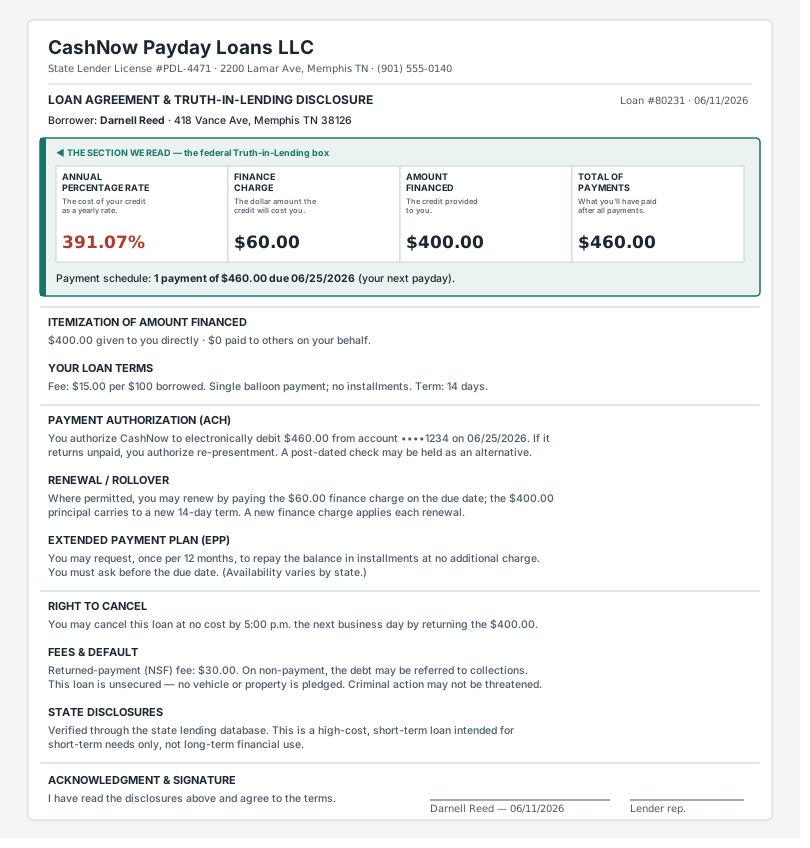
This is the whole document Darnell signs — not just the box everyone photographs. Read top to bottom, it has a masthead (the licensed lender, its license number, address), the borrower line, the federal Truth-in-Lending box (tinted — the section we'll read most closely), the itemization of where the $400 went, the loan terms, the ACH payment authorization that hands over his bank account, the renewal/rollover language that quietly enables the §4 trap, the Extended Payment Plan notice that is his hidden exit, the right to cancel, the fees and default terms, the state disclosures, and the signature block. Seeing it intact matters because the danger isn't concentrated in the APR alone — it's distributed across sections most people never read, and the breakdown will give every one of them the full treatment.
Two things are worth noticing even before that field-by-field walk. First, the document is almost disarmingly honest: the 391.07% APR isn't buried or disguised — federal law (the Truth in Lending Act) forces it onto the page in a standardized box, in the same format as a mortgage or car loan, precisely so it can be compared. The payday lender isn't hiding the rate; it's relying on Darnell not knowing what 391% means or not reading the box at all. The disclosure regime did its job; the gap is comprehension, which is exactly what §12 closes. Second, three sections that look like fine print — the ACH authorization, the renewal terms, and the EPP notice — are actually the three most consequential things in the contract after the APR: one hands the lender first claim on his paycheck, one is the on-ramp to the rollover trap, and one is the escape hatch he's not supposed to notice. A payday agreement rewards careful reading more than almost any document in this course.
Next turn takes the document apart in its own reading order — every field with what it is, what it does for Darnell specifically, and why it matters — starting with the four cells of that federal box and what the 391.07% actually buys. That's §12.
12. Reading the payday agreement — field by field
The cost disclosure. The masthead names the lender and its state lending license — "CashNow Payday Loans LLC, State Lender License #PDL-4471." That license number is what signals Darnell is dealing with a lender operating under his state's rules, which is what makes the rate cap, the database check, and the cancel and EPP rights below actually apply to his loan. It matters more than its small print suggests: the most dangerous versions of this product — the online "tribal" and "rent-a-bank" lenders of §2 — operate without a state license precisely to escape these protections, so a real, lookup-able license number is the first reassurance that he's inside the regulated system, and its absence is a reason to walk out. The borrower line — "Darnell Reed, 418 Vance Ave" — identifies who is legally on the hook and ties the debt, and the bank authorization further down, to him personally. Small as it is, it's where an unsecured loan becomes his: because nothing is pledged as collateral, the lender's recourse on default runs against Darnell himself — his credit, collections — not against any asset.
Then come the four cells of the federal Truth-in-Lending box, the tinted heart of the document. The Annual Percentage Rate, 391.07%, is the cost of the credit as a yearly rate — the one figure engineered so he can compare this loan to any other on equal footing, translating the friendly "$15 per $100" into the comparable unit (a card is ~25%, a PAL ~28%, this is 391%). Federal law forces it onto the page so Darnell can't be told the fee is "only 15%" without the truth sitting beside it; the common error is to read this cell as the fee rate, when it is the annualized rate, and the distance between 15% and 391% is the whole product. The Finance Charge, $60.00, is the total dollar cost of borrowing — the fee in real money — and it matters precisely because it is the number that feels small and reasonable ("just sixty bucks"), which is the impression the APR cell exists to puncture: $60 for two weeks is cheap-sounding and 391%-expensive at once. It is the cost, not the total he owes, which sits two cells over. The Amount Financed, $400.00, is the credit actually provided — the cash in hand — and confirms he receives the full $400 with nothing skimmed off the top; on a payday loan it equals what he asked for, but the habit of checking this field is what protects him elsewhere, because a personal loan often deducts an origination fee so its Amount Financed is less than the sticker amount. The Total of Payments, $460.00, is what Darnell will have paid once every payment is made — principal plus finance charge — and it is the number that should anchor his decision; the danger is not its size ($460 is small) but its timing, since the schedule beside it shows the entire $460 due in one shot. A small Total of Payments is not safety here — it is the balloon of §3, the whole sum at once.
The payment schedule — "1 payment of $460.00 due 06/25/2026" — states when and how he repays: one lump on his next payday, making the balloon explicit. It is the single most consequential line for whether the loan becomes a trap, because the one-payment structure is the thing Darnell usually cannot meet, which feeds the renewal terms below; the disclosure box doesn't just state the cost, it quietly states the trap's trigger. The itemization of amount financed — "$400 given to you directly, $0 to others" — breaks down where the money went and confirms all $400 reached Darnell with nothing diverted into add-ons; it is clean here, but it is the exact field that catches packing on larger loans, since a quietly financed "loan-protection" product would surface here, inflating what he owes. An itemization that is entirely "to you" is the honest baseline to expect. Finally, the loan terms restate the pricing in plain words — "$15 per $100, single balloon payment, 14-day term" — the everyday-language version of the box and the place to confirm the term, because, as §3's slider showed, a shorter term makes the same fee annualize to a higher APR; a 14-day term on a $60 fee is precisely what produces the 391.07% above. Read together, the cost half tells one coherent story: a $400 loan that costs $60, repays $460, comes due whole in fourteen days, and prices out at 391% a year — all disclosed, none hidden, waiting only to be understood.
The mechanics and the rights. The payment authorization (ACH) is Darnell's signed permission for the lender to debit the full $460 from his checking account on payday, electronically, with the right to re-present — retry — if it bounces. What it does is hand the lender first claim on his paycheck: on the 25th, CashNow's $460 leaves before he has decided how to cover rent or groceries. It matters two ways — it is the mechanism behind the overdraft risk of §10, since each retry can trigger a ~$35 bank fee, and it is the structural reason the rollover feels like the only exit, because with the lender positioned to drain the account, "pay just the $60 fee to renew" looks easier than letting the debit fail. People read this as a routine payment method; it is the lever — direct, prioritized access to the account — and there is a real off-switch, since Darnell can revoke the ACH authorization and stop payment at his bank (§19). The renewal/rollover clause is the contractual on-ramp to the §4 trap: instead of repaying the $460, he can pay only the $60 fee and push the loan out another two weeks, principal untouched. It does exactly what the rollover simulator showed — convert a one-time $60 cost into a recurring one while the $400 never shrinks — and it matters because this is where the product's real business model lives in writing: the lender earns far more from five renewals ($300 in fees, still owing $400) than from one clean repayment. "Renew" sounds like relief and reads as a feature, but it is the mechanism that keeps the principal alive indefinitely; the qualifier "where permitted" matters too, since rollovers are banned or capped in many states (§2), where the lender achieves the same loop through back-to-back reborrowing instead.
The Extended Payment Plan (EPP) is Darnell's right — required in many states — to convert the lump-sum balloon into a no-extra-cost installment plan, breaking the $460 into manageable payments. It is the single clean escape from the trap that doesn't require finding $460 at once or borrowing elsewhere, and it matters enormously because lenders rarely volunteer it: an EPP earns them nothing, so the incentive is to steer him toward another $60 renewal. The catch is timing — he must ask before the due date — so the knowledge is only useful if he has it before the crisis; it is easy to skim as boilerplate, yet it is arguably the most valuable sentence in the contract for a borrower who is stuck. The right to cancel gives a short cooling-off window: if Darnell changes his mind, he can return the $400 by the next business day and owe nothing — no fee, no interest, as if the loan never happened. It converts a rushed, pressured storefront decision into a reversible one, so if he gets home, runs the §15 numbers, and realizes a PAL or a payment plan on the actual repair bill costs a fraction, he can walk the $400 right back; most borrowers never learn it exists, and it is the cheapest out in the document, but only for the first day.
The fees and default terms state the consequences and two important boundaries — "Returned-payment (NSF) fee $30.00; on non-payment the debt may be referred to collections; this loan is unsecured; criminal action may not be threatened." They tell Darnell the real downside of this product — a $30 charge if the ACH bounces, and on genuine default, collections and credit damage — but they also state two protections explicitly. The loan is unsecured, so unlike the title loan of §5–6 no car or property is on the line; his downside, while real, is bounded to the debt and his credit, not an essential asset. And the lender may not threaten criminal action, a real legal limit, because some payday collectors have illegally implied that a bounced repayment is "check fraud" to frighten borrowers into paying. It lets him weigh the true worst case honestly — bad but recoverable — and arms him against the most common illegal scare tactic. The state disclosures place the loan in context — "verified through the state lending database; this is a high-cost, short-term loan intended for short-term needs only, not long-term financial use." The database check is what enforces limits like one-loan-at-a-time and rollover caps, and the warning is, in effect, the regulator speaking through the contract: the "short-term needs only" line is the official acknowledgment that using this product repeatedly — the §4 trap — is a misuse the law itself flags.
The acknowledgment and signature bind Darnell to everything above and legally affirm he read and understood the disclosures. The quiet point the whole walkthrough builds toward is here: signing certifies comprehension, but the disclosures only protect him if he used them. Everything that makes the loan survivable rather than ruinous — that the APR is 391%, that the EPP exists, that he can cancel tomorrow, that he can stop the ACH, that nothing is secured — is on this page, above his name. The signature is where disclosure either became understanding or became a formality. Read whole, the agreement splits into a cost half that tells Darnell exactly what the loan costs and a mechanics-and-rights half that determines whether it becomes a trap or stays a one-time stopgap; the trap-builders (the ACH authorization and the renewal clause) and the escape hatches (the EPP and the cancel right) sit in the same fine print, undifferentiated by typeface, separated only by whether he knows which is which. That is the entire skill this walkthrough teaches: the protection was never missing; it was unread.
The next document is the one that adds the danger payday loans don't have — a car on the line. That's §13, the auto title loan agreement specimen.
13. Document Walkthrough: An auto title loan agreement
Where & what + mode. When Darnell takes the $1,000 title loan, the title lender hands him a contract usually titled "Motor Vehicle Title Loan Agreement & Truth-in-Lending Disclosure" — signed on paper at the counter, where he also surrenders the physical title and, increasingly, lets them install a GPS or starter-interrupt device. Like the payday agreement it carries a federal TILA box, so it looks familiar — but it has whole sections the payday document doesn't: the security agreement that pledges his car, the repossession terms, the device disclosure, and the surplus language. Those are the focus here, because they're where the car is put on the line. Here is the whole thing:
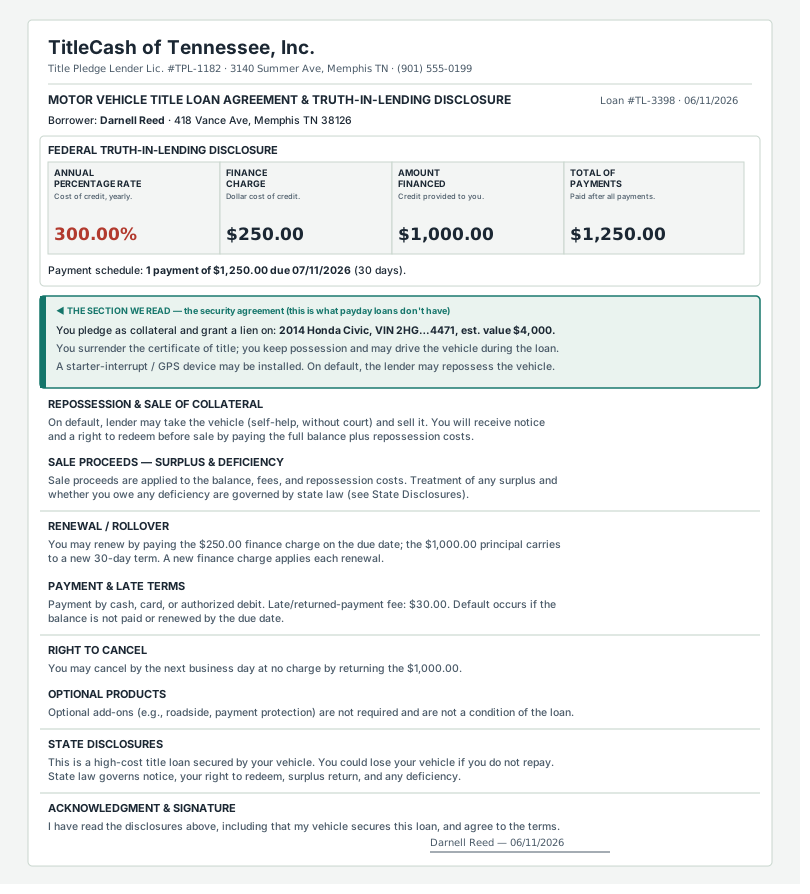
This is the whole title agreement, and the comparison to the payday document is the lesson. Read top to bottom it shares the familiar skeleton — masthead (a licensed title pledge lender), borrower line, federal TILA box, renewal terms, payment and late terms, right to cancel, state disclosures, signature — but it adds four sections the payday agreement simply doesn't have, and they're where the danger lives: the tinted security agreement that pledges his car and grants a lien, the repossession & sale terms, the surplus & deficiency language, and the device disclosure tucked into the security section. There's also an optional-products line worth noting — the place where add-on "payment protection" packing would appear if the lender tried it (it's marked not-required here, which is what the law requires it to say).
Two things stand out even before the field-by-field walk. First, the TILA box again does its honest job: the 300.00% APR is right there in the same federal format as the payday loan's 391%, so Darnell can see this is a triple-digit-rate loan — but notice the box looks gentler than the payday one. The Total of Payments is $1,250 against $1,000 borrowed; the finance charge is "only" 25% of principal; the APR, while horrifying, is lower than payday's. Nothing in the TILA box signals that this loan is far more dangerous than the payday one — because the thing that makes it worse isn't the price, it's the security agreement, which the federal cost box doesn't capture at all. That's the trap of reading only the box: it discloses the cost perfectly and the risk to his car not at all.
Second, the most consequential sentences are the ones whose meaning is pushed off the page to "state law" — the surplus and deficiency treatment. Whether Darnell gets his ~$2,750 of equity back after a repossession sale, or the lender keeps all of it (§6), isn't decided in this contract; it's decided by his state's title-lending statute, which the document merely points to. So the single most financially important question — what happens to the value of his car beyond the debt — is answered elsewhere, which is exactly why §21's protections section matters and why "know your state's rules" keeps recurring. The breakdown takes every field apart in reading order, with the security, repossession, and surplus sections at the center. That's §14.
14. Reading the title agreement — field by field
Masthead — "TitleCash of Tennessee, Inc. · Title Pledge Lender Lic. #TPL-1182." The licensed lender and its license — but note the license type: a title pledge license, not a payday one. What it does for Darnell is place his loan under the state's title-lending statute, which is a separate body of law from payday lending. Why it matters is the §2 point made concrete: title loans are frequently regulated under their own rules and are often exempt from the payday rate caps that would otherwise apply — which is exactly how a 300% loan can be legal in a state that limits payday loans. ↳ A title-pledge license isn't a "safer" license — it's a different door, and the protections behind it (especially on surplus and repossession) are often weaker than payday's.
Borrower line — "Darnell Reed · 418 Vance Ave." Who is legally on the hook. What it does here is more than identify him — it's the first half of a sentence the security section completes: on the payday loan, only Darnell's credit stood behind the debt; on this one, Darnell and his car do. Why it matters is that this is where a secured loan attaches the obligation not just to a person but to a specific, essential asset he owns.
The federal TILA box — APR 300% · Finance Charge $250 · Amount Financed $1,000 · Total of Payments $1,250. These four cells mean exactly what they did on the payday agreement (the full mechanics are in §12), so here the job is the title-specific reading of each. The APR (300%) is the yearly cost — triple-digit and ruinous, but, tellingly, lower than payday's 391%. The Finance Charge ($250) is the dollar cost, a comparatively modest-looking 25% of principal. The Amount Financed ($1,000) is the cash Darnell receives — and the box quietly exposes the §5 over-lending nudge, because it's double the $500 his repair actually needed. The Total of Payments ($1,250) is what he'll repay. What this box does is give him a federally-comparable cost figure; why it matters is the single most important insight of this whole walkthrough: the box looks gentler than the payday one — lower APR, smaller finance-charge ratio — yet the loan is far more dangerous, because the TILA box discloses cost and says nothing about the car. Reading only the box, Darnell would rank this loan safer than payday; the security section below is what inverts that ranking. ↳ A lower APR than payday is not lower danger here — the risk that matters isn't priced into this box at all. And the $1,000 Amount Financed against a $500 need is the over-lend, visible in print: borrow only what the emergency requires.
Payment schedule — "1 payment of $1,250.00 due 07/11/2026 (30 days)." When and how he repays: one lump, 30 days out. What it does is make the balloon explicit, on a monthly clock rather than payday's biweekly one. Why it matters is that it's the same balloon-you-can't-meet dynamic from §3–4 — but on a secured loan, missing this single payment doesn't just trigger a rollover, it triggers the repossession path in §14b. ↳ The monthly term makes the APR look milder than payday's, but it's the identical "whole sum at once" structure — now with the car as the consequence of missing it.
Security Agreement (the focus) — "You pledge as collateral and grant a lien on: 2014 Honda Civic, VIN…, est. value $4,000. You surrender the certificate of title; you keep possession and may drive the vehicle during the loan. A starter-interrupt / GPS device may be installed. On default, the lender may repossess." This is the section that doesn't exist on a payday agreement, and it's the entire reason this loan is more dangerous — so it's worth taking apart clause by clause. The pledge and lien: Darnell grants the lender a legal claim (lien) on his car, pledging it as collateral. This is what does the work of converting the loan from unsecured (payday) to secured by an essential asset (§1) — and the lender's stated "est. value $4,000" against the $1,000 loan is the 4-to-1 over-collateralization from §5, written right into the contract. Why it matters: this one clause is what drops the loan into the §1 "worst corner," and the value ratio reveals that repossession would be profitable for the lender, not a last resort. The title surrender: he hands over the physical certificate of title. What it does is give the lender the document needed to transfer and sell the car on default; why it matters is that it's the operational key to repossession — the lender holds the title the entire time, so the legal machinery to take the car is already in their hands before anything goes wrong. Keep possession and drive: Darnell keeps and drives the car during the loan. This is the clause that does the psychological work — it makes the loan feel low-stakes ("I still have my car, nothing's changed"). Why it matters is precisely that the feeling is false comfort: possession during the loan is not ownership-security, and the same sentence that lets him keep driving is the one that lets the lender take the car the moment he defaults. ↳ The "you keep driving" reassurance is the hook — it disguises that he's already signed the car away on default. The device: "A starter-interrupt / GPS device may be installed." What it does is let the lender locate and remotely disable the car (§6). Why it matters — and why it's flagged — is that this consequential consent is buried mid-paragraph in the security section, so most borrowers never register that they've authorized a remote kill-switch on their own vehicle; on default, the car simply won't start. ↳ Easy to skim as a technicality; it's what makes repossession frictionless and instant. Repossess on default: on default, the lender may take the car. This clause states the consequence and matters because it's where the §6 cascade begins — combined with the surrendered title and the installed device, it makes losing the car fast and near-certain once Darnell misses the balloon.
The cost box told Darnell this loan is expensive; the security agreement is what tells him it's dangerous — and only one of those is the federally-mandated headline. The next fields finish the document: what actually happens when he defaults (repossession and sale), the all-important surplus-and-deficiency question that decides whether he loses his equity, and the rights — renewal, cancel — that remain.
Repossession & Sale of Collateral — "On default, lender may take the vehicle (self-help, without court) and sell it. You will receive notice and a right to redeem before sale by paying the full balance plus repossession costs." This is the §6 cascade in contract form. What it does is authorize the lender, the moment Darnell defaults, to take the car without going to court ("self-help" repossession) and sell it — and it grants him two procedural protections in return: advance notice of the sale, and a right to redeem (recover the car before it's sold) by paying the entire balance plus the lender's repossession costs. Why it matters cuts both ways. The notice-and-redeem rights are real and worth knowing — they're a genuine window to save the car — but the redemption price is the full balance plus costs, the same lump Darnell already couldn't produce, now larger (tow and storage fees added). So the "right to redeem" is meaningful only if he can suddenly find more money than he owed in the first place, which is why the practical defense (§15) is to pay the loan off with a cheaper source before it ever reaches this clause. ↳ "Self-help, without court" surprises people — there's no judge, no hearing; the device and surrendered title from §14a make it near-instant. "Right to redeem" sounds protective but is priced at more than the balloon he already couldn't meet.
Sale Proceeds — Surplus & Deficiency — "Sale proceeds are applied to the balance, fees, and repossession costs. Treatment of any surplus and whether you owe any deficiency are governed by state law." This is, financially, the single most important sentence in the document — and notice what it does: it answers the most consequential question by deferring it, pointing Darnell to "state law" rather than stating his outcome. The two scenarios behind it are the §6 stakes. The surplus is the money left over when the car sells for more than he owes — his ~$2,750 of equity on a $4,000 car against a $1,250 debt; whether he gets that back, or the lender keeps all of it, depends entirely on his state. The deficiency is the reverse — if the sale undershoots the debt plus fees, whether the lender can still bill Darnell for the shortfall (the recourse question from §1). Why it matters so much is that these two state-law answers are the difference between losing $1,250 of value and losing $4,000 of value (plus possibly owing more) — and the contract resolves neither, which is precisely why §21's protections section, and the discipline of knowing your state's title rules before signing, are not optional. ↳ The most important number in the deal — what happens to your equity — is the one this contract refuses to state. That deferral is the tell: read your state's title statute before you sign, not after repossession.
Renewal / Rollover — "you may renew by paying the $250.00 finance charge… the $1,000.00 principal carries to a new 30-day term. A new finance charge applies each renewal." The on-ramp to the §5 monthly rollover trap. What it does is identical to the payday renewal clause (§12) — pay only the fee, push the loan out, principal frozen — just on a 30-day cycle. Why it matters in the title context is the compounding danger: each renewal is another $250 and another month with the car still on the line, so the rollover trap and the repossession risk run simultaneously. Roll it six times and Darnell has paid $1,500 in fees, still owes $1,000, and has had his car one missed payment from seizure the entire time. ↳ Same "renew" wording as payday, but here the recurring fee buys continued exposure of the car, not just continued debt.
Payment & Late Terms — "Payment by cash, card, or authorized debit. Late/returned-payment fee: $30.00. Default occurs if the balance is not paid or renewed by the due date." The mechanics of paying and the definition of default. What it does is pin down the exact trigger — default = balance not paid or renewed by the due date — which is the precise line that activates the repossession clause above. Why it matters is that it shows how thin the margin is: one missed 30-day deadline, with no payment and no renewal, is the whole distance between "current" and "they can take the car." There's no grace period named, no cure window beyond the renewal option itself. ↳ Knowing the exact default trigger is what lets Darnell act before it — the day before the due date, the EPP-style payoff or a cheaper refinance is still possible; the day after, the repossession clock starts.
Right to Cancel — "you may cancel by the next business day at no charge by returning the $1,000.00." The same next-day cooling-off window as the payday loan. What it does is give Darnell a penalty-free undo for about 24 hours. Why it matters even more here than on the payday loan: this is his clean chance to un-pledge the car — if he gets home, reads §15's cheaper options, and realizes a credit-union PAL or a payment plan on the repair itself would cost a fraction and keep his title free, he can return the $1,000 the next business day and walk away with his car never having been at risk. ↳ The cheapest exit in the document, and the one that fully removes the car from the equation — but only on day one.
Optional Products — "Optional add-ons (e.g., roadside, payment protection) are not required and are not a condition of the loan." The disclosure governing any extras. What it does is state, as the law requires, that add-on products are voluntary and not a condition of approval. Why it matters is that this is the exact spot where loan packing would appear (the legacy-L7 predator pattern): a lender padding the loan with overpriced "payment protection" or roadside coverage, financed at interest, inflating what Darnell owes. The clause is protective if read — "not required" means he can and should decline every add-on — but packing works by enrolling borrowers who never read it or who are told the extras are mandatory. ↳ "Not required" is your script: decline all of it. If a clerk implies an add-on is necessary to get the loan, that's the packing tactic, and it's not true.
State Disclosures — "This is a high-cost title loan secured by your vehicle. You could lose your vehicle if you do not repay. State law governs notice, your right to redeem, surplus return, and any deficiency." The state-mandated plain warning. What it does is say, in the lender's own document, the blunt truth this section has been building — you could lose your vehicle — and re-route the four most important outcomes (notice, redemption, surplus, deficiency) to state law. Why it matters is that it's the regulator speaking through the contract to contradict the "you keep driving" comfort from §14a: the warning exists precisely because borrowers underestimate the car risk, and it names the four state-law questions Darnell must answer for his own state before this is a decision he can make safely.
Acknowledgment & Signature — "I have read the disclosures above, including that my vehicle secures this loan, and agree to the terms. / Darnell Reed." His binding signature — and note the wording is stronger than the payday agreement's: it makes him specifically affirm he understood the car secures the loan. What it does is close the contract and create a record that the central risk was disclosed. Why it matters is the walkthrough's closing point: the lender has, in writing, made Darnell acknowledge the one fact that should stop him — that he's pledged his car — and the signature is the moment that acknowledgment either registered as a real decision or slid past as a formality. Everything that makes this loan survivable-or-ruinous is above his name: the 300% he can compare, the over-lend he can refuse, the device he can question, the surplus rule he must look up, the cancel right he can use tomorrow, and the cheaper options (§15) he can reach instead.
Read whole, the title agreement is the payday agreement plus a car — same balloon, same rollover, same cancel right, but with a security section that pledges an essential asset, a repossession path the cost box never hints at, and the most important financial outcome deliberately left to state law. The skill it teaches is the §6 lesson in document form: the danger isn't priced into the APR, so reading only the rate gets the ranking exactly backwards. The honest takeaway the whole DW points to is the §15 one — for a $500 repair, there is almost always a cheaper way that doesn't put the car in the contract at all.
15. The same $500, eight different prices
Everything so far has looked at the products one at a time. The point of this section is to put them in a single frame and price one emergency — Darnell's $500 car repair — through every door at once, because the gaps only become undeniable side by side. Set the amount and how long he needs to repay, and watch the order and the spread:
The same $500 — 8 different prices
0% — ask the biller directly
0% — the cheapest loan there is
0% — grace period applies
Installments, no rollover possible
Fee + interest, no grace period
Tips + express fee = hidden APR
Non-recourse — loses item, not car
Car on the line — avoid
Rollover trap — avoid
Cost shown = total interest + fees over 1 month. Work the list top-down — the first open door is the right one.
The ranking is the lesson, and at the default — $500 over one month — the spread is roughly $0 to $150 for the identical $500 borrowed. Same need, same amount, and the price swings by a factor that isn't subtle: the trap doors cost ten times or more what the cheap doors do, and slide the "repaid over" lever to several months and the gap widens further still, because the trap products keep charging every cycle while the cheap ones are fixed or already paid off. Read top to bottom, the order falls into four tiers.
At the top sit the free or near-free options. A payment plan on the repair bill itself — asking the mechanic to split the $500 over a couple of paychecks — is frequently 0% and costs Darnell nothing but the asking; it's the most overlooked move in the whole list. A card purchase paid by the due date is also $0, on the grace period (§10). And not shown because it isn't borrowing at all: his own emergency fund, the cheapest "loan" there is. These cost essentially nothing and risk nothing.
Next, the genuinely cheap borrowing. A credit-union PAL runs about $32 here — 28% capped plus a small fee, repaid in installments — and it's the product purpose-built to be the humane alternative (its own document is §17). A card cash advance lands near $37 (the 5% fee plus a month of ~28%), and a cash-advance app around $35 in absolute dollars, though its APR is high and it caps near $500. All three are bounded, none stakes an asset, and each costs a fraction of the bottom tier.
Then the costly-but-bounded middle: a pawn loan at ~$100 for the month. Genuinely expensive, but non-recourse (§7) — Darnell's downside is capped at the item he chose, and his credit is untouched. It hurts, but it's recoverable.
And at the bottom, the ruinous-and-dangerous tier: the auto title loan at ~$125 a month with his car on the line, and the payday loan at ~$150 a month with the rollover trap waiting. These aren't just the priciest by dollars — they're the only two that carry a trap (fees that recur indefinitely) or stake an essential asset (the car). The cost is the smaller of their two problems.
Two doors from earlier sections are deliberately absent from this particular comparison, and it's worth saying why: rent-to-own (§8) is for durable goods, not a cash repair, so it doesn't apply to a service like fixing a car; and overdraft (§10) isn't built to fund a $500 expense — forcing it would stack multiple $35 fees, an awkward and expensive misuse. The comparison here is strictly the cash-emergency products.
The decision rule the calculator makes obvious is the spine of the back half of this lesson: work the list top-down. Try the free options first (payment plan, emergency fund, a card you can pay off), then the cheap bounded ones (PAL, card cash advance), and treat the bottom two — title and payday — as the last resort they are, never the first stop, especially for a need as small as $500, where staking a $4,000 car or entering a fee cycle is wildly out of proportion to the problem. This is exactly where the lesson's cruel inversion bites Darnell hardest: the cheap doors all assume something he may not have — a card with room (his is near its limit, §10), credit-union membership, savings, or a biller willing to wait. Maya, who has those, lives in the top tier by default; Darnell may find the top tier narrower for him, which is precisely why the next two sections widen it — first by tackling the single biggest emergency-borrowing trigger of all, medical debt, and then by mapping the better alternatives in full, including how Darnell can open the cheap doors that aren't yet available to him.
16. Medical debt — the biggest reason people reach for these products
Medical debt deserves its own section because it is the single most common trigger for everything in this lesson. It's unplanned, often large, and almost always involuntary — nobody chooses a kidney stone or an ER visit — and roughly 100 million Americans carry it, making it the most common debt in collections by far. It's worth stating plainly, the same way the lesson opened: a medical bill is not a sign of irresponsibility. It is frequently the product of a billing error, an insurance dispute, or simple bad luck. And precisely because it arrives as a panic — a $3,800 hospital bill landing on Maya's kitchen table weeks after a surprise ER trip, well past her ~$1,000 buffer — it is the moment people make the one mistake this whole lesson exists to prevent: they rush it onto a credit card or a loan. That instinct is exactly backwards, because a medical bill is the most forgiving debt there is — and converting it into card or loan debt throws that forgiveness away. There's a playbook, and it runs opposite to the panic:
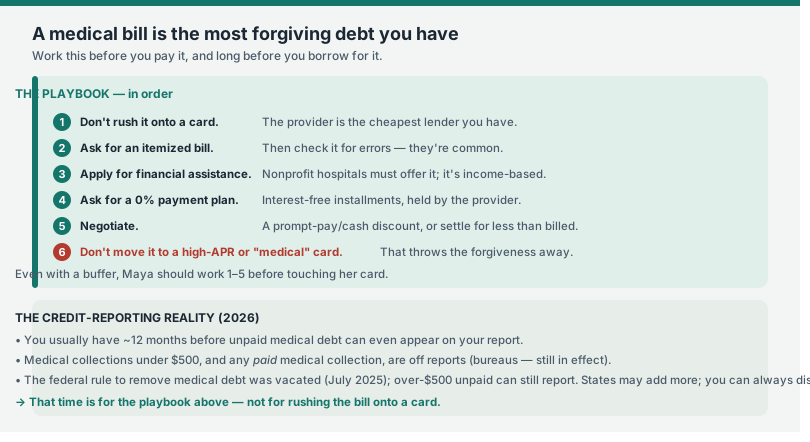
The playbook's order is the opposite of the panic, and each step saves real money. The first move is simply not to move — not to put the $2,800 she can't cover on her credit card, because the provider is the cheapest lender Maya has, and almost anything she does with the provider beats borrowing around it. Then she asks for an itemized bill, because medical bills are riddled with errors — duplicate charges, wrong billing codes, services never rendered — and reviewing Maya's turns up a ~$400 charge for a test she didn't receive, knocked off on a single phone call. Next, and most overlooked, she applies for financial assistance (often called "charity care"): nonprofit hospitals are required to offer income-based assistance, and a large share of people who qualify never apply because no one tells them to — for Maya's income it could cut the bill substantially, and for lower earners it can erase it entirely. Whatever remains, she asks to put on a 0% payment plan — interest-free installments held by the provider, which is the §15 "payment plan on the bill" option in its most common form. And she can negotiate: a prompt-pay or cash discount, or a settlement for less than billed, because the "chargemaster" sticker price is rarely the real price.
The sixth step is the one in red, and it's where Hector comes in. Sitting in the billing office, he's offered a "medical credit card" — a CareCredit-style product pitched as "0% if paid in full" financing for the balance. This is the §L5 deferred-interest predator wearing a medical coat: if Hector doesn't clear the entire balance by the promotional deadline, all the back-interest is charged retroactively, often at 25–30%. Moving a medical bill onto one of these cards does two destructive things at once — it converts a 0%, forgiving, provider-held debt into an interest-bearing, immediately-reporting one, and it strips away every tool above (you can't ask a credit-card company for charity care or an itemized hospital review). The provider's own 0% plan does the same job — spread the balance over time — without any of that risk. The rule is blunt: never move a medical bill onto a high-APR or deferred-interest card when the provider will hold it interest-free.
What makes this playbook workable rather than aspirational is the credit-reporting reality, which is the panel's lower band — and it's worth getting exactly right because it changed recently. The headline fear — "this bill will wreck my credit" — is far weaker than people assume. The three major credit bureaus voluntarily removed medical collections under $500 from reports, and removed paid medical collections regardless of amount, and those voluntary changes remain in effect; on top of that, unpaid medical debt generally has a 12-month grace period before appearing on reports. So Maya typically has about a year before an unpaid medical bill can even surface on her credit — which is exactly the window the playbook is meant to fill. The federal rule that would have gone further — the CFPB's January 2025 rule removing most medical debt and barring lenders from considering it — did not survive: on July 11, 2025, a federal court vacated the rule, and as of 2026 it is no longer enforceable, with the CFPB having joined the industry groups in asking the court to strike it down. So over-$500 unpaid medical debt can still be reported after the grace period, and lenders can still consider it. Some states have passed their own protections, though the July ruling cast doubt on them via federal preemption, and the picture remains contested; independently, Maya can always dispute inaccurate medical debt under the Fair Credit Reporting Act, which matters because billing errors are so common. The practical synthesis is the green line: the time before a medical bill can touch her credit is time to work the playbook — to get the itemized bill, the charity-care reduction, and the 0% plan — not a reason to rush it onto a card that reports immediately and charges interest from day one.
That's why medical debt is the lesson's most important "trigger" section: it's the single biggest reason people end up at a payday or title lender or maxing a card, and it's the situation where the better path is most available and most ignored. The same panic that makes Darnell take a title loan for a car repair makes Maya consider carding a hospital bill — and in both cases the answer is to slow down and work the cheaper options first. Those cheaper options, in their fullest form — including how someone like Darnell can open doors that aren't yet available to him — are the subject of the next section, the heart of the lesson: the better alternatives, with the credit-union PAL agreement as its document. That's §17.
17. The better alternatives — the heart of the lesson
This is the section the whole lesson has been pointing toward. Every product in the first half exists because people in a crunch don't know — or can't reach — the cheaper options, and §15 proved those options cost a tenth of payday or title for the same need. So the real skill isn't avoiding the traps; it's knowing the alternatives and the order to try them in. Here is the toolkit as a decision tool — check the doors that are open to you, and it points to the cheapest one:
Better-alternatives door checker — check every door that's open to you
The cheapest open door is where you start. Anything on this list beats a payday or title loan.
The tool is built around one rule: whatever sits highest on that list and is open to you is where you start, and anything on it beats the payday or title loan outright. Working down it in order is the whole method.
At the top is an emergency fund — your own savings, at $0 cost, the cheapest "loan" there is, and the thing §18 will show how to build after the crisis passes. Next, the payment plan on the bill itself — the §15 and §16 move — negotiating directly with the mechanic, hospital, or utility, which is frequently 0% and is the most overlooked option of all. Then an employer or payroll advance: many employers will advance a paycheck for free or nearly so, and the better-end earned-wage programs from §9 fit here. Then a regular credit card you can pay off, or a personal loan you qualify for — far cheaper than payday, and bounded.
In the middle of the list sits the product purpose-built to be the humane payday alternative, and it deserves the spotlight: the credit-union Payday Alternative Loan (PAL). The federal credit-union regulator (the NCUA) defines it tightly, and the rules read like a point-by-point repair of everything wrong with a payday loan. Both types carry a maximum interest rate of 28% and an application fee capped at $20 — so where payday is ~391%, a PAL is capped near 28%. They're installment loans aligned to pay periods, not balloons. And critically, the NCUA bars credit unions from rolling over PALs, with only one PAL to a member at a time — meaning the §4 rollover trap is structurally impossible. There are two flavors: PAL I runs $200 to $1,000 with one-to-six-month terms and requires one month of credit-union membership before applying; PAL II goes up to $2,000 with one-to-twelve-month terms and no waiting period, so you may be able to apply as soon as you join. And the eligibility is the part that matters most for Darnell: qualifying is usually based on your income, not your credit score — so his 580 doesn't shut the door. Run his $500 need through it: a PAL repaid over four months at 28% plus the $20 fee costs him roughly $67 total, in affordable installments that actually end — about what a single month of the payday loan's fees would cost, except this one can't trap him and finishes on schedule. One caution worth carrying: some online lenders borrow the "payday alternative loan" name without being credit unions, so read the fine print — a real PAL comes from a credit union and obeys those NCUA caps.
Lower on the list, but able to solve the problem without borrowing at all, are the community options — and these are worth naming concretely, because "get help" is useless without a number to call. 211 is a free, nationwide service (dial 2-1-1, or visit 211.org) that connects you to local emergency assistance: rent and utility help, food, prescription aid, and more — often a grant, not a loan, meaning the need gets covered with nothing to repay. And for the underlying budget problem, the National Foundation for Credit Counseling (NFCC) offers free or low-cost nonprofit credit counseling — reachable at 1-800-388-2227 — which can help build a plan and, where appropriate, negotiate with creditors. Finally, family or friends: genuinely 0%, but put the terms in writing, because an unspoken loan is how relationships get damaged.
This is also where the lesson's cruel inversion finally gets its answer. Darnell, checking that list honestly, lands on fewer open doors than Maya — his card is near its limit, he has thin savings, he isn't yet a credit-union member — which is exactly the structural unfairness the lesson opened with. But the list isn't fixed: most of those doors can be opened. He can join a credit union today (PAL II lets him borrow the day he joins), he can dial 2-1-1 right now for help that doesn't require any credit at all, he can call the mechanic about a payment plan, and he can start an emergency fund the moment this crunch passes so the next one finds more doors open. The inversion is real, but it's not a life sentence — and refusing the payday and title loans in favor of opening one of these doors is the single highest-value financial move someone in Darnell's position can make.
The PAL earns the lesson's third Document Walkthrough because it's the one document here a person should actively seek out and recognize — the safe contract that does everything the payday and title agreements don't. The next turn presents it whole, as a specimen, so its differences from the trap documents are visible side by side. That's §17b.
17b. Document Walkthrough: A credit-union PAL agreement
Where & what + mode. After Darnell joins a credit union, the branch (or the member portal) gives him a "Payday Alternative Loan (PAL II) Agreement & Truth-in-Lending Disclosure" to take the $500 — signed on paper or online. It carries the same federal TILA box as the payday and title agreements, which is the point: put side by side, the differences are obvious. This is the document to learn by heart as the safe one — so its safeguards (the rate cap, the installments, the no-rollover rule, the income-based approval, the credit-building) are the tinted focus. Here is the whole thing:
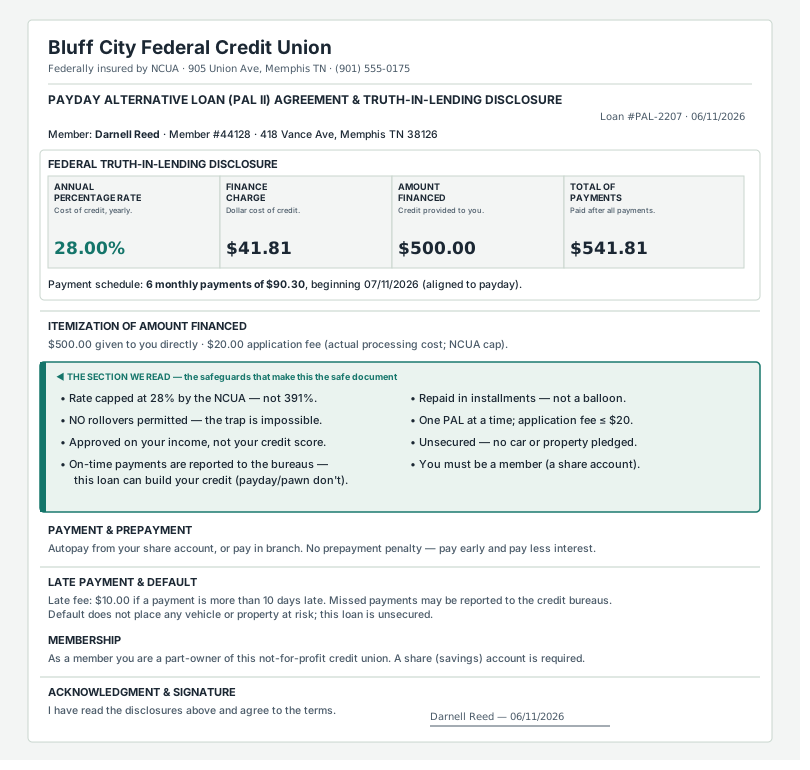
This is the whole PAL agreement, and read against the payday and title documents from §11 and §13, it's almost a point-by-point rebuttal of them. It has the same skeleton — masthead, member line, federal TILA box, itemization, payment and prepayment terms, late and default terms, membership note, signature — but the tinted safeguards section is where the contrast lives, and it's worth seeing how directly each safeguard answers a trap from earlier.
The single most striking thing is the TILA box itself: the APR reads 28.00%, rendered here in teal rather than the danger red of the payday loan's 391% and the title loan's 300%. Same federal box, same four cells, in the same standardized format Darnell can now read fluently — and the number in the headline cell is roughly one-fourteenth of the payday loan's. The whole purpose of teaching the box across all three documents pays off right here: a person who has learned to read that top-left cell can tell these three products apart in two seconds, because the cap is in the box. Everything below the box then reinforces it: where the payday agreement's fine print held an ACH authorization and a renewal clause that built the trap, the PAL's fine print holds the opposite — no rollovers permitted, so the §4 cycle is structurally impossible; installments, not a balloon, so there's no single impossible payment; approved on income, not credit score, so Darnell's 580 doesn't shut the door; unsecured, so unlike the title loan no car is pledged; and a feature neither trap product offers — on-time payments report to the credit bureaus, so this loan can actually build his credit while payday and pawn loans cannot.
Two quieter contrasts complete the picture. The prepayment line says there's no penalty for paying early — pay it off ahead of schedule and pay less interest — which is the precise inverse of the payday loan, where the only way to "end" it early was to produce the full balloon, and the rollover quietly extended the cost. And the itemization shows the $20 application fee plainly, capped by the NCUA at actual processing cost; it's worth noting honestly that on a small, short loan that $20 fee can nudge the effective TILA APR a little above the 28% note rate — a real quirk — but "a bit above 28%" against payday's 391% is not a contest. The signature line, finally, binds Darnell to a contract whose every clause runs toward his recovery rather than against it.
That's why this document earns a walkthrough of its own: it's the one a person in a crunch should be able to recognize on sight and actively seek, and the skill of reading the trap documents is exactly what makes the safe one legible. The next turn takes it apart field by field — in the bulleted reading-order format the methodology specifies for breakdowns — so each safeguard's IS / DOES / MATTERS is explicit. That's §17c.
17c. Reading the PAL agreement — field by field
Masthead — "Bluff City Federal Credit Union · Federally insured by NCUA." What it is: the lender's identity plus its federal regulator and deposit insurer. What it does for Darnell: tells him this is a not-for-profit federal credit union operating under NCUA rules — the same body that caps PALs at 28% and bans their rollover — and that his deposits are federally insured. Why it matters: the regulator named here is what makes every safeguard below enforceable, and it's the structural opposite of the for-profit storefronts and online imitators of §2. "Federally insured by NCUA" is itself the first check that he's at a real PAL source, not an online lender borrowing the name (the §17a caution).
Member line — "Darnell Reed · Member #44128." What it is: his identification as a member, with a member number rather than a mere customer account. What it does: confirms he's joined the credit union — the eligibility gate for any PAL. Why it matters: this quietly proves the one prerequisite that trips people up — you must be a member to get a PAL, ideally before you need it. It's the §17a "join before the emergency" point made concrete; with PAL II he could apply the day he joined, where PAL I would have required a month's membership first.
The TILA box — APR 28.00% · Finance Charge $41.81 · Amount Financed $500.00 · Total of Payments $541.81. What it is: the same four federal cells taught in §12, now reading safe. The APR (28.00%) is the capped yearly cost — about one-fourteenth of payday's 391%. The Finance Charge ($41.81) is the dollar cost over six months — roughly what a single payday rollover fee would be, except this is the entire cost, not a recurring one. The Amount Financed ($500.00) is the cash to Darnell, and the Total of Payments ($541.81) is everything he'll repay. What it does: gives him a federally-comparable figure to set directly beside the payday and title boxes. Why it matters: this is the payoff of learning the box three times — the same top-left cell that screamed 391% and 300% now reads 28%, and that two-second read is the test that tells the safe loan from the traps. The one honest caveat: the $20 fee can nudge the effective TILA APR slightly above the 28% note rate on so small a loan — but "a little above 28%" against 391% is no contest.
Payment schedule — "6 monthly payments of $90.30, aligned to payday." What it is: the repayment plan — six equal installments timed to his paychecks. What it does: replaces the payday and title balloon (the whole sum at once) with predictable payments Darnell can actually budget around. Why it matters: this one structural difference — installments versus balloon — is what makes the loan repayable for the target borrower and the root reason it cannot trap him, because each payment reduces the principal and the loan shrinks toward an end. It's worth holding the §4 contrast in mind: a payday "payment" (the rollover fee) reduced nothing, while a PAL payment reduces what he owes — the same word doing opposite work.
Itemization — "$500 to you · $20 application fee (NCUA cap)." What it is: where the financed money went, plus the only fee. What it does: confirms he receives the full $500 and that the fee is the NCUA-capped $20, charged only to recoup actual processing cost, with no packed add-ons. Why it matters: it's the clean baseline the trap products never offered — the $20 cap is a hard legal limit, leaving no room for payday's open-ended fees, rent-to-own's hidden markup, or the financed add-ons of loan packing.
The PAL safeguards (the focus). This is the section that makes the document the safe one, and each line answers a specific trap. The 28% NCUA rate cap holds the price near a credit card rather than a payday loan, and it's law, not the lender's goodwill. No rollovers permitted makes the §4 cycle structurally impossible — there simply is no renew-for-a-fee option to take, which is the safeguard that most directly defuses the lesson's central danger. One PAL at a time prevents stacking small loans into a new trap. Approved on income, not credit score is the cruel inversion answered: the safe product is deliberately accessible to the very people — Darnell at 580 — that the traps target. Unsecured, no car or property pledged is the direct rebuttal of the title loan (§5–6): default here can hurt his credit but cannot take his transportation. And on-time payments are reported to the credit bureaus, which flips the entire script — a payday or pawn loan can only hurt his credit (through collections) and never help it, while a PAL handled well actually builds his score, making his next emergency cheaper. That credit-building upside is a genuine benefit the trap products structurally cannot offer.
Payment & prepayment — "Autopay from your share account, or pay in branch. No prepayment penalty." What it is: how he pays, plus the right to prepay for free. What it does: lets him pay early to save interest, with no penalty. Why it matters: it's the exact inverse of the payday loan, where the only way to end it early was to produce the full balloon and where rolling extended the cost — here, paying ahead shrinks it. And the autopay is the good version of auto-debit: it pulls from his own credit-union savings account behind a no-rollover, installment structure, not a payday lender's first-claim ACH (§3).
Late payment & default — "Late fee $10 if more than 10 days late; missed payments may be reported; unsecured." What it is: the consequences of falling behind. What it does: a small, capped late fee and an honest disclosure that missed payments can ding his credit — but with no asset at risk. Why it matters: the downside is bounded and proportionate (a $10 late fee against payday's NSF cascade or the title loan's repossession), and the same credit-reporting mechanism that creates the risk on a missed payment is the one that builds his score on an on-time one — it cuts both ways, mostly toward the upside.
Membership — "you are a part-owner of this not-for-profit credit union; a share account is required." What it is: the member-owner structure. What it does: explains why the terms are humane — a credit union is owned by its members, not profit-seeking shareholders, so it isn't built to extract from him. Why it matters: this is the structural root of everything above. The §opening inversion exists because for-profit lenders maximize fees from the desperate; a member-owned cooperative has the opposite incentive, which is precisely why the safe product comes from here and not from the storefront.
Acknowledgment & signature — "I have read the disclosures above and agree. / Darnell Reed." What it is: his binding signature. What it does and why it matters: it closes a contract whose every clause runs toward his recovery — the mirror image of the payday and title signatures, where the clauses ran against him. Signing this is the move the whole lesson recommends: the safe document he learned to recognize, chosen over the traps he learned to read.
Read whole, the PAL agreement is the trap documents' photographic negative — a capped rate where they had a ruinous one, installments where they had a balloon, a no-rollover rule where they had renewal clauses, unsecured where the title loan pledged the car, income-based access where the traps exploited the same desperation, and credit-building where the others built nothing. The deeper point uniting all three Document Walkthroughs is the one the lesson keeps returning to: the protection — and the danger — was always in the document. The only variable is whether the reader can see it, and Darnell, having read all three, now can.
With the alternatives mapped and the safe document recognized, the lesson turns to putting it all into a single procedure — how to actually handle an emergency, step by step, including the honest, non-preachy answer to the question people really have: is it ever okay to use one of these? That's §18, the emergency playbook.
18. The emergency playbook — and the honest answer to "is it ever okay?"
Everything in this lesson reduces to one procedure for the moment an emergency actually lands — when Darnell's car won't start before a shift and the panic says fix it now, however you can. The whole point is that panic is the enemy, not the emergency, so the playbook is built to slow the moment down and route it through the cheap doors before the expensive ones:
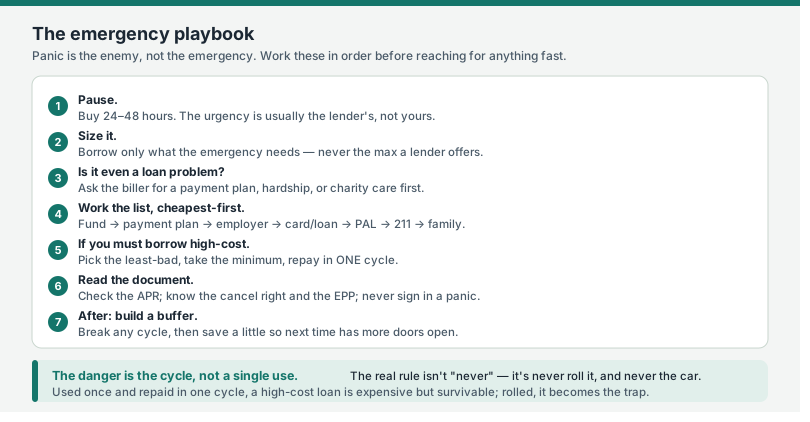
Walk Darnell through it and the procedure does real work. He pauses — instead of driving straight to the title lender, he buys himself a day, recognizing that the storefront's "act now" pressure is the lender's urgency, not the repair's; the car will still be broken tomorrow, and a day is enough to find a better answer. He sizes it — the repair is $500, so he needs $500, not the $1,000 a title lender will happily push on him (§5's over-lend). He asks whether it's even a loan problem — calls the mechanic about splitting the bill over two paychecks, which costs nothing if the shop agrees. If borrowing is genuinely needed, he works the list cheapest-first (§17) — and even if his card is near its limit and his savings are thin, joining a credit union for a PAL, dialing 2-1-1, or asking his employer for an advance all sit above the trap products. Only if every cheaper door is truly closed does he reach step five — if you must borrow high-cost, pick the least-dangerous (a pawn on something expendable over a title loan on the car; a card cash advance over payday), take the minimum, and have a concrete plan to repay in a single cycle. Whatever he signs, he reads the document — checks the APR cell, knows he can cancel by the next business day, asks about the EPP — and never signs in a panic. And afterward, he breaks any cycle he's in and starts a small buffer, because the deepest fix for the §opening inversion is to make sure the next emergency finds more of his doors already open. Even $500 in savings would have let him skip this entire decision.
That leaves the honest question the lesson owes you, the one a preachy guide dodges: is it ever actually okay to use one of these? The truthful answer is rarely, but yes — and pretending otherwise would be both condescending and wrong. The lesson's position has never been that these products are evil or that needing one makes you foolish; it's that they're dangerous and usually avoidable. There is a narrow case where a high-cost loan is a defensible choice, and it requires all three of these to hold at once: the need is genuinely urgent and avoiding it prevents a worse cost (a utility shutoff with a steep reconnection fee, an eviction filing, losing the car you need for the job that's your only income); you've actually worked the list and every cheaper door is closed to you right now; and — the non-negotiable one — you can repay it in full, in a single cycle, with certainty, not as a hope. Under those exact conditions, a single payday loan or a pawn on something expendable, used once and retired on schedule, is expensive but survivable.
The distinction that makes this honest rather than reckless is the one in the panel's teal band: the danger is the cycle, not the single use. A high-cost loan taken once and repaid in one cycle costs you a steep fee and ends; the same loan rolled is what becomes the months-long trap of §4. So the real rule was never "never borrow" — it's never roll it, and never stake the car. But that rule comes with a hard, honest caveat, because the trap is engineered precisely around the failure of "I'll repay in one cycle": the balloon is sized to the budget that couldn't cover the emergency in the first place (§3), so most people who sincerely believe they'll clear it in one cycle can't. That's not a character flaw; it's the product working as designed. So the guidance is genuinely cautious even within the "yes": be ruthlessly sure you can repay in one cycle, because the odds say you'll overestimate — and if there's any real doubt, a cheaper option, or even letting a non-catastrophic bill go a little late, usually beats stepping into the cycle.
And the lines that stay firm: never a title loan for a small or short-term need, because the car-versus-a-few-hundred-dollars asymmetry (§6) can't be managed, only avoided; never to paper over a recurring shortfall, because that's not an emergency, it's a dependency, and the product will deepen it rather than fix it; and never when a cheaper door is open, which, having read §17, Darnell now knows is more often than it feels. Within those lines, the choice is his — the lesson's job is to make sure it's an informed one, made with the APR understood, the cheaper options exhausted, and the cycle refused.
That informed-choice framing is also exactly what the predators in this space work hardest to deny. The next section names them directly — the rollover-and-repossession business model, the rent-a-bank and tribal tricks for dodging rate caps — and how to report them. That's §19, the Predator Watch.
19. Predator Watch — when the trap is the business model
This lesson has shown that these products are expensive. The Predator Watch names what makes the worst of them predatory — a different and sharper charge. An expensive loan costs a lot; a predatory loan is engineered around your failure to repay it. That distinction is the whole tell, and it shows up in two intertwined patterns Darnell should be able to name on sight:
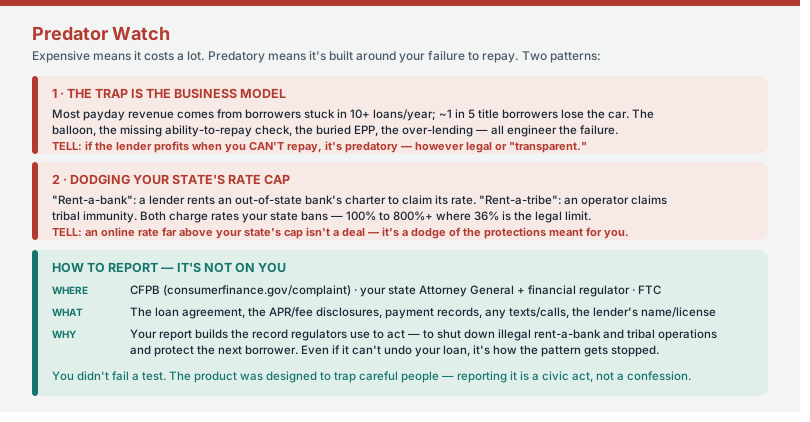
The first pattern is the one that defines predatory lending: the trap is the business model. A normal lender profits when you repay — that's the deal. A predatory payday or title lender profits when you can't — and the data from §4 and §6 isn't incidental, it's the revenue plan: the majority of payday lenders' income comes from borrowers stuck in ten or more loans a year, and roughly one in five single-payment title borrowers loses the vehicle. A business that makes most of its money from customers who fail to repay cleanly has every reason to engineer that failure, and across this lesson you've seen exactly how it does: the balloon sized to the budget that couldn't cover the emergency so full repayment is unlikely (§3); the missing ability-to-repay check, because the lender relies on the ACH access and the collateral, not on whether you can actually afford it (§3); the rollover offered as the easy "relief" while the buried, no-fee EPP that would actually help goes unmentioned (§4, §12); the over-lending that pushes more than you need to maximize interest (§5); and the 4-to-1 over-collateralization plus a GPS kill-switch that make repossession profitable and instant rather than a last resort (§5–6). None of these is an accident or a borrower's mistake. They are design choices that point one direction. So the tell is clean and portable: if a lender profits when you can't repay — if the product is built around your failure — it's predatory, no matter how legal or how "transparent" the disclosures are. Honesty about a 391% APR doesn't make the trap less of a trap.
The second pattern is how predators reach Darnell even where the law has tried to stop them: dodging the state rate cap. Twenty states and D.C. have effectively banned high-cost lending by capping rates near 36% (§2, §opening), which is a serious problem for the predator — so two schemes exist to get around it. In "rent-a-bank," a high-cost lender partners with a bank chartered in a state with no meaningful cap; because federal law lets banks "export" their home-state rate across state lines, the bank is named as the lender on paper and the loan claims its rate — even though the non-bank operator does all the real marketing, underwriting, and servicing and simply buys the loan. The bank, in effect, rents out its charter, and a 100–200% loan appears in a state that bans it. In "rent-a-tribe," an online operator affiliates with a Native American tribe and claims tribal sovereign immunity to sidestep state usury and licensing laws entirely, charging 400–800% or more; often a non-tribal financier runs the operation and the tribe takes a small cut. Both are contested — state attorneys general challenge them under "true lender" doctrine (looking past the nominal bank or tribe to who really makes the loan), and courts have split — but they persist, and the detailed current legal status is §21's territory. The tell here is just as portable: an online lender offering a rate far above your state's legal cap is not a generous exception — it's a structure built to dodge the protection meant for you. A legitimate lender obeys your state's cap; one charging triple it is telling you, in the rate itself, that it has engineered its way around the law.
That framing — the product was built to trap you — is exactly why reporting these lenders carries no shame, and the how-to-report panel is deliberately styled as the constructive, civic act it is rather than as a danger. If Darnell has been caught — rolled into a payday cycle, hit with an illegal rent-a-bank rate, threatened by a collector — he can report it in three places: the CFPB (at consumerfinance.gov/complaint), which handles federal complaints about lending practices; his state Attorney General and state financial regulator, who are the right venue for rate-cap violations, unlicensed lenders, and rent-a-bank or tribal evasion in a capped state; and the FTC (reportfraud.ftc.gov) for deceptive or fraudulent practices. He should have ready whatever documents he has — the loan agreement, the APR and fee disclosures, payment records, any texts or calls, and the lender's name and license number (or the conspicuous absence of one). And the reason to do it is genuinely civic: a single complaint rarely undoes one person's loan, but complaints aggregate into the record regulators and AGs use to act — to fine or shut down illegal operations, to unwind rent-a-bank arrangements, to force restitution. Darnell's report is how the next person in his position gets protected. The framing the whole lesson has held applies most of all here: he didn't fail a test. These schemes are engineered to catch careful, reasonable people doing the locally-sensible thing under pressure; being caught is evidence of the design, not of a personal failing, and reporting it is an act of repair, not a confession.
That non-blame stance carries directly into the next section, which speaks to anyone the warning came too late for — the reassurance beat, with the concrete resources to get unstuck. That's §20.
20. If this already happened to you
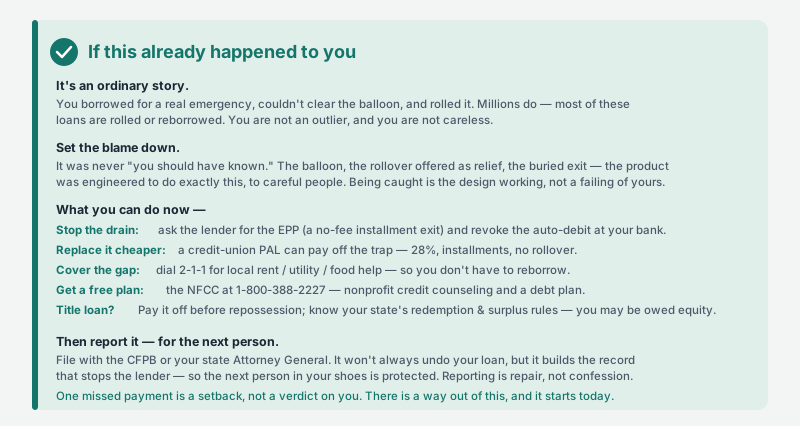
If you're reading this already inside one of these loans — rolled into a payday cycle, watching a title-loan clock run on your car — this section is for you, and it's worth saying the gentlest part first: what happened to you is an ordinary story, not a personal failure. Picture Darnell four months on: he took the $400 payday loan for a real car repair, couldn't pull together the $460 balloon out of the same tight paycheck, and rolled it three times, so he's now paid roughly $180 in fees and still owes the original $400 — and the title loan he took to "get ahead of it" has his car on a thirty-day clock. That is not a cautionary tale about a careless person. It's the typical outcome: around twelve million Americans use payday loans in a year, and most are rolled or reborrowed exactly as Darnell's was. If you're in it, you are squarely in the company of millions of careful, working people, not off in some corner of the irresponsible.
So set the self-blame down, because it's aimed at the wrong target. The instinct after the fact is "I should have known better" — but everything in this lesson's Predator Watch points the other way: the balloon was sized to be unrepayable for the budget that needed the loan, the rollover was offered as the easy relief, and the no-fee exit was buried precisely so you wouldn't take it. Being caught in that is the design functioning as intended, not a verdict on your judgment. The product was built to trap careful people. Holding the shame only keeps you stuck; setting it down is what frees you to take the concrete steps, which are real and start today.
Here is what you can actually do now, and each step is something Darnell can begin this week. First, stop the drain: ask the lender for the Extended Payment Plan — the no-fee installment exit many states require but lenders don't advertise (§4, §12) — and revoke the ACH authorization and place a stop-payment at your bank, which you have the right to do, so the auto-debit stops emptying your account before rent. Second, replace the trap with something that ends: join a credit union and ask for a PAL to pay off the payday or title loan — at 28% in fixed installments with no rollover possible, it converts an open-ended trap into a loan with a finish line, and it can even rebuild your credit while it runs (§17). Third, cover the gap without reborrowing: dial 2-1-1 for local rent, utility, and food assistance — often a grant, not a loan — so the shortfall that drives the next reborrow gets filled some other way. Fourth, get a free plan: call the National Foundation for Credit Counseling at 1-800-388-2227 for nonprofit credit counseling and, where it fits, a debt-management plan to consolidate and lower what you're juggling. And if it's a title loan, the priority is the car: pay it off before repossession if you possibly can, and know your state's redemption and surplus rules (§6, §21) — if the car has already been taken, you may be owed surplus equity that the lender is required to return. Underneath all of it, you have rights: a collector who threatens you with arrest or "check fraud" is violating federal law, and that's reportable too.
And when you're steadier, report it — for the next person. File with the CFPB (consumerfinance.gov/complaint) or your state Attorney General, exactly as §19 laid out. It may not undo your own loan, but it builds the record regulators use to act against the lender — and that's how the next person walking into the same storefront gets protected. Your stumble, reported, becomes someone else's guardrail. One missed payment is a setback, not a verdict on you, and there is a way out of this that begins with a single phone call — to the credit union, to 2-1-1, to the NFCC — made today.
That care carries into the final substantive section, which arms you with the rights and protections behind several of these steps — the rate caps, the Military Lending Act, the federal rule status, the collection and bank-account rights — so you know exactly what the law does and doesn't give you. That's §21.
21. Protections and recourse — what the law actually gives you
Several steps in the playbook and the reassurance beat rested on rights, and this section names them plainly, because knowing exactly what the law does and doesn't give you is the difference between a vague hope and a usable lever. The protections stack in layers, and a clear-eyed look at 2026 is that the most reliable ones are no longer federal:
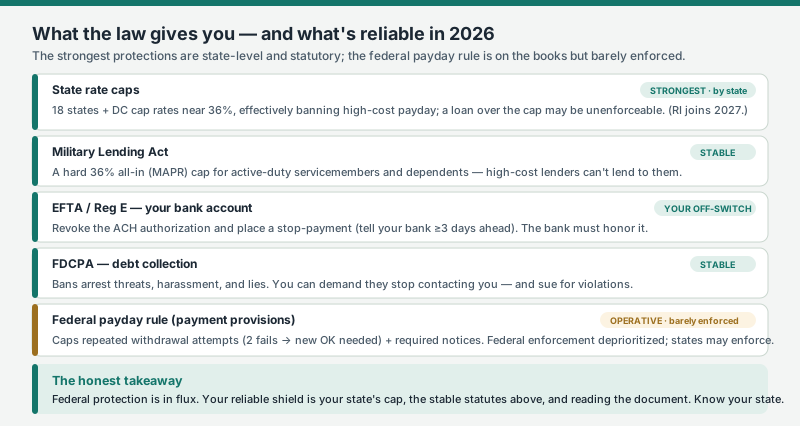
The strongest protection is your state's rate cap, and it's the first thing Darnell should know about his own state. As §2 and the opening established, 20 states plus the District of Columbia effectively ban high-cost payday lending by capping rates near 36%, with Rhode Island joining in 2027 — and in those states a loan made above the cap may be void or unenforceable, meaning the lender can't legally collect it. This is the most powerful and most durable protection precisely because it doesn't depend on any agency choosing to enforce it: it's the law of the state, and a borrower charged an illegal rate can report it to the state Attorney General and state financial regulator, who are the right venue for rate-cap violations, unlicensed lenders, and the rent-a-bank and tribal schemes from §19. The flip side is the §opening point: where Darnell lives largely determines what protection he has, and title loans are often regulated separately, with the surplus, redemption, and repossession rules (§6) varying state to state — so "know your state's rules" is not a throwaway line, it's the single most consequential piece of legal homework here.
The Military Lending Act is a hard federal floor that hasn't moved: a 36% all-in cap (the Military APR, which includes fees and add-ons) for active-duty servicemembers and their dependents. Because the cap counts the fees that payday and title lenders rely on, it effectively makes their high-cost products unlawful for the military community — and notably, even as other federal protections have receded, the CFPB has signaled it intends to keep its focus on military and veteran protections. If Darnell were active-duty, no licensed lender could legally put him in a 391% loan.
The EFTA / Regulation E rights are the concrete "off-switch" the lesson kept pointing to. Under the Electronic Fund Transfer Act, Darnell can revoke the ACH authorization he gave the lender and place a stop-payment order with his bank — and if he notifies the bank at least three business days before a scheduled transfer, the bank must honor it. This is what lets him stop the auto-debit from repeatedly draining his account (§3, §20). One honest caveat: revoking the authorization stops the withdrawal, it doesn't erase the debt — he still owes it — but regaining control of his bank account is often the first step to breaking the cycle, because it stops the overdraft cascade and lets him direct his own paycheck toward the EPP or a PAL instead.
The FDCPA — the Fair Debt Collection Practices Act — governs third-party collectors and is also stable. It bans threatening you with arrest, harassment, calling at unreasonable hours, and false statements — which is exactly why the payday agreement's "criminal action may not be threatened" line (§12) reflects real law: a collector implying that a bounced repayment is "check fraud" you'll be jailed for is committing an FDCPA violation. Darnell can demand in writing that a collector stop contacting him, dispute the debt, and sue for violations (with statutory damages). Abusive collection isn't something he has to simply endure.
The federal payday rule is the one in genuine flux, and it's worth stating precisely rather than vaguely. The CFPB's "Payday, Vehicle Title, and Certain High-Cost Installment Loans" rule originally had two parts; the ability-to-repay (underwriting) requirements were rescinded back in 2020, leaving only the "payment provisions," which prohibit lenders from attempting to withdraw payment after two consecutive failed attempts without new authorization, and require advance notice before withdrawal attempts — protections aimed squarely at the overdraft cascade (the CFPB found one lender debited an account eleven times in a single day). After years of litigation those provisions finally became operative on March 30, 2025 — but just two days before, on March 28, 2025, the CFPB announced it "will not prioritize enforcement or supervision actions" regarding the payment provisions, redirecting its resources elsewhere. So the rule is technically on the books and operative, yet federally unenforced — though, importantly, state regulators may still bring enforcement actions under it. It's a protection that exists more on paper than in federal practice right now.
That pattern is the honest takeaway, and it's the panel's teal band. Across this entire lesson's subject area, federal consumer protections have been weakened or left unenforced in 2025–2026 — the payday rule deprioritized, the earned-wage-access products declared not-credit (§9), the overdraft cap repealed (§10), the medical-debt rule vacated (§16). The throughline is that Darnell should not count on a federal cavalry. His reliable shield is his state's rate cap, the stable statutes (the Military Lending Act if he qualifies, the FDCPA, the EFTA off-switch), and his own ability to read the document — the skill the three Document Walkthroughs built. In a moment when the federal floor is shifting, the protections that hold are the ones written into state law and the ones he can exercise himself, which is exactly why this lesson spent so long teaching him to recognize the APR, the rollover clause, and the cancel right on his own. The law gives him real levers; in 2026, the surest ones are the ones closest to him.
With the products mapped, the documents read, the alternatives ranked, the predators named, and the protections known, only the wrap-up remains: the questions people actually ask, and a quick self-check. That's §22.
22. Most common questions
"Isn't a payday loan cheaper than racking up overdraft fees?" This is exactly how payday lenders market themselves, and the absolute dollar cost of a single payday fee can sometimes look smaller than a cascade of $35 overdrafts. But the comparison is rigged two ways: overdraft is something you can simply opt out of (the transaction declines instead of charging a fee, §10), and a payday loan rarely stays a single loan — it rolls (§4). Don't compare payday to overdraft; compare it to the real alternatives (a payment plan, a PAL), and opt out of overdraft so it isn't on the table at all.
"I already gave a payday lender access to my bank account — can I stop them from taking the money?" Yes. Under federal law (the EFTA) you can revoke the ACH authorization with the lender and place a stop-payment with your bank — notify the bank at least three business days ahead, and it must honor it (§21). Important caveat: this stops the withdrawal, it doesn't erase the debt — you still owe it — so pair it with an Extended Payment Plan or a cheaper payoff rather than just walking away.
"Will paying off a payday or title loan build my credit?" Generally no. Most payday and title lenders don't report your on-time payments to the credit bureaus, so paying them does nothing for your score — while a default can hurt it. A credit-union PAL is the opposite: it reports on-time payments and can actually build your credit (§17). If building credit matters to you, that's one more reason the PAL beats the trap products.
"The title lender offered me more than I asked for — should I take the extra as a cushion?" No. Borrow only what the emergency requires. A bigger loan just means more interest and a larger balance riding on your car; the "cushion" offer is the over-lending nudge (§5), and it serves the lender, not you. If you need $500, borrow $500.
"Is pawning really better than a payday loan?" In one decisive way, yes: a pawn loan is non-recourse, so your worst case is capped at the item — no debt cycle, no collections, no credit damage if you forfeit (§7). It's still expensive and you do lose the item if you can't repay, so pawn only what you can afford to lose — but structurally it's safer than payday or title, because the downside is bounded.
"What's the single most important number to check on any of these loans?" The APR in the federal Truth-in-Lending box. It puts every loan in the same comparable unit — a payday loan's ~391%, a title loan's ~300%, a PAL's 28%, a card's ~25% — so you can rank them in seconds (§11, §13, §17). And if a product hides the APR (rent-to-own, some cash-advance apps, §8–9), treat that absence as a warning in itself.
"My credit's bad — aren't payday and title loans my only options?" No, and this is the heart of the lesson. Most of the cheaper options don't hinge on your credit score: a credit-union PAL is approved on your income, 211 and nonprofit aid don't check credit at all, a payment plan on the bill is between you and the biller, and an employer advance rests on your job. Bad credit narrows your doors but doesn't close the cheap ones — and several of them you can open (join a credit union, build a small buffer, §17).
"Are online lenders advertising a 'payday alternative loan' trustworthy?" Not automatically. A real PAL comes from a credit union and obeys the NCUA caps (28%, a ≤$20 fee, no rollovers). Some online outfits borrow the "payday alternative" name without being credit unions or following those rules — so confirm it's an actual credit union, read the fine print, and check the APR before trusting the label (§17).
That closes the lesson's content. Step back and see what the whole arc gave Darnell, Maya, and Priya — and you. The lesson opened on a cruel inversion: the people with the fewest options are offered the worst terms, and the fastest, easiest loans are the costliest and most dangerous. Everything since has been the answer to that inversion. You can now recognize the high-cost products on sight and say what each really costs; you can read their documents — the TILA box that states a 391% APR in black and white, the rollover clause and the security agreement that build the trap, and the credit-union PAL agreement that does the opposite; you can see how the traps are engineered — the balloon sized to fail, the rollover offered as relief, the car staked four-to-one — so they can't surprise you; you know the better alternatives in cheapest-first order and, crucially, how to open the cheap doors that aren't yet available; and you know your rights — the state cap, the Military Lending Act, the EFTA off-switch, the FDCPA — and which ones actually hold in 2026. The inversion is real, but it's not a sentence: an informed borrower, even one with bad credit and little cushion, has a way through every emergency that doesn't run through a payday or title loan. That's the whole point of the lesson — to make sure the next time the car won't start, the first move isn't panic, it's the playbook.
Key takeaways
- "Secured" doesn't mean safe — a savings-secured loan at 1% and a title loan at 300% are both secured. Judge a loan by its rate and what asset is at risk, never by the label.
- Payday loans quote a flat fee ($15/$100) that annualizes to ~391% APR — the same federal TILA box that sits on a car loan states it in black and white. Shorter terms make the same fee annualize even higher.
- The rollover trap is engineered: the balloon is sized to the budget that couldn't cover the emergency, so each fee buys only two more weeks while the principal never shrinks. The cycle is a design choice, not a borrower failure.
- A credit-union PAL is capped at 28%, installment-based, and structurally bars rollovers — Darnell's 580 credit score doesn't close the door, and the §4 cycle is impossible. On-time payments even build his credit.
- Work the list cheapest-first: payment plan on the bill, emergency fund, employer advance, PAL, 211, nonprofit aid — most cheap options don't hinge on credit score, and several can be opened before the next emergency hits.
- In 2026, the reliable shield is your state's rate cap and the stable statutes (EFTA off-switch, FDCPA, EPP right) — federal enforcement of the payday payment rule has been deprioritized. Read the document and exercise the rights you can invoke yourself.
Knowledge check
8 questions
A payday lender charges a flat fee of $15 per $100 borrowed on a 14-day loan. What does that fee work out to as an annual percentage rate?