In this lesson
- Opening
- What a Credit Card Actually Is
- Getting a Card and How Your Limit Is Set
- The Billing Cycle and Grace Period — Where "Pay in Full" Becomes Free
- The Three Balances — What You Actually Owe, and Which One to Pay
- How Card Interest Is Actually Calculated
- Cash Advances — The Most Expensive Way to Use a Card
- The APR Family — and Why Your Rate Moves on Its Own
- The Fee Stack — Which Are Avoidable, and Which Are a Choice
- Document Walkthrough #1 — the Credit Card Agreement
- DW#1 Breakdown, Part 1 — Interest Rates, Fees, Interest Method, and Grace Period
- DW#1 Breakdown, Part 2 — Payment Allocation, Minimum Payment, Penalty APR, and Other Terms
- Rewards — the Mechanics, the Bonus, and the Break-Even
- The Rewards Trap — When "Earning" Becomes Losing
- Utilization — How Your Cards Drive Your Score
- The Types of Card, and How to Pick the Right One
- The Balance Transfer — Buying an Interest-Free Runway
- Document Walkthrough #2 — the 0% Balance-Transfer Offer
- DW#2 Breakdown, Part 1 — At-a-Glance Box and Disclosure Tables
- DW#2 Breakdown, Part 2 — Important Terms
- Managing Your Cards — Set It Once, Then a Monthly Glance
- The Card-Debt Trap — and the Way Out
- Fraud & Security
- Predator Watch — Deferred-Interest "Special Financing"
- If This Already Happened to You
- Protections and Recourse — the Card as a Shield
- Most Common Questions
Credit Cards & Revolving Credit
Grace periods, the minimum-payment trap, daily compounding, balance transfers, and the Schumer box decoded — with the true cost of carrying a balance across three borrower scenarios.
What you'll learn
- Explain what makes a credit card revolving/open-end credit, and how it differs from a debit card, charge card, and prepaid card.
- Trace the billing cycle, grace period, and the all-or-nothing rule that makes 'pay in full' the mechanical switch between the card's two modes.
- Calculate the daily interest cost of a carried balance using the average-daily-balance method and explain why carrying even a small amount is more expensive than it appears.
- Read a credit card agreement field by field — interest-rate table, fee schedule, and all narrative sections — and identify what each term means and what it costs.
- Evaluate a balance-transfer offer, distinguish a true 0% APR from deferred interest, and know when each is the right tool.
- Manage utilization timing, select the right card type for a given situation, and run the annual-fee break-even math.
- Recognize the deferred-interest predator, name the tell that separates it from a legitimate 0% offer, and know the recourse path when a dispute arises.
Opening
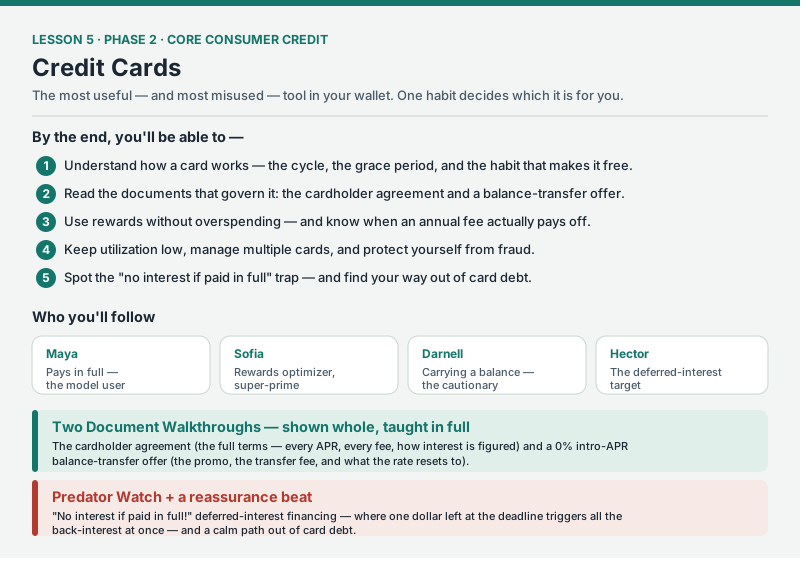
This is the most familiar product in the whole curriculum — nearly everyone reading this either has a credit card or soon will — and it's also the one most people use without ever quite understanding. The lesson's job is to fix that, because a credit card rewards understanding more dramatically than almost anything else in personal finance.
Here is the single most important thing to understand about a credit card, and almost everything else in this lesson follows from it: a credit card is two completely different products, and which one you're holding is decided by a single habit — whether you pay the balance in full each month.
Pay it in full, every month, and a credit card is one of the best deals in consumer finance. It's a free short-term loan — you buy now, the bank floats the money for up to several weeks, and you pay zero interest. It comes wrapped in fraud protection most other payment methods can't match, it builds your credit history (the §-Lesson-1 and Lesson-4 machinery), and on top of all that, the bank often pays you — in cashback or points — for the privilege of using it. Used this way, the card is a tool that quietly works for you, and the bank makes its money from the merchant, not from you. This is exactly how Maya uses the card she opened back in Lesson 1, and how Sofia runs her rewards: the bank is, in effect, their employee.
Carry a balance, and the same card flips into one of the most expensive loans most people will ever touch. The moment Maya doesn't pay in full, the free float disappears, interest starts compounding at an APR that typically runs north of 20%, and — this is the part that stings — whatever rewards she earned become a rounding error against what she's now paying in interest. A 2% cashback card earning her $2 while charging her $20 in interest isn't a rewards card anymore; it's a high-interest loan with a small consolation prize. This is the side of the line Darnell has been living on since Lesson 2, and it's where the product stops working for the cardholder and starts working on them.
That's the whole drama of the credit card, and it's worth sitting with how stark it is: same card, same person, opposite outcomes, separated by one recurring choice. The card itself isn't "good" or "bad" — moralizing about credit cards misses the point entirely. It's a tool that is extraordinarily good if you pay in full and extraordinarily costly if you don't, and the entire purpose of this lesson is to make sure you can always stay on the first side of that line — and to find your way back if you've slipped onto the second, the way Darnell will.
So the lesson is built to make the card legible: how the billing cycle and grace period actually work (so "pay in full" stops being a slogan and becomes a mechanic you understand), how interest hits the moment you carry, how to read the agreement and a balance-transfer offer, how to use rewards without letting them use you, how to keep your cards from quietly damaging your credit score, how to spot the deferred-interest trap that snares Hector, and how to protect yourself when fraud inevitably comes knocking. It's a long lesson, because the credit card is the product a beginner can get the most wrong — and the most right.
It starts with the most basic question, the one underneath all the others: what is a credit card, really — what kind of borrowing is it, and how does it differ from the debit card in the same wallet? That's the next turn.
What a Credit Card Actually Is
Strip away the rewards and the logos and a credit card is one specific thing: revolving, open-end credit. Each of those words does work. Open-end means there's no fixed end — unlike a car loan, there's no set amount, no set number of payments, no payoff date built in. Revolving means the credit replenishes: the bank grants Maya a credit limit (say $3,000), she borrows against it by spending, and as she pays the balance down, that available credit comes back for her to use again — over and over, without ever reapplying. A loan hands you a lump of money once and you pay it off on a schedule until it's gone; a card hands you a standing line you can draw on, repay, and draw on again indefinitely.
That contrast is the cleanest way to understand it, and it's the credit-mix pairing from Lesson 4 seen structurally: Maya's car loan is installment (also called closed-end) credit — fixed $14,000, fixed 60 months, fixed $304 payment, then done. Her credit card is the opposite in every dimension — open-ended, reusable, and, crucially, she chooses how much to pay each month. But "credit card" only makes sense against the other cards that look identical in the wallet and behave completely differently:
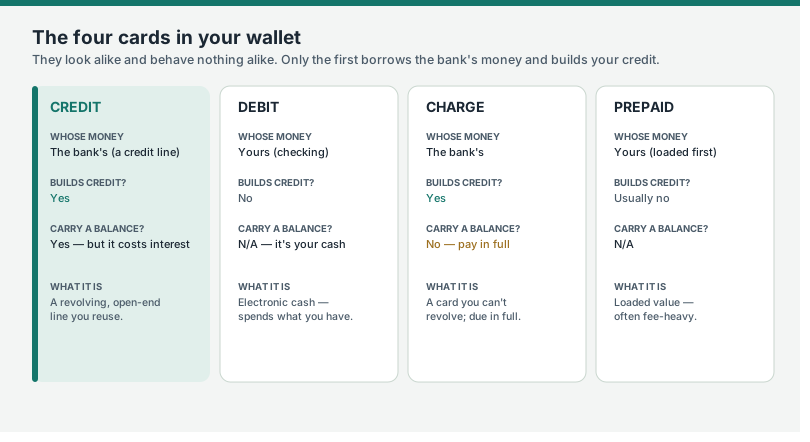
The distinctions matter more than they look. A debit card spends Maya's own money straight from checking — it's electronic cash, it borrows nothing, it builds no credit, and it even sits under a different fraud-protection law (weaker for the consumer, a point §21 returns to). A charge card borrows the bank's money like a credit card but can't revolve — the full balance is due every month, with no option to carry — so it's a credit card with the dangerous choice removed. A prepaid card is money Maya loads on first, so it's really a spending tool, usually builds no credit, and often carries fees. The credit card is the only one of the four that combines borrowing the bank's money, building credit, and letting you choose how much to repay — which is exactly the combination that makes it both powerful and perilous.
There's a question hiding underneath the opening's claim that a paid-in-full card is "free" and even pays you: how can a bank possibly afford to lend Maya money for weeks at no charge and hand her cashback on top? The answer is the part of the system almost no one sees:
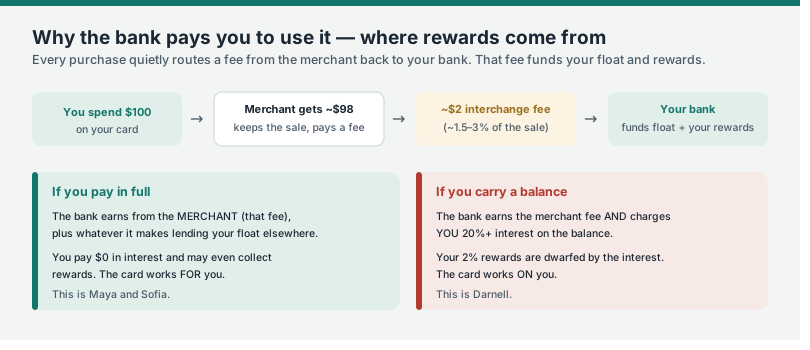
This hidden plumbing explains the whole opening. Every time Maya buys something, the merchant pays a small fee — called interchange, typically around 1.5–3% of the sale — that flows back through the card network to her bank. That fee is the engine: it's why the bank can lend her the money interest-free for a few weeks and still hand her cashback, because it's already being paid by the store. When Maya pays in full, the bank earns from the merchant (and from lending out her float in the background), she pays nothing, and the rewards are real profit to her — the card genuinely works for her. The instant she carries a balance, the bank earns that merchant fee and charges her 20%-plus interest on top, at which point her 2% rewards are dwarfed by what she's paying, and the card has quietly turned to work on her. Same plumbing, opposite direction, decided by the pay-in-full choice.
Which brings the definition full circle to the feature that makes a credit card uniquely double-edged: because it's open-end, the cardholder decides every month how much to pay — anywhere from the minimum to the entire balance. That choice is the card's great power: it's flexibility a fixed loan can't offer, a buffer for a hard month, a tool that adapts to life. But it's also the rope, the same one that's held Darnell since Lesson 2 — because "you may pay as little as the minimum" is an invitation to carry a balance, and carrying is exactly what flips the card to the costly side. Maya's car loan never asks her this question; it decided her payment for her at signing. Her credit card asks it every single month, and her answer — full, or less — is the entire difference between the two products this lesson is about.
Understanding that requires understanding the rhythm the question gets asked on — the billing cycle and the grace period, where "pay in full" stops being advice and becomes a mechanic. That's the next turn.
Getting a Card and How Your Limit Is Set
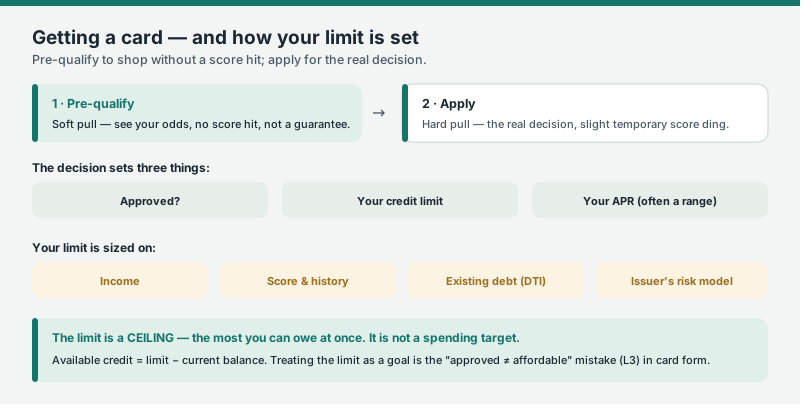
Before any of the mechanics matter, there's the question a beginner actually faces first: how do you get a card, and where does that credit limit come from? When Maya applies — online, in a branch, or by responding to a pre-approval offer — the issuer pulls her credit (a hard inquiry, from Lesson 4), checks her income and existing debts, and decides three things at once: whether to approve her, what credit limit to grant, and what APR to charge. Here's the on-ramp:
A few practical points turn this from a diagram into something Maya can act on.
Pre-qualify before you apply. Most issuers let her pre-qualify (or pre-approve) with a soft pull — it estimates her odds without touching her score and isn't a binding guarantee. Applying is the hard pull and the real decision, with the small temporary score ding from Lesson 4. The smart sequence is to pre-qualify across a few cards to see where she stands, then formally apply only for the one she's likely to get — which keeps her hard inquiries to a minimum (the §2 restraint from Lesson 4). Shopping with soft pulls and committing with one hard pull is how she avoids the inquiry flurry that drags a score down.
How the limit gets sized, and why a small first limit is normal. The four inputs — income, credit score and history, existing debt (her DTI from Lesson 3), and the issuer's own risk model — combine into the number the bank is willing to risk. A first card on a thin file typically gets a low limit, a few hundred to a couple thousand dollars; a secured card's limit simply is the deposit (Lesson 4); and someone like Sofia, super-prime, gets high limits offered unsolicited. A low first limit isn't a judgment of Maya's character — it's the bank starting cautiously with someone it doesn't know yet, and it grows with her history.
What the limit is — and what it absolutely isn't. The limit is a ceiling, the most Maya can owe at any moment, not a spending target and not a statement of her worth. A $3,000 limit is not $3,000 she's meant to spend; it's the maximum the bank will let her borrow, and her available credit at any time is the limit minus her current balance. Treating the limit as a goal — "I have room, so I'll use it" — is exactly the approved-isn't-affordable error, and it's the first mental step toward Darnell's side of the line.
Limit increases are a quiet gift — for a reason most people miss. After six to twelve months of good use, Maya can request a credit-limit increase (or get an automatic bump), and the real benefit isn't more spending room — it's that a higher limit lowers her utilization at the same spending. The same $300 balance is 30% of a $1,000 limit but only 10% of a $3,000 limit, so a bigger limit improves her score without her spending a dollar more (§14 develops this). Two cautions: a CLI request may be a soft or a hard pull, so it's worth asking which before requesting; and a larger limit is emphatically not permission to carry a larger balance — the ceiling rose, the spending shouldn't.
Two more things worth knowing. Maya reports income on the application, and under the CARD Act, an applicant under 21 generally needs their own income or a co-signer (the Lesson 4 §16 rule) — issuers are required to consider her ability to pay, not just her score. And if she's declined, she's legally entitled to an adverse-action notice stating the reason (a right under ECOA and FCRA): she can use it — address the specific reason and reapply, or, if the answer is "insufficient history," start with a secured card and build first, exactly as Priya is doing and as Maya herself did before graduating to the unsecured card she carries now.
That graduation is worth pausing on as the encouraging note: Maya's path — secured card in Lesson 1, used well, graduated to a real card with a real limit — is the on-ramp working as designed. The limit she now holds is something she earned with a year of small, on-time payments, not something she was simply handed.
With the card in hand and the limit understood, the next thing to master is the rhythm it runs on — the billing cycle and the grace period, where "pay in full" becomes a concrete mechanic. That's the next turn.
The Billing Cycle and Grace Period — Where "Pay in Full" Becomes Free
"Pay in full" has been the refrain since the opening, but it only becomes actionable once Maya understands the rhythm her card runs on — because the magic word "free" depends entirely on paying the right amount at the right moment. Three dates govern everything: the cycle, the statement, and the due date.
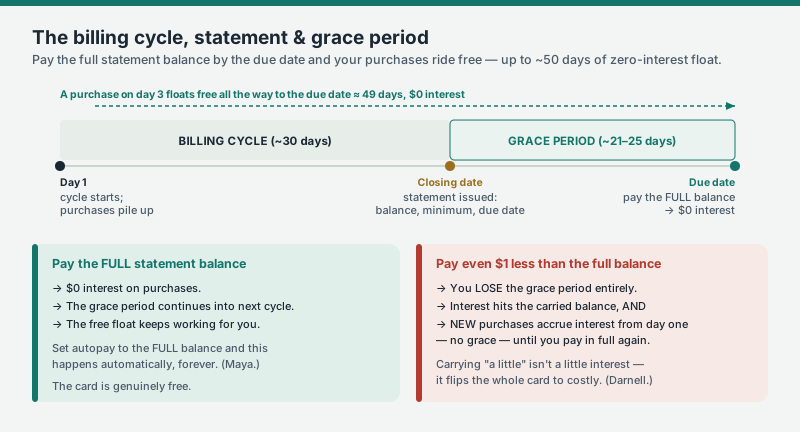
Walk the timeline once and the mechanic clicks. The billing cycle is roughly a month during which Maya's purchases simply accumulate — nothing is charged in interest yet, nothing is due. At the end of it, the closing date, the issuer totals everything into a statement that shows three numbers: her statement balance (what she owed at closing), her minimum payment, and her due date — which, by law (the CARD Act), must be at least 21 days after the statement, giving her a window of about 21 to 25 days to pay. That window is the grace period, and it's the entire source of the card's magic.
Here's the rule that everything in this lesson protects, stated as plainly as it can be: if Maya pays her full statement balance by the due date, she owes zero interest on her purchases — ever. Not reduced interest, not a little interest: none. The grace period is the bank lending her the purchase money for free, and because a purchase made early in the cycle gets floated from its purchase date through the statement and all the way to the due date, that's up to roughly 50 days of interest-free credit on her own spending. The "free short-term loan" from the opening is literally this: buy in week one, pay nothing until seven weeks later, owe no interest. The cleanest way to guarantee it is the single most important card setup there is — set autopay to the full statement balance (not the minimum). Done once, it means Maya can't carry a balance, can't lose the grace period, and can't pay interest, no matter how distracted a month gets. This is how she and Sofia turn the card into the free, paying tool from §1.
And here is the part most people don't know — the cliff in the red panel, and the single most important thing in this section: the grace period is all-or-nothing. If Maya pays even one dollar less than her full statement balance, she doesn't just owe interest on that small leftover — she loses the grace period entirely. Two things happen at once. The carried balance starts accruing interest, and — the part that blindsides people — her new purchases begin accruing interest from the day she makes them, with no grace period at all, until she pays in full for (usually) two consecutive cycles to earn it back. So carrying "just a little" doesn't cost "a little interest on a little balance"; it flips the whole card to the expensive side, charging her from day one on groceries she hasn't even been billed for yet. This is exactly what happened to Darnell in Lesson 2: the moment he carried a balance, his card stopped floating him and started charging him on everything, which is why a small carried balance is so much more corrosive than it appears.
This is also why the statement carries a feature worth noticing: by law, it shows a minimum payment warning — a box stating roughly how many years and how many dollars it would take to clear the balance paying only the minimum. It exists because the minimum is engineered to feel manageable while keeping the cardholder in interest indefinitely (the trap §13 and §20 take apart). The minimum keeps Maya current; only the full balance keeps her free.
So the whole drama of the credit card reduces to one recurring action on one recurring date: pay the full statement balance by the due date, and the card is a free, rewarded, fraud-protected tool. Pay less, and the grace period collapses and the meter starts running on everything. "Pay in full" isn't moralizing advice — it's the mechanical switch between the two products from §1.
That raises the obvious next question: exactly how much does it cost when the meter does run — how is the interest actually calculated once the grace period is gone? That's the next turn.
The Three Balances — What You Actually Owe, and Which One to Pay
When Maya opens her card app, she doesn't see one number — she sees several, all labeled some version of "balance," and confusing them is the most common credit-card mistake there is. Pay the wrong one and she either loses her grace period or overpays out of confusion. Three numbers matter, and they mean genuinely different things:
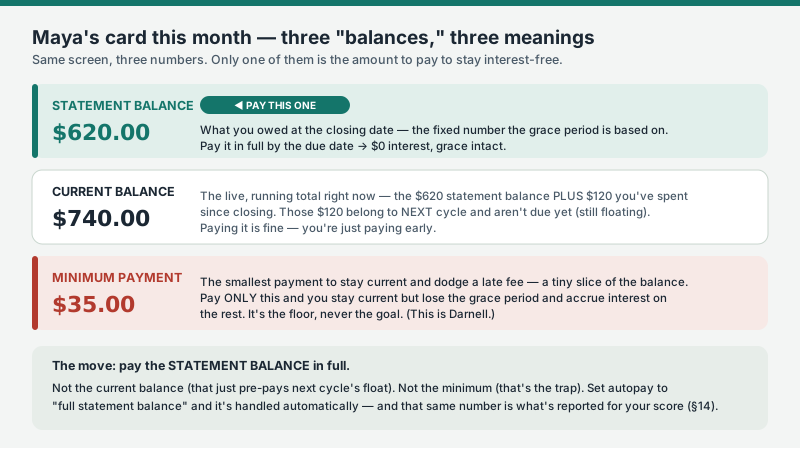
Each number answers a different question, and getting them straight is what makes "pay in full" foolproof.
The statement balance ($620) is the one that matters most. It's a fixed snapshot — what Maya owed at the closing date — and it's the exact figure the grace period is built on (§3). Pay this in full by the due date and she owes zero interest, full stop. Critically, it doesn't change during the grace period: purchases she makes after closing don't get added to it, so she always knows the precise number she needs to pay. This is the answer to "how much do I pay to stay free?" — always the statement balance, never more is required, never less is safe.
The current balance ($740) is the live, running total of everything she owes right now — the $620 statement balance plus the $120 she's spent since the cycle closed. It moves every time she taps her card. The confusion it causes is predictable: Maya sees $740 when her statement said $620 and wonders if something's wrong. Nothing is — that extra $120 belongs to the next statement and isn't due yet; it's still floating interest-free (§3). She can pay the full $740 if she likes, but she'd just be pre-paying next cycle's float early, surrendering a few days of free credit. It's harmless, not required. (And the flip side: when she "pays off" the card and then sees the balance creep back up, that's not interest reappearing — it's simply new purchases landing on the live current balance. Also normal.)
The minimum payment ($35) is the dangerous one precisely because it looks reasonable. It's the smallest amount that keeps her account current and dodges a late fee — typically a tiny slice of the balance, often around 1–3% or a flat floor like $35. Paying only the minimum keeps Maya current, which is why it feels safe, but it does two costly things: it leaves the rest of the balance to accrue interest, and (per §3) it loses the grace period so even new purchases start charging from day one. The minimum is the floor — the line between "current" and "late" — and it is never, ever the goal. Treating it as the goal is precisely the road Darnell has been on since Lesson 2.
So the verdict resolves cleanly, and it's the whole section in one move: pay the statement balance in full. Not the current balance (that only pre-pays the float she's entitled to keep), and emphatically not the minimum (that's the trap). The cleanest execution, tying back to §3, is to set autopay to "full statement balance" — most issuers offer exactly that option alongside "minimum," "current balance," and "fixed amount." Choosing statement balance means the precise number that keeps her interest-free and her grace period intact is paid automatically, every cycle, without her having to log in and decode three figures under pressure.
One bonus worth flagging, because it connects two parts of the lesson: the statement balance isn't only the number that governs interest — it's typically also the balance reported to the credit bureaus, the figure that drives her utilization and therefore her score (§14). So that single number does double duty: pay it down and she's protecting both her wallet (no interest) and her credit (low reported utilization) at once. Getting the three balances straight isn't just trivia — it's the difference between Maya using the card and the card using her.
That settles which number to pay. The next turn faces the other side: what actually happens, in dollars, when someone doesn't — exactly how the interest is calculated once the grace period is gone. That's §5.
How Card Interest Is Actually Calculated
The last two sections established when interest starts — the moment Maya carries any balance and loses the grace period. This one answers how much, in dollars, because the mechanics are specific to cards and worth seeing concretely. Once the grace period is gone, the card charges interest by the average daily balance method, and it runs on a daily meter. Try it with a carried balance:
What a carried balance actually costs
Interest runs on a daily meter once you lose the grace period. Pay in full and all of this is $0.
Daily periodic rate (APR ÷ 365)
0.0685%/day
≈ $0.68 of interest per day
Cost of carrying it
~$20.74 / month
~$284 / year — an effective 28.4% APY
The mechanism is the Lesson 2 interest machinery applied to a card's daily rhythm. The issuer takes the APR and divides it by 365 to get a daily periodic rate — for Darnell's 24.99% card, that's about 0.0685% per day. Each day, it multiplies that rate by his balance to find that day's interest, adds it to the balance, and repeats — so the interest itself starts earning interest, compounding daily (the §-Lesson-2 §3 mechanic). Over a cycle, it works out to roughly his average daily balance times the daily rate times the days in the cycle. Carrying $1,000 at 24.99% costs him about $0.68 a day, ~$20.50 a month — and because of the daily compounding, a balance held all year costs closer to $284, an effective rate near 28%. That gap between the 24.99% on the label and the ~28% he actually pays is the Lesson 2 point exactly: the APR is the name, the daily compounding is the bite.
Three card-specific consequences make this worse than the single number suggests, and they're the reason "pay in full" is non-negotiable rather than just thrifty.
First, the grace-period multiplier from §3. The $20.50 isn't the whole cost — once Darnell loses his grace period, his new purchases also start accruing from day one. So the meter doesn't run only on the old $1,000; it runs on the old balance plus every new swipe, immediately, with no float on any of it. Carrying a balance doesn't just cost interest on the balance — it converts the entire card to an instant-interest instrument.
Second, because the charge is based on a daily average, when he pays matters, not just whether he pays by the due date. If he's already carrying, paying $400 down on the 5th of the cycle instead of waiting until the due date lowers his average daily balance for the rest of the month and shaves the interest. It's a small lever, and it's no substitute for paying in full — but for someone digging out, every day a payment lands sooner is a day of lower balance being metered.
Third, there's a protection worth knowing about how payments are applied. Under the CARD Act, any payment Darnell makes above the minimum must be applied to his highest-APR balance first — a genuine consumer safeguard. This matters most when he carries a mix of rates: say purchases at 24.99% and a balance transfer sitting at 0% (the §11 document). The minimum payment can legally be applied to the lowest-rate portion (which favors the issuer), but everything above the minimum attacks the highest rate first (which favors him). So the move, when carrying mixed rates, is to pay well above the minimum, knowing the extra is automatically aimed at the most expensive debt.
The takeaway lands where the whole lesson keeps pointing: the only way to pay $0 is to never carry. There's no clever payment timing or rate that beats simply paying the statement balance in full — once the balance carries, the meter runs every day, on everything, compounding. The interactive's last line is the entire point: change the inputs however you like, and the figure becomes $0 the moment "pay in full" is true.
One balance type is even worse than a carried purchase balance, because it skips the grace period entirely and starts at a higher rate — the cash advance. That's the next turn.
Cash Advances — The Most Expensive Way to Use a Card
There's one use of a credit card that breaks every protective feature at once, and it deserves its own section precisely because it's so easy to trigger by accident. A cash advance is using the card to get actual cash — at an ATM, a bank teller, or via the "convenience checks" issuers mail out — or to make a cash-like transaction. It's borrowing physical cash against the credit line, and it is, by a wide margin, the most expensive ordinary thing a card can do:
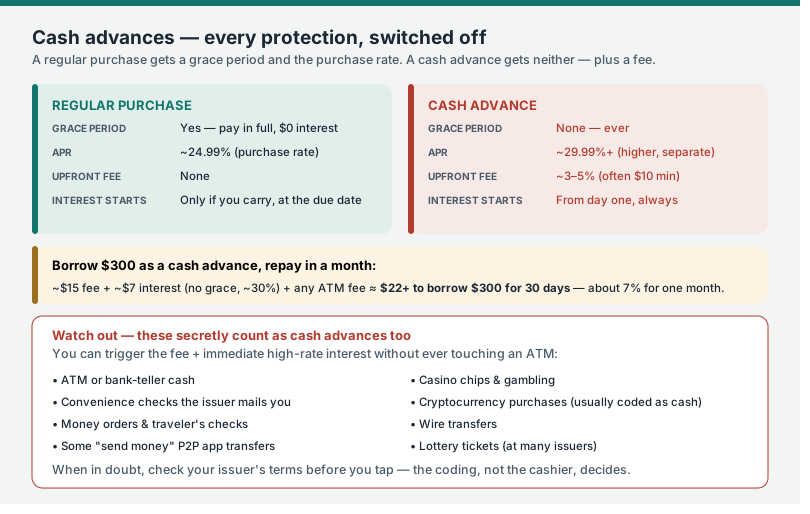
The comparison shows why this is uniquely punishing: a cash advance stacks three penalties that a normal purchase never faces. There's no grace period — interest accrues from the moment Darnell takes the cash, day one, with no "pay it off before the statement" escape hatch that purchases enjoy (§3). There's a higher, separate APR — the cash-advance rate, often near 30% or above, runs well past the purchase rate, and it's listed as its own line in the §-Lesson-1 Schumer box for exactly this reason. And there's an upfront fee — typically 3–5% of the amount (with a $10-ish minimum), charged immediately, so a $300 advance costs about $15 before a penny of interest. On top of those, the ATM levies its own fee, and the cash-advance sub-limit is usually a fraction of his total credit line. The cost strip makes it concrete: borrowing $300 for a single month runs about $22-plus all-in — roughly 7% for thirty days, a rate that makes even a carried purchase balance look gentle.
But the part that catches careful people off guard is the transactions that are secretly coded as cash advances even though no ATM is involved. The convenience checks an issuer mails out are cash advances. So are money orders and traveler's checks, casino chips and gambling, wire transfers, lottery tickets at many issuers, and — the modern surprise — cryptocurrency purchases, which most issuers treat as cash advances, complete with the fee and the day-one high-rate interest. Even some peer-to-peer "send money" transfers can trip it. The danger here is accidental: Darnell could buy $500 of crypto thinking it's a normal purchase and get hit with a ~$25 fee and ~30% interest from the moment the transaction clears, having "used a cash advance" without ever intending to. The rule of thumb is that the coding decides, not the cashier — so when a transaction is cash-like, it's worth checking the issuer's terms first.
There's a small protective nuance from §5: because the cash-advance balance is usually his highest APR, any payment above the minimum is applied to it first (the CARD Act allocation rule), which helps him clear it faster — but it still bleeds at that ~30% until it's gone, and the minimum portion of his payment can be steered to a lower-rate balance, so the advance lingers if he only pays the minimum.
The honest answer to "when is a cash advance ever the right move?" is almost never. It's a last-resort emergency tool and a bad one even then. The far better instrument for "I suddenly need cash" is the thing Lesson 3 built for exactly this moment — the emergency fund, which exists precisely so a surprise doesn't have to be met with 30% borrowing. If Darnell finds himself reaching for a cash advance, that's less a transaction to optimize than a signal to lean on savings, find a lower-rate option, or pause. The practical takeaway is twofold: avoid cash advances as a matter of course, and learn what your card secretly counts as one, so you never trigger the worst pricing on the card by accident.
That covers the costliest transaction type. The next turn steps back to the rates themselves — the full APR family and how those rates can move — so the numbers in the Schumer box stop being a mystery. That's §7.
The APR Family — and Why Your Rate Moves on Its Own
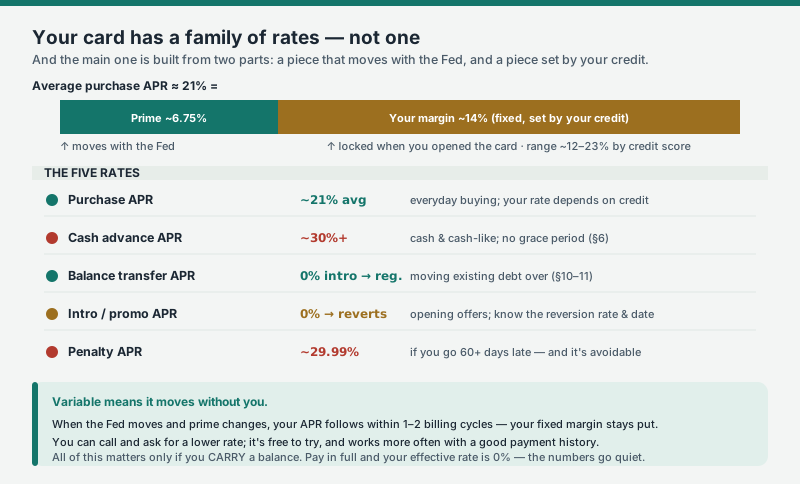
The anatomy at the top is the key to demystifying why a card rate seems to change on its own. Most card APRs are variable, built as prime rate plus a fixed margin. The prime rate — currently around 6.75% — is the benchmark banks track off the Federal Reserve; the margin is a fixed number set when Maya opens the card, based on her creditworthiness. At a 6.75% prime, credit card APRs run roughly 18.75% to 29.75% — prime plus a margin of about 12% to 23% — and the average is about 21% per the Federal Reserve. So the "average 21%" decomposes into prime (~6.75%) plus a typical margin (~14%), and which margin Maya gets is set by her credit — a 750-plus score earns the low end of a card's rate range, while subprime profiles get the highest APRs. Sofia, super-prime, sits near the bottom of the range; a thin-file beginner sits near the top.
A credit card doesn't have one interest rate; it has a whole family of them, which is why the Schumer box from Lesson 1 (and DW#1, coming in §9) lists several. Each rate applies to a different use, and they range from merely high to genuinely punishing:
- Purchase APR — the rate on everyday spending; variable (prime + margin), typically the lowest rate in the family
- Balance-Transfer APR — the rate on balances moved from another card; often equals the purchase rate at the regular (non-promo) level
- Cash-Advance APR — separate, higher (often near 30%), with no grace period; covered at length in §6
- Penalty APR — the punitive rate (often up to 29.99%) imposed when a payment goes 60+ days late
- Intro/Promotional APR — a temporary reduced rate (sometimes 0%) on purchases or balance transfers for a set window; reverts to the regular rate at the deadline
That structure explains the Lesson 2 mystery — "my rate went up and I didn't do anything." Because the rate is variable, when the Federal Reserve changes rates, the prime-rate move passes through to cardholders quickly, usually within one to two billing cycles. Maya's margin never changes, but the prime piece rides up and down with the Fed automatically, with no action — or notice beyond the statement — on her part. (Truly fixed-rate cards exist but are rare, and even those can change with 45 days' notice.)
The one rate Maya actually controls is the penalty APR — a punitive rate, often around 29.99%, that the issuer can impose if she triggers it, most commonly by letting a payment go 60 or more days late. Here the CARD Act builds in real guardrails: the issuer must give 45 days' advance notice before raising the rate on new transactions; it generally can't raise the rate on her existing balance in the first year (the 60-day-late case is the main exception); and if a penalty APR was imposed for lateness, six months of on-time payments requires the issuer to restore the prior rate on that existing balance. The upshot is simple and reassuring: the penalty APR is entirely avoidable — don't go 60 days late, and it never appears.
The other rates in the family are mostly handled elsewhere — the cash-advance rate (highest, no grace) was §6, and the balance-transfer and intro/promo rates are promotional numbers that revert to a regular rate on a deadline, which §10 and §11 take apart (knowing the reversion rate and date is the whole game with those). But two practical points apply across the whole family. First, Maya is not stuck with her rate: she can call and ask for a lower APR, which costs nothing and works surprisingly often with a solid payment history, and improving her credit over time qualifies her for genuinely lower-rate cards. Second — the teal note's quiet point, and the thread running through this entire lesson — all of these rates only matter if she carries a balance. As the data sources put it bluntly, for someone who pays the full statement balance every month, the rate is essentially moot; interest never gets the chance to accrue. Knowing the family isn't about fearing the numbers — it's so she reads the Schumer box correctly and is never ambushed by the cash-advance or penalty rate.
That makes this the natural moment to look at the other recurring cost the card can carry — the fees — before we read the document that lists every rate and fee in one place. Fees are the next turn.
The Fee Stack — Which Are Avoidable, and Which Are a Choice
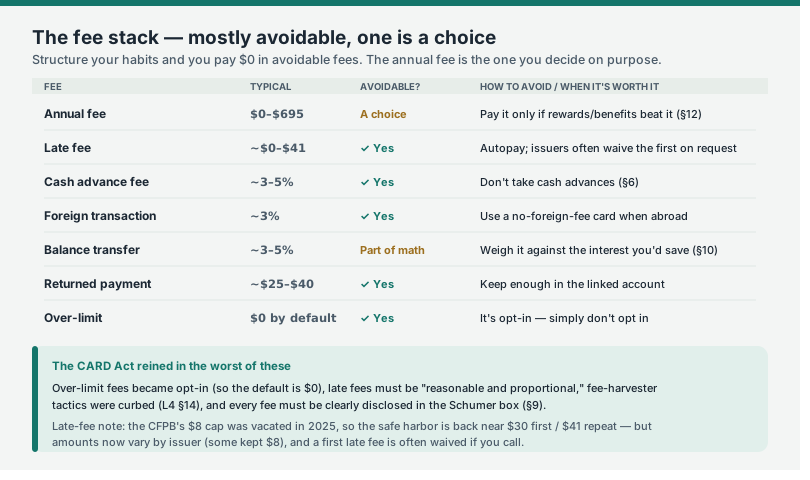
The CFPB's $8 late-fee cap was vacated in April 2025, so late fees reverted to the CARD Act's higher "reasonable and proportional" amounts, though actual fees now vary by issuer.
Interest is what a card charges when you carry; fees are what it can charge regardless. There aren't many, and the useful way to see them is in two buckets: fees you avoid entirely by behavior, and one fee that's a choice you make on purpose.
The two buckets are the whole mental model, so it's worth taking them in turn.
The avoidable-by-behavior fees — these should all be $0 for you. A late fee hits if you miss the due date, and the current picture is worth stating precisely because it's been in flux: the CFPB finalized an $8 cap in 2024, but a federal court vacated that rule on April 15, 2025, with the CFPB itself agreeing it violated the CARD Act, so the safe-harbor amounts reverted to roughly $30 for a first missed payment and $41 for subsequent late payments. In practice it now varies — some large issuers kept the lower $8 fee, while subprime and smaller issuers sit at the older schedule, and a first late fee is often waived if you simply call and ask. But the dollar amount is almost beside the point, because the late fee is fully avoidable with the autopay-to-statement-balance setup from §3 — and avoiding it matters for reasons bigger than the fee: a late payment can trigger the penalty APR (§7) and, if it reaches 30 days late, put a derogatory mark on your credit report, which costs far more than $41. A cash-advance fee (~3–5%) and a foreign-transaction fee (~3%) are avoided the same way — don't take cash advances (§6), and carry a no-foreign-fee card when you travel, since many travel and rewards cards waive that 3% entirely. A returned-payment fee (~$25–$40) is avoided by keeping enough in the linked account, and it's especially worth dodging because a bounced payment can also make you late, stacking two fees. And the over-limit fee is, by default, $0 — because the CARD Act made it opt-in: unless you affirmatively choose to allow over-limit transactions, a charge that would exceed your limit is simply declined at no cost, so the move is just to never opt in.
The one fee that's a choice — the annual fee. Unlike the others, the annual fee ($0 to $695) isn't an accident to avoid; it's a deliberate trade. You pay it to buy something — a higher rewards rate, travel credits, lounge access, purchase protections — and it's worth paying only if the value you'll actually use exceeds the fee, which is the break-even math §12 works through with real numbers. For many people, including Maya, a solid no-annual-fee card does the core job free. For someone like Sofia, whose spending and travel let her extract more value than the fee costs, paying it is rational. The fee itself is neither good nor bad; it's only worth it if the math works, and §12 shows how to check.
Underneath all of this sits the CARD Act, which reined in the worst fee abuses: it made over-limit fees opt-in, required late fees to be "reasonable and proportional" to the violation, curbed the fee-harvester tactics from Lesson 4's predator, and — most usefully for you — required that every fee be clearly disclosed in one place, the Schumer box. That last point is the practical skill this section builds toward: read the fee schedule before you get a card, know exactly which fees it charges, and structure your habits — autopay, no cash advances, the right card abroad, funds in the account — so you pay zero in avoidable fees, paying an annual fee only when you've done the math and it earns its keep. Do that, and the entire fee column of a credit card becomes either $0 or a deliberate, profitable choice.
That fee schedule lives inside a larger document — the one that also lists every APR from §7, the grace-period terms from §3, and the minimum-payment formula. It's time to read it in full. The Credit Card Agreement is the next turn, the first of the lesson's two Document Walkthroughs.
Document Walkthrough #1 — the Credit Card Agreement
WHERE & WHAT + MODE. This is the Cardholder Agreement — the binding contract that governs Maya's card, and the single document that contains everything the last seven sections discussed in one place. Where: she receives it when she opens the card (mailed and/or posted to her online account), and it lives permanently in her card's app or website under "Documents" or "Cardholder Agreement"; a condensed version of its cost tables — the Schumer box from Lesson 1 — also appears on the application and card mailer. What: it has two parts — the TILA cost-summary tables ("Interest Rates and Interest Charges" and "Fees," the regulated boxes) plus the narrative terms that spell out how interest is calculated, how the grace period works, how payments are applied, how the minimum is figured, when the penalty APR hits, and the legal boilerplate. Mode: mostly digital now (a PDF in her account), sometimes paper at opening — and the whole point is that she can, and should, read it before she ever carries a balance. Here is the full document:
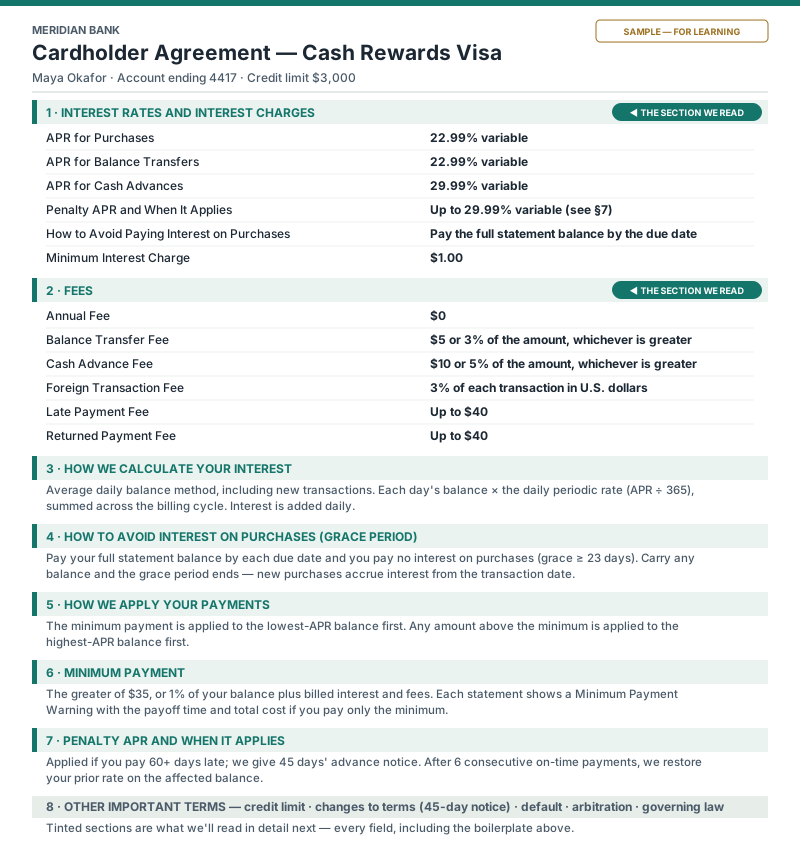
That's the whole document, the way it actually arrives — not a fragment of it. Notice the shape: the two tinted tables at the top (Interest Rates, and Fees) are the regulated Schumer box that Lesson 1 introduced, the standardized cost summary every card must show. Everything below them is the part most people never open — the narrative sections (3 through 8) that explain how those numbers actually operate: how interest is computed, how the grace period is won or lost, how payments land, how the minimum is figured, when the penalty rate strikes, and the legal terms governing the account. The tables tell Maya the prices; the sections tell her the rules of the game. Reading only the tables — which is as far as most people get — is like knowing a car's price but not how to drive it.
Two things are worth flagging before the detailed read. First, every number here is something the last seven sections already taught Maya to understand: the 22.99% purchase APR is prime-plus-margin (§7), the 29.99% cash-advance APR with no grace is §6, the "average daily balance" method in section 3 is the §5 calculation, and the grace-period language in section 4 is the §3 all-or-nothing cliff in legal form. The agreement isn't introducing new concepts — it's the place where all of them are written down for her specific card. Second, the boilerplate section 8 is shown deliberately, because it's part of the real document and contains things that matter (the changes-to-terms clause, the arbitration provision) — and the breakdown will teach those at the same depth as the headline rates, not skip them as "fine print."
The detailed walkthrough comes next, split across two turns so nothing gets compressed: §10 reads the two cost tables plus the interest method and grace period (sections 1–4), and §11 reads payment allocation, the minimum payment, the penalty APR, and the other terms (sections 5–8). That's the next turn.
DW#1 Breakdown, Part 1 — Interest Rates, Fees, Interest Method, and Grace Period
Section 1 — Interest Rates and Interest Charges
APR for Purchases — 22.99% variable. This is the rate Maya pays on everyday purchases if she carries a balance; "variable" means it's prime plus her fixed margin (§7), so it drifts with the Fed. For Maya specifically, this number never actually touches her — as a pay-in-full user, it's the price of a mistake she doesn't make. The stake is what it would cost: carry $1,000 here and it's about $230 a year. It's the headline rate, and for her it's effectively 0% — but it's the meter that starts the day she ever slips.
APR for Balance Transfers — 22.99% variable. The rate on a balance moved from another card. On this base agreement it equals the purchase rate, with no promotional discount. It's irrelevant to Maya unless she transfers a balance — and if she did, transferring to this card would save her nothing, since the rate's identical. The real savings on a transfer come only from a 0% intro offer (the subject of DW#2). Commonly misread: transfers get no grace period even though purchases do — a transferred balance starts accruing immediately, which trips up people who assume "pay it next month" works the same as on a purchase.
APR for Cash Advances — 29.99% variable. The rate on cash advances (§6) — separate, higher, and with no grace period. For Maya it sits seven points above her purchase rate and would accrue from day one if she ever took cash. This is the written confirmation of why §6 said "almost never": the stake is that a $300 advance starts costing immediately at ~30%, on top of its upfront fee.
Penalty APR and When It Applies — up to 29.99% variable. A punitive rate the issuer can impose if Maya triggers it (the full terms are section 7). It would apply if she paid 60+ days late — which, with autopay, she won't. It matters because it's the single most expensive rate on the card and entirely within her control: the stake is that one 60-day-late event could push her whole balance toward 30%.
How to Avoid Paying Interest on Purchases — pay the full statement balance by the due date. This is the agreement stating the grace-period rule (§3) in its own words. For Maya, this one line is her entire strategy, written by the issuer: pay in full, owe nothing. It's the most important sentence in the document for her — follow it and she pays $0 interest forever; ignore it and the §5 meter starts.
Minimum Interest Charge — $1.00. The floor: if she's ever charged interest, it's at least $1, even when the daily math computes to less. It never applies to Maya (she pays $0 interest), but for someone carrying a tiny sliver, a few computed cents round up to a dollar. The stake is small but instructive — there's no such thing as "one cent of interest"; the smallest possible interest event is a dollar, a quiet reminder that carrying even a trace isn't free.
Section 2 — Fees
Annual Fee — $0. What Maya pays yearly just to hold the card — here, nothing. This is the no-fee choice from §8: she gets rewards, the float, and fraud protection at zero standing cost. The stake is exactly what a beginner's everyday card should be — free to carry, costing her nothing as long as she pays in full.
Balance Transfer Fee — $5 or 3%, whichever is greater. Charged when she moves a balance onto this card. Irrelevant unless she transfers, but if she moved $3,000, the fee would be $90. It matters as the cost side of the balance-transfer math (§16): the fee can eat into the interest a transfer is supposed to save, so it's the first number to weigh on any transfer.
Cash Advance Fee — $10 or 5%, whichever is greater. Charged immediately on a cash advance (§6). A $300 advance means a $15 fee plus the 29.99% running from day one. It matters because it stacks with the cash-advance APR — together they're what make advances the worst use of the card — and the stake is roughly $15 gone before any interest even begins.
Foreign Transaction Fee — 3% of each transaction. A surcharge on purchases made abroad or in a foreign currency. If Maya travels and spends $1,000 overseas, that's $30 in fees. It's fully avoidable by carrying a no-foreign-fee card on trips (§8), so the stake is small but pointless to pay. Commonly misread as "only when traveling": it can also hit online purchases from foreign merchants made from her couch at home — the fee follows where the merchant is, not where she is.
Late Payment Fee — up to $40. Charged if she misses the due date; the "up to $40" reflects the CARD Act safe harbor that returned after the CFPB's $8 cap was vacated (§8). For Maya it's $0 with autopay, and even a one-time slip is often waived on first request. But the fee is the small part — lateness also risks the penalty APR and, at 30+ days, a credit-report ding. The stake isn't the $40; it's the credit damage that dwarfs it.
Returned Payment Fee — up to $40. Charged if a payment bounces for insufficient funds. Avoided entirely by keeping enough in the linked account. It matters because a bounce can also make her late, stacking two fees and the late consequences — so the stake is up to $40 plus everything a late payment triggers.
Section 3 — How We Calculate Your Interest
Average daily balance, including new transactions. This is the method from §5 stated as contract: each day's balance times the daily periodic rate (APR ÷ 365), summed across the cycle, with interest added daily so it compounds. For Maya it defines, to the penny, what a carried balance would cost — and the three words "including new transactions" are the §3 grace-loss cliff in legal form: once she's carrying, every new purchase joins the daily average immediately. It matters because this clause is the engine behind every interest figure on the card. The phrase to catch: "including new transactions" is easy to skim past, but it's exactly what makes carrying so corrosive — new spending starts accruing from the transaction date, with no grace, the moment a balance is carried.
Section 4 — How to Avoid Interest on Purchases (Grace Period)
Pay your full statement balance by each due date → no interest; grace ≥ 23 days. The grace-period rule (§3) as a binding term, with this card's specific window spelled out: at least 23 days between statement and due date. For Maya it confirms her float — purchases ride free if she pays in full, and 23-plus days is the time she has to do it. It matters as the operational heart of "pay in full," and the clause's second sentence — carry any balance and the grace period ends, new purchases accruing from the transaction date — is the all-or-nothing cliff written into the contract. The stake is the whole game: this single provision is what keeps her card free.
That's sections 1–4 read in full. The remaining sections — how payments are applied, how the minimum is calculated, the penalty-APR terms, and the boilerplate that quietly carries real weight — are §11, the next turn.
DW#1 Breakdown, Part 2 — Payment Allocation, Minimum Payment, Penalty APR, and Other Terms
Section 5 — How We Apply Your Payments
The minimum goes to the lowest-APR balance first; anything above the minimum goes to the highest-APR balance first. This is the payment-allocation rule from §5 written as contract, and it has two halves that pull in opposite directions. What it is: a rule splitting Maya's payment by destination depending on whether it's the minimum or more. What it does for her: if she ever carries a mix of rates — say purchases at 22.99% and a cash advance at 29.99% — the half that favors the issuer (the minimum) is steered to her cheapest balance, while the half that favors her (everything above the minimum) is automatically aimed at her most expensive balance. Why it matters: this is the CARD Act protection that rewards paying more than the minimum — the extra dollars attack the 29.99% cash advance first, clearing her priciest debt fastest. The stake is concrete: on a mixed balance, paying only the minimum lets the high-rate piece linger by design, while paying above it dissolves the worst debt first. The asymmetry to catch: people assume a payment hits "the balance" uniformly — it doesn't; the minimum and the amount above it are routed to opposite ends of the rate ladder, which is exactly why "pay more than the minimum" is mechanically, not just morally, the right move.
Section 6 — Minimum Payment
The greater of $35, or 1% of your balance plus billed interest and fees. What it is: the formula that produces the minimum-payment figure Maya sees on each statement (the §4 "floor" number, now defined). What it does for her: it tells her how that small number is built — a flat $35 floor, or, once her balance is large enough that 1% exceeds $35, one percent of the balance plus that cycle's interest and fees. Why it matters: the formula reveals why minimum payments trap people — at just ~1% of principal, the minimum barely dents what's owed, so a balance paid at the minimum shrinks at a crawl while interest reloads it (the Lesson 2 Darnell math). The stake is that the minimum is engineered to be survivable, not to make progress — which is the whole point of the warning that comes with it.
The Minimum Payment Warning — payoff time and total cost if you pay only the minimum. What it is: the CARD Act-required disclosure box printed on every statement. What it does for her: it shows, in plain numbers, how many years and how many dollars it would take to clear the balance at the minimum — turning an abstract trap into a concrete one. Why it matters: it exists precisely because the minimum is so seductive; for someone like Darnell it's the line on the statement that says, in effect, "this path costs you years and thousands." The stake is that this box is the issuer legally telling the cardholder the truth about the minimum — and it's worth reading every time.
Section 7 — Penalty APR and When It Applies
Applied if you pay 60+ days late; 45 days' advance notice; restored after 6 consecutive on-time payments. What it is: the full terms behind the section-1 penalty rate (§7). What it does for Maya: it spells out the exact trigger (a payment 60 or more days late), the warning she'd get (45 days' notice before it hits new transactions), and — crucially — the way back (six straight on-time payments restores her prior rate on the affected balance). Why it matters: it makes the worst rate on the card both avoidable and reversible — she controls the trigger, and even if she ever hit it, it's not permanent. The stake is real but bounded: a 60-day slip is costly, but the contract itself provides the off-ramp, so it's a setback, not a life sentence. Commonly misread as "any late payment": a single payment a few days or even a few weeks late does not trigger the penalty APR here — the contract trigger is 60+ days, which is a meaningfully high bar that autopay clears easily.
Section 8 — Other Important Terms (the boilerplate — read at full depth)
Credit Limit — $3,000, may change with notice. What it is: the ceiling from §2, stated as a term, plus the issuer's right to adjust it. What it does for her: it confirms the most she can owe and flags that the bank can raise it (often automatically, helping her utilization) or lower it. Why it matters: a limit cut — which issuers can do, especially if they see risk — would suddenly raise her utilization on the same balance (§14) and could even put her near her limit unexpectedly. The stake is that her limit isn't permanently fixed, so a surprise reduction is something to watch for, not assume away.
Changes to Terms — 45 days' advance written notice; opt-out on certain changes. What it is: the clause governing how the issuer can change the agreement itself. What it does for her: it guarantees Maya 45 days' warning before a significant change (like a rate increase on new transactions) and, for certain changes, a right to reject them — typically by closing the account to new purchases and paying off the existing balance at the old terms. Why it matters: this is the boilerplate that protects her from silent term changes; the stake is that those "notice of changes to your account" inserts she might toss as junk mail are exactly this clause in action, and ignoring one could mean accepting a worse rate by default. Worth catching: the notices that look most like junk mail are the ones this clause requires — they're the warning system, not advertising.
Default — triggered by events like a returned payment or exceeding your limit. What it is: the definition of what puts the account in default. What it does for her: it lists the missteps (bounced payment, over-limit, serious lateness) that can flip the account into a default state with harsher consequences. Why it matters: default can unlock the penalty APR and other remedies, so knowing what counts as default helps her avoid stumbling into it. The stake is that "default" isn't only failing to pay — smaller events can trigger it, which is one more reason the avoidable fees in §8 are worth avoiding.
Arbitration — disputes may be subject to binding arbitration; reject within the stated window. What it is: the clause routing legal disputes to private arbitration rather than court, usually with a class-action waiver. What it does for her: it sets how a serious dispute with the issuer would be resolved — and many agreements give a brief window after opening to opt out of arbitration in writing while keeping the card. Why it matters: it quietly shapes her legal recourse; the stake is meaningful enough that it's worth checking whether her card offers an opt-out and the deadline to use it — a right most people never realize they have because they didn't read this far. The genuinely consequential fine print: this is the clause people most often regret not reading, because the opt-out window closes early and silently.
Governing Law — federal law plus the issuer's home-state law. What it is: the clause naming which laws govern the agreement. What it does for her: it explains a quirk of US credit cards — the issuer's home state (often one with permissive rate rules) governs the contract, not necessarily Maya's state of Ohio. Why it matters: it's why card APRs aren't capped by her state's usury limits — the issuer's chosen state controls. The stake is mostly contextual, but it answers a real question ("why can my card charge 23% when my state caps loans lower?") and reinforces that with cards, the federal floor plus the issuer's-state rules are what apply, not her local protections.
That closes DW#1. Read in full, the Cardholder Agreement is the entire lesson written down for one specific card: the §7 rate family in the first table, the §8 fee stack in the second, the §5 interest math and §3 grace cliff in the narrative, and — in the boilerplate everyone skips — the protections (45-day notice, arbitration opt-out) and risks (limit cuts, default triggers) that quietly govern the relationship. The takeaway for Maya, and for anyone: the tables tell you the prices, the sections tell you the rules, and the "fine print" is often where the most useful rights and the most avoidable traps both live. Reading it once, before you ever carry a balance, is an hour that pays for itself.
With the agreement fully read, the lesson turns to the reason most people want a card in the first place — the rewards — and the math of whether they're actually winning. That's the next turn.
Rewards — the Mechanics, the Bonus, and the Break-Even
Rewards are the reason most people want a particular card, and now that §1 explained where the money comes from, they're easy to understand honestly. A reward is the issuer sharing back a slice of the interchange fee (§1) — the bank earns ~2% from the merchant on Maya's spending, and it hands some of that back to her to win and keep her business. That's the whole engine, and it carries the lesson's central caveat: rewards are "free money" only if she pays in full, because the moment she carries a balance, her interest dwarfs anything she earns (§1).
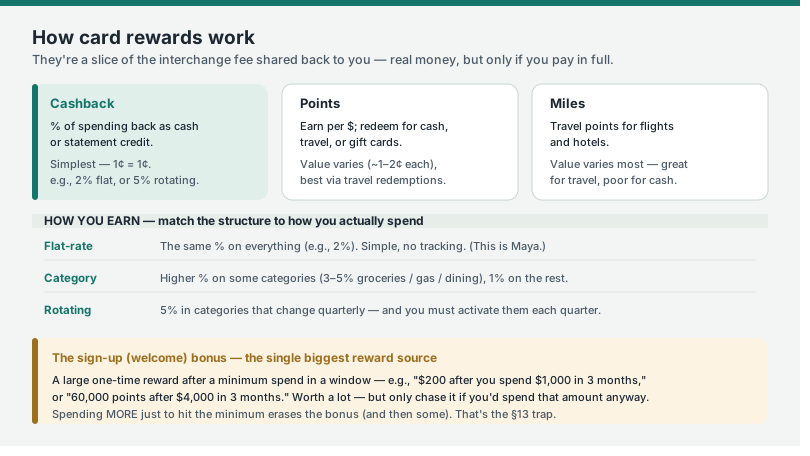
The three currencies differ mainly in how predictable their value is. Cashback is the simplest and the easiest to judge — a percentage of spending back as cash or statement credit, where a penny is always a penny. Points are earned per dollar and redeemed for cash, travel, or gift cards, but a point isn't fixed at 1¢: it's typically worth around 1 to 2 cents depending on how it's redeemed, with travel redemptions usually paying the most and gift-cards or merchandise often the least. Miles are travel-focused and have the widest swing in value — excellent when redeemed for flights, poor when cashed out. The practical rule is that the "cents per point" you actually get at redemption is what matters, not the headline point total — and that cashback wins on simplicity precisely because there's no redemption guesswork.
The earning structures are where Maya matches a card to her real spending. A flat-rate card pays the same percentage on everything (say 2%) with nothing to track — which is exactly why it suits Maya, who wants rewards without managing categories. A category card pays more on specific buckets (3–5% on groceries, gas, or dining) and 1% elsewhere, rewarding someone whose spending concentrates there. A rotating card offers 5% in categories that change each quarter — and the catch is in the small print: she has to activate them every quarter or earn nothing extra. The optimizer's move, which Sofia plays well, is to hold a couple of cards and route each purchase to whichever earns the most; the simplifier's move, which serves Maya fine, is one good flat-rate card and no thinking. Neither is wrong — the higher rate only matters if the effort fits the person.
The gold panel holds the single largest reward source: the sign-up bonus. A welcome offer — "$200 after spending $1,000 in three months," or "60,000 points after $4,000" — dwarfs ongoing earning, often delivering more value in one bonus than a year of regular rewards. But it comes with a minimum spend in a window, and that's the hinge: the bonus is pure profit if Maya would have spent that amount anyway, and a trap if she spends more than she otherwise would just to qualify — because the extra spending erases the bonus and then some (the §13 subject). The bonus rewards normal spending that happens to clear the bar; it punishes manufactured spending.
The one genuinely quantitative decision in rewards is whether a card's annual fee pays for itself — the §8 "choice" fee, now with the math. A fee card only wins if its extra earning plus the benefits Maya actually uses exceed the fee versus a free card. Run it for any spending profile:
Does the annual fee pay off?
Compare a fee card against a free 2% cashback card, for your own spending. (Preloaded: Sofia.)
Free 2% card nets
$400
Fee card nets (after fee)
$855
The break-even logic is just a subtraction, and the calculator makes it concrete. A free 2% card simply returns 2% of spending. A fee card returns its rate on spending, plus whatever benefits Maya genuinely uses (travel credits, lounge access), minus the fee — and it only wins if that total beats the free card. The preloaded numbers are Sofia's: on $20,000 of spending, a 3% card earns $600, plus $100 in benefits she actually uses, minus a $95 fee, nets $605 — versus $400 from the free 2% card, so the fee card wins by about $205 a year for her. But slide the spending down toward Maya's level, or zero out the benefits she wouldn't use, and the advantage shrinks and then flips: the fee card loses when its extra earning can't clear the fee. That's the entire point — the same fee card is a smart choice for Sofia and a waste for Maya, and the only way to know is to run your own numbers. Two cautions the math hides: the benefits only count if she'll truly use them (a $300 travel credit she never redeems is worth $0, not $300), and a fee card's value can erode over time, which is why §19 covers downgrading to a no-fee version when a card stops earning its keep.
Step back, and the honest framing of rewards is the bridge to the next section. Rewards are real money — but they're a rebate on spending Maya would do anyway, not a reason to spend. Paid in full, a 2% card quietly returns 2% of her normal life; chased with extra spending or carried as a balance, the rewards evaporate against the cost. As long as the reward never changes what or how much she buys, she's purely winning. The instant it does, she's losing — and that flip, the rewards trap, is the next turn.
The Rewards Trap — When "Earning" Becomes Losing
Rewards are real money, but only on one condition, and a whole set of traps live in the gap between earning rewards and keeping them. The traps are less about math than about psychology — the way "earning" makes spending feel like winning. Two money facts anchor everything:
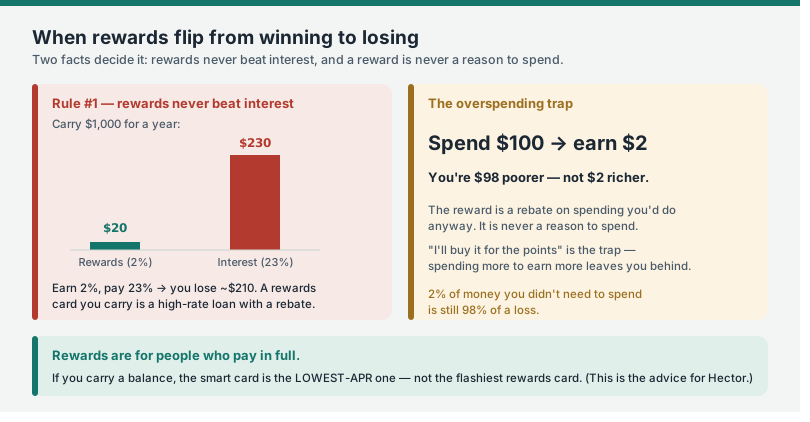
Rule #1 — rewards never beat interest — is the trap that costs the most, and the bars make it brutal. On $1,000 carried for a year, a 2% rewards rate earns about $20 while a 23% APR charges about $230. Earning 2% while paying 23% isn't earning at all — it's losing 21%, and the "reward" is a rounding error against the interest. This is the §1 point in its sharpest form: a rewards card that carries a balance is simply a high-interest loan wearing a small rebate, and the rebate never comes close to the cost. The behavioral danger is that the rewards make the card feel beneficial even as it bleeds money, so the points soften the very wound they're attached to. For anyone carrying a balance, the rewards are worse than irrelevant — they're camouflage.
The overspending trap is the subtler one, because it can catch even a disciplined pay-in-full user. Since a reward is a percentage of spending, the instinct to "spend more to earn more" runs exactly backwards: spend $100 to earn $2 and you are $98 poorer, not $2 richer. The reward is a rebate on spending you'd do anyway — it can never be a reason to spend, because the spending always dwarfs the reward by a factor of fifty. "I'll buy it for the points" is the trap stated aloud; 2% of money you didn't need to spend is still 98% of a pure loss. This is the same logic that turns a sign-up bonus from a gift into a snare (§12): if Maya buys things she doesn't need to hit a "$4,000 in three months" minimum, the manufactured spending erases the bonus and then some.
Around those two money facts sit the behavioral traps that make them easy to fall into, and naming them is the defense:
The "earning" illusion is the root of it. The dopamine of points ticking upward reframes spending as a gain — the app celebrates each purchase, and the brain files it under "I earned something" when the truth is "I spent something." Rewards programs are engineered to feel productive precisely so that spending feels good, and the well-documented behavioral fact underneath is that people spend more with cards than with cash, and more still when chasing rewards. The reward is the bait that increases the interchange the bank collects — Maya's "winning" is also, by design, the issuer's.
Category-chasing is the optimizer's version of the trap: contorting spending to maximize a 5% category — buying things in a bonus category she wouldn't otherwise buy, or routing purchases through gift cards and portals for marginal gains — can easily cost more in unneeded spending (and time) than the extra rewards return.
Points hoarding wastes rewards the opposite way: letting points expire, or redeeming them at poor value (gift cards and merchandise instead of the cash or travel that pays more per point, §12), quietly throws away what was earned. And the annual-fee trap from §12 completes the set: paying $300 a year for a premium card whose travel credit she never redeems means she paid $300 to feel premium — a benefit unused is worth zero, not its face value.
Who does all this actually harm? Not Maya or Sofia, who pay in full and treat rewards as a passive rebate. It harms someone like Hector — tight on cash, prone to carrying a balance — for whom a flashy rewards card is actively worse than a plain one, because his interest swamps any rewards and the "earning" framing nudges him to spend more than he can pay off. The honest, counterintuitive advice for anyone in that position is in the teal strip: if you carry a balance, the smart card is the lowest-APR one you can get, not the best-rewards one. Rewards are a tool for people who've already won the pay-in-full game; for everyone else, a low rate matters infinitely more than a points multiplier.
So the way to win with rewards is almost boringly simple, and it's the mirror image of every trap above: use a card that rewards your normal spending, pay in full so interest never touches you, redeem at good value, and never once let the tail — the rewards — wag the dog — your budget. Don't spend to earn, don't carry to keep points, don't pay a fee for benefits you won't use. Do that, and rewards are free money on the life you were already living. The discipline isn't in maximizing the rewards; it's in refusing to let them change a single thing about how you spend.
That refusal — keeping spending normal — connects directly to the other way a card quietly shapes Maya's finances: how the balance she carries (or doesn't) drives her credit score. Utilization is the next turn.
Utilization — How Your Cards Drive Your Score
Cards don't just cost money; they report on Maya every month, and the chief thing they report is utilization — the percentage of her available revolving credit she's using. From Lesson 4, this is about 30% of a FICO score, the second-biggest factor, and because cards are the revolving accounts, they're its main driver. The mechanics here are specific and, once understood, give Maya a lever most people never realize they're holding. Try it against her $3,000 limit:
What your statement-closing balance reports
Utilization is a snapshot taken when the statement closes — not an average. (Maya's limit: $3,000.)
Reported utilization
72%
Hurting — well over the guideline
The single most important thing in this section is the one the calculator quietly demonstrates: utilization is a snapshot, taken at the statement closing date. The balance that gets reported to the bureaus is the statement balance (§4) — not Maya's average balance over the month, and not her current balance, but whatever the total happens to be the moment the statement closes. This has a consequence that catches even disciplined people off guard: a pay-in-full user can still report high utilization. If Maya runs $1,500 through her $3,000 card and lets the statement close at that balance, she reports 50% utilization — a real drag on her score that month — even though she pays it off in full by the due date and owes $0 in interest. Paying in full protects her wallet; it does nothing, by itself, to protect her reported utilization.
The fix is the lever, and it's all about two different dates. Paying by the due date avoids interest (§3). Paying before the closing date lowers the reported balance. They're separate goals on separate dates, and the trick is to use both: make a payment (or pre-pay a big purchase) before the statement closes so the snapshot catches a low number. If Maya pays that $1,500 down to $300 before her statement closes, she reports 10% instead of 50% — same spending, same $0 interest, dramatically different score impact. A heavy spender who pays in full but lets statements close high is leaving score points on the table for no reason.
A few refinements complete the picture. Utilization is measured at two levels: per-card (each card's balance ÷ its limit) and aggregate (all balances ÷ all limits). Both matter, so a single maxed-out card can ding her even if her overall ratio is low — spreading spending across cards helps the per-card number. The targets are the Lesson 4 ones, refined: under 30% is the common guideline, under 10% is ideal, and — a subtlety — a tiny positive balance (1–9%) often scores slightly better than a flat 0%, because it shows active use. So the goal isn't zero; it's low but not nothing. And the levers to lower utilization without spending a dollar less are worth collecting: pay before the closing date (timing), request a credit-limit increase (§2 — a bigger denominator shrinks the ratio), keep old cards open (§19 — their limits count toward total available credit, so closing one raises utilization), and spread spending across cards.
The most reassuring fact comes last: utilization has no memory. It's recalculated every month from the latest reported balances, so a high month dings Maya that month, and a low month next month restores her — unlike a late payment, which lingers for years (§-Lesson-4 §12). High utilization is one of the few credit problems that's instantly fixable: report a high number in May, report a low one in June, and June is what counts. There's no penalty box to sit in. So if Maya ever needs to apply for a loan, she simply pays her cards down before the statements close in the month or two prior, and presents a low utilization exactly when it matters.
This also closes a loop from §4: the statement balance does double duty. It's both the number Maya pays to avoid interest and the number reported for her score — so paying it down before closing protects her wallet and her credit in a single move. Keep spending normal (§13), let nothing close high, and utilization takes care of itself.
With the score effects understood, the lesson turns to choosing — the types of cards and how to pick the right one for a given situation. That's the next turn.
The Types of Card, and How to Pick the Right One
There are more kinds of credit card than most people realize, and the goal isn't to know them all — it's to know which one your situation calls for. First, the survey of what's out there:
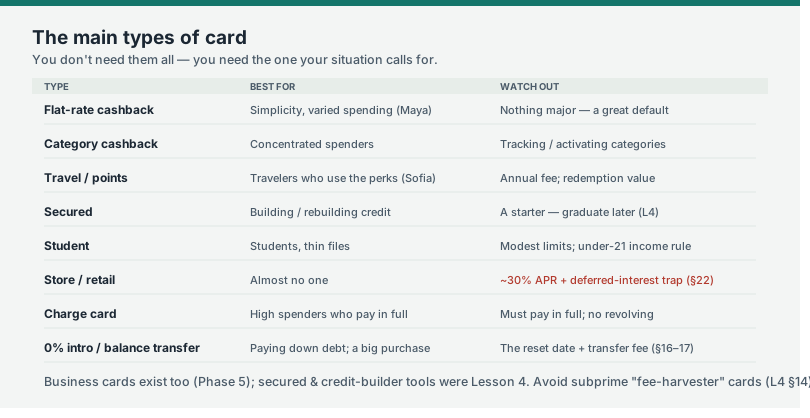
A few of these deserve a word of caution or context. Store/retail cards are the ones to be most skeptical of: they're easy to get and dangle a discount at checkout, but they typically carry APRs near 30% and are the primary vehicle for the deferred-interest trap that §22 covers — so the 15%-off-today rarely beats the cost if a balance ever lingers. Charge cards flip the usual model — no preset limit, but the entire balance is due monthly with no option to revolve (§1) — which suits a disciplined high spender and traps anyone who can't pay in full. Secured and student cards are the building tools from Lesson 4, meant to be graduated from once credit is established. And the 0% intro/balance-transfer card is a tool for a job — paying down existing debt or floating a planned big purchase — whose whole value hinges on the reset date and transfer fee (§16–17). The rest — flat-rate, category, travel — are the everyday rewards cards §12 already dissected.
Now the part this section exists for: how to actually pick. The mistake most people make is choosing on the flashiest offer — the biggest bonus, the shiniest perks — when they should choose on their own situation. The right card falls out of a short series of questions, asked in order of importance:
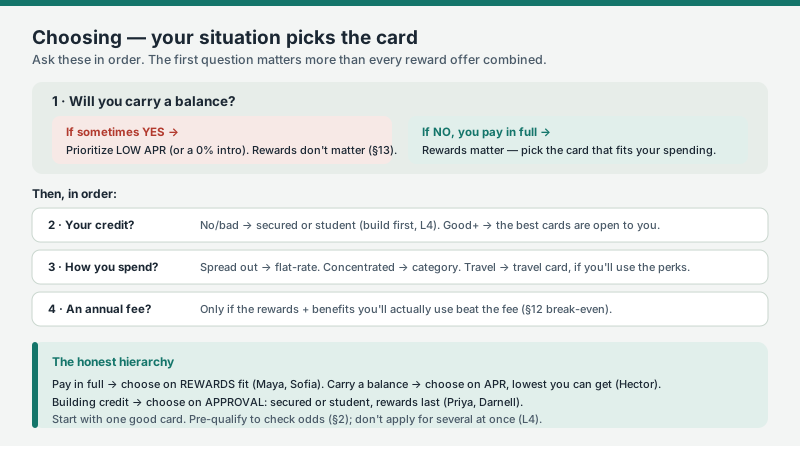
The first question — will you carry a balance? — outranks everything else, and it's the one most people skip. If the honest answer is "sometimes yes," then rewards are irrelevant (the §13 rule: a 2% reward never beats a 23% APR), and the right card is simply the lowest-APR one available, or a 0% intro card to pay down what's there. Choosing a flashy rewards card when you carry a balance is choosing to lose money for points. If the answer is a confident "no, I pay in full," then rewards matter, and the choice opens up to fit. This single fork determines more about whether a card helps or hurts than any feature comparison — which is why it goes first.
After that, the questions narrow the field. Credit sets what's available: no or damaged credit means a secured or student card to build first (Lesson 4), while good-or-better credit opens the best cards. Spending pattern picks the flavor for a pay-in-full user: spread-out spending favors a flat-rate card (Maya's choice), concentrated spending favors a category card, and frequent travel favors a travel card — but only if the perks will actually be used (the §12 break-even). And the annual fee is the last filter: pay it only when the rewards and benefits you'll genuinely use exceed it, otherwise take the no-fee version.
The honest hierarchy in the teal panel is the whole section in three lines, and it maps cleanly onto the roster. Pay in full → choose on rewards fit — Maya picks a simple flat-rate card, Sofia a travel card whose perks beat the fee. Carry a balance → choose on APR — the right move for Hector isn't a rewards card at all, it's the lowest rate he can find, because his interest will dwarf any rewards. Building credit → choose on approval — Priya and Darnell take secured or student cards and worry about rewards later, once a history exists. Notice that the same person would choose differently at different life stages: Darnell rebuilding picks for approval; Darnell in a few years, paying in full, picks for rewards. The card follows the situation, not the other way around.
Two practical closers. Start with one good card — a single card matched to the current situation beats a wallet full of mismatched ones, and complexity (multiple cards, category-juggling) is only worth adding once it clearly pays off. And before applying, pre-qualify to check the odds with a soft pull (§2) and resist applying for several at once (Lesson 4 §2), since each application is a hard inquiry. The flashiest offer in the mail is rarely the right answer; the right answer is whichever card your honest answers to those four questions point to.
One of those card types — the 0% intro / balance-transfer card — is a tool powerful and tricky enough to warrant its own treatment, because it's how someone like Darnell could actually escape a carried balance. The balance transfer is the next turn.
The Balance Transfer — Buying an Interest-Free Runway
For someone already carrying a balance — Darnell, with $5,000 sitting at 24.99% — there's a legitimate tool to escape it, and it's one of the card types from §15: the balance transfer. The idea is to move a high-interest balance onto a card offering a 0% introductory APR for a set window (commonly 15 to 21 months), so that for that stretch, every dollar he pays attacks principal instead of feeding interest. Used right, it's a powerful debt-payoff accelerator; used carelessly, it just relocates the debt. The math decides which — run Darnell's:
Is a balance transfer worth it?
It only works if you clear the balance during the 0% window. (Preloaded: Darnell.)
Transfer fee (upfront)
$150
Net saved vs. staying
~$1109
The mechanics are four simple steps, and the calculator makes the stakes concrete. Darnell opens a card with a 0% intro balance-transfer offer, transfers his $5,000 (the new issuer pays off the old card, moving the debt), pays a transfer fee of about 3% — $150 — added to the balance, and then, during the 0% window, every payment he makes goes entirely to principal rather than interest. The numbers reward this dramatically: staying put at 24.99% would cost him roughly $1,200 in interest while he pays it down; the transfer costs a $150 fee instead, a net saving near $1,100. The transfer essentially buys him an interest-free runway to attack the debt — which is exactly why it's the escape hatch for a carried balance.
But that entire benefit hinges on one condition the calculator enforces in the runway line: he must clear the balance during the 0% window. At $290 a month, his $5,150 clears in about 18 months — just inside the window, so he wins. Drop the payment, though, and the runway turns red: at $200 a month it takes 26 months, well past the 18-month window, and the leftover balance gets hit with the regular APR at the reset. This is the central trap of balance transfers — the snap-back. When the intro period ends, the normal rate (often 20%+) lands on whatever remains. (Importantly, and unlike the deferred-interest predator in §22, a balance-transfer 0% is real 0% during the period — the reset applies going forward to the remaining balance, not retroactively to the whole thing. Still costly, but not the retroactive ambush.) So the transfer is only as good as the payoff plan behind it: it works for someone who can realistically clear the balance before the deadline, and merely relocates the debt for someone who can't.
Several smaller traps trip people up, and they're worth naming because they quietly undo the benefit. The transferred balance gets no grace period, and new purchases on the transfer card usually don't get the 0% rate — they accrue at the regular purchase APR, and may not get grace while he's carrying the transfer — so the rule is to use a balance-transfer card only to pay down the transfer and not spend on it at all. The fee eats the savings on small balances or ones he'd pay off quickly anyway — transferring $800 he'd clear in two months to save a few dollars of interest isn't worth a $24–$40 fee. And the most damaging trap is behavioral: transferring the debt and then running the old card back up, ending with double the debt. The transfer is a payoff tool with a deadline, not a reset that frees up the old card to spend again.
So the honest verdict on when it's a good tool: when Darnell has high-APR debt he can realistically pay off within the 0% window, the fee is clearly less than the interest he'd save, and he stops using the old card. It's not a good move when he can't clear it in time (he'll just hit the reset), when he'll keep spending, when the balance is too small to justify the fee, or when he needs the new card to spend rather than to pay down. Treated as a disciplined payoff plan with a countdown, it can save him over a thousand dollars; treated as free money, it deepens the hole — which is the §20 distinction between getting out of card debt and just moving it around.
That's the concept. The way these offers actually arrive — the fine print that hides the reset date, the fee, and what counts as 0% — is a document worth reading carefully, and it's the lesson's second Document Walkthrough. The 0% intro / balance-transfer offer is the next turn.
Document Walkthrough #2 — the 0% Balance-Transfer Offer
WHERE & WHAT + MODE. This is the promotional offer Darnell would evaluate to execute the §16 transfer — the document behind the "0% APR!" pitch. Where: these arrive as mailers, emails, and online offers when he shops for a transfer card or when issuers prospect him, and they're posted on issuers' "balance transfer" pages and comparison sites. What: a credit-card offer with three layers — the marketing headline up top, the legally required rate and fee disclosure (the Schumer-box tables) in the middle, and the fine-print terms that actually govern the promo: the transfer window, the fee, what forfeits the 0%, and the reset. Mode: mostly digital or mailed, and he'd apply online. The headline sells the dream; the disclosure and terms are where the real deal lives — which is exactly where §18 will read. Here is the whole offer:
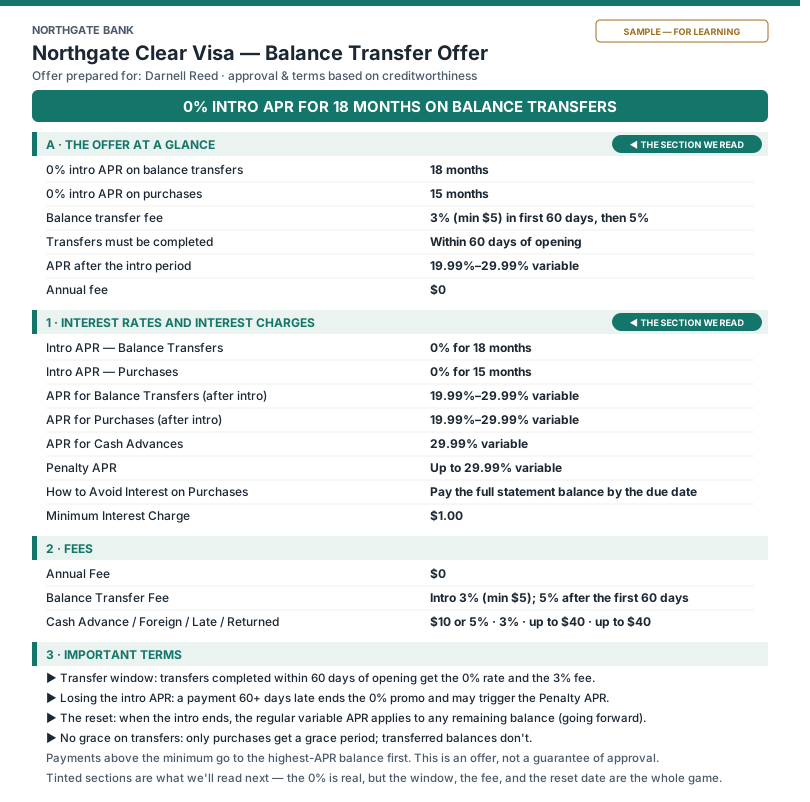
That's the whole offer as it actually arrives — not just the teal banner, which is all most people read. Notice the structure mirrors what §16 warned about: the headline sells "0% for 18 months," but the real deal is distributed across the at-a-glance box, the rate table, and especially section 3's terms, where the things that can cost Darnell money live — the 60-day transfer window, the fee that jumps from 3% to 5% after that window, the two different intro periods (18 months on transfers, only 15 on purchases), the events that forfeit the 0%, and the reset to a rate as high as 29.99%. The offer isn't dishonest — the 0% is genuinely 0% — but everything that determines whether it helps him is below the banner.
Two things to flag before the detailed read. First, every figure here is something the lesson already taught Darnell to interpret: the reset rate is the §7 APR family, the transfer fee is the §8 fee stack, the "no grace on transfers" line is the §3 grace mechanic, the payment-allocation note is §5, and the whole 0%-with-a-deadline structure is the §16 runway. The offer is the §16 concept made into a specific contract he can accept or decline. Second — and this is the contrast that matters most — this document's 0% is real during the promo and resets only going forward, which is exactly what distinguishes it from the deferred-interest predator in §22, where the 0% is a mirage that bills all the back-interest retroactively. Reading this offer carefully is also how Darnell learns to tell the legitimate tool from the trap that mimics it.
The detailed walkthrough comes next, split across two turns so nothing compresses: §18 part 1 reads the at-a-glance box and the two disclosure tables (rates and fees), and §18 part 2 reads the important terms — the window, the forfeit triggers, the reset, the no-grace rule, and the approval caveat. That's the next turn.
DW#2 Breakdown, Part 1 — At-a-Glance Box and Disclosure Tables
Section A — The Offer at a Glance
0% intro APR on balance transfers — 18 months. What it is: the headline promise — no interest on transferred balances for 18 months. What it does for Darnell: it's the runway from §16 — 18 months where every dollar he pays on his transferred $5,000 attacks principal, not interest. Why it matters: this single number defines his payoff deadline — at his $290/month, he clears the balance in about 18 months, so this term is the difference between saving ~$1,100 and hitting the reset. The stake is the whole reason he'd open the card. The trap to catch: "18 months" sounds like a long, soft cushion, but it's a hard countdown — the day after month 18, the reset rate applies, so he has to back the deadline into a monthly payment from day one.
0% intro APR on purchases — 15 months. What it is: a separate promo on new purchases, lasting a different period. What it does for Darnell: it tempts him to spend on the card at 0% — but at a shorter window than the transfer. Why it matters: this is a quiet trap the §16 rule already flagged — he should use this card only to pay down the transfer, not to spend. The stake is twofold: spending splits his payments across two balances (slowing the transfer payoff), and the 15-month purchase window expires before the 18-month transfer window, so a purchase balance could reset to ~29% while he's still focused on the transfer. Easy to miss: the two intro periods are different lengths (18 vs 15) — assuming they end together would leave a purchase balance accruing interest three months early.
Balance transfer fee — 3% (min $5) in the first 60 days, then 5%. What it is: the cost of moving the balance, charged upfront and added to it. What it does for Darnell: on his $5,000, transferring within 60 days costs $150 (3%); waiting past 60 days would cost $250 (5%). Why it matters: this is the §8/§16 cost side — the fee he weighs against the interest saved — and the tiered structure rewards acting fast. The stake is a concrete $100 difference for doing the transfer promptly versus dawdling. The tier is the catch: the attractive 3% is time-limited; the fee nearly doubles after 60 days, so "I'll get to it" literally costs more.
Transfers must be completed within 60 days of opening. What it is: the deadline to actually move the balance and lock in the promo. What it does for Darnell: it tells him the 0% rate and 3% fee apply only to transfers he completes in the first 60 days — not whenever he gets around to it. Why it matters: missing this window can mean no 0% on a later transfer (or the worse fee), so the offer has a use-it-now clock. The stake is the entire promo: a transfer initiated on day 70 may get none of the benefit that made the card worth opening.
APR after the intro period — 19.99%–29.99% variable. What it is: the regular rate that takes over when the promo ends. What it does for Darnell: it's the rate his remaining balance would face at the reset — and as someone rebuilding (~580), he'd land near the high end, ~29%. Why it matters: it's the §16 snap-back made specific, and it's why clearing the balance in 18 months is non-negotiable for him — leaving a balance means it reverts to roughly the same ~25–29% he was trying to escape. The stake is that the reset rate is as bad as his original problem, so the transfer only helps if he beats it.
Annual fee — $0. What it is: the yearly cost to hold this card — nothing. What it does for Darnell: it means the transfer tool itself adds no standing cost beyond the one-time fee. Why it matters: a no-fee transfer card keeps the math clean — his only cost is the $150 fee, with no recurring drag (§8). The stake is small but favorable: nothing about holding the card eats into his savings.
Section 1 — Interest Rates and Interest Charges
This table restates the offer's rates in the regulated format, and several rows repeat the at-a-glance box by design (the disclosure must stand on its own) — so the breakdown focuses on what each adds.
Intro APR — Balance Transfers: 0% for 18 months (table row). What it is: the promo transfer rate in the binding disclosure. What it does for Darnell: it confirms the 18-month runway in the document that actually governs, sitting directly above its reset row so the before/after is legible at a glance. Why it matters: if the glossy banner and this table ever disagreed, the table controls — so this row, not the headline, is what he legally relies on. The stake is contractual certainty about his payoff deadline.
Intro APR — Purchases: 0% for 15 months (table row). What it is: the promo purchase rate, binding. What it does for Darnell: it's where he verifies — in the contract, not the marketing — that the two windows genuinely differ. Why it matters: the stake is catching the three-month gap (15 vs 18) in the enforceable terms; a glance that assumes both promos end together is how a purchase balance gets repriced early.
APR for Balance Transfers (after intro): 19.99%–29.99% variable. What it is: the rate the transferred balance reverts to at the reset. What it does for Darnell: it tells him precisely what his remaining $5,000 would face if any survives month 18 — a range, because his exact rate tracks his credit. Why it matters: rebuilding near 580, he should plan against the top of the range (~29.99%), not hope for the floor. The stake is that an unpaid transfer snaps back to roughly the same rate he was escaping.
APR for Purchases (after intro): 19.99%–29.99% variable. What it is: the reset rate for purchases, a separate line. What it does for Darnell: it tells him what a purchase balance reverts to after its 15-month window. Why it matters: this reset arrives three months earlier than the transfer reset, so a purchase balance reprices to ~29% while he's still mid-payoff on the transfer. The stake is a hidden, earlier interest meter — and it's the §16 don't-spend-on-this-card rule, restated by the contract itself.
APR for Cash Advances: 29.99% variable. What it is: the cash-advance rate (§6), unchanged by any promo. What it does for Darnell: it confirms there's no 0% on cash — advances are full-price from day one even on a "0% card." Why it matters: the stake is avoiding the §6 mistake of thinking a 0% card means free money; cash advances are exempt from the promo entirely.
Penalty APR: up to 29.99% variable. What it is: the punitive rate (§7). What it does for Darnell: it's the rate that could hit if he forfeits the promo (the trigger is in section 3). Why it matters: on a balance-transfer card, the penalty rate is doubly costly — it can end the 0% and reprice the balance, so the stake is the entire promo, not just a fee.
How to Avoid Interest on Purchases: pay the full statement balance by the due date. What it is: the grace-period rule (§3). What it does for Darnell: it applies to purchases — but he's not supposed to make purchases on this card. Why it matters: the stake is a reminder that grace covers purchases, not the transferred balance (section 3 spells this out), reinforcing the don't-spend rule.
Minimum Interest Charge: $1.00. What it is: the floor if any interest is ever charged. What it does for Darnell: during the 0% period on the transfer, it shouldn't apply; after the reset, it's the usual floor. Why it matters: a small stake, but it confirms that once the promo ends, normal interest mechanics (including the $1 minimum) resume.
Section 2 — Fees
Annual Fee: $0. Confirms the at-a-glance box in the regulated table — no recurring cost, keeping the transfer math clean (§8). The stake: nothing to subtract beyond the one-time transfer fee.
Balance Transfer Fee: intro 3% (min $5); 5% after the first 60 days. The fee in its binding form, with the same tiered, time-sensitive structure. For Darnell, $150 now versus $250 later on his $5,000. The stake is the §16 cost input and the reward for acting within 60 days. The "min $5" matters on small transfers: moving $100 still costs $5, not $3 — so tiny transfers are fee-inefficient.
Cash Advance Fee: $10 or 5%, whichever is greater. What it is: the upfront charge on a cash advance (§6). What it does for Darnell: nothing, if he never takes one — which he shouldn't. Why it matters: it confirms the §6 point that "0% card" never means free cash; a $300 advance here still costs $15 plus 29.99% from day one. The stake is avoiding the single worst use of a card he opened to save money.
Foreign Transaction Fee: 3%. What it is: the surcharge on foreign-currency or foreign-merchant purchases (§8). What it does for Darnell: irrelevant to a payoff-only card he won't spend on. Why it matters: fully avoidable; the stake is small, but it confirms this isn't the card to carry abroad even if he kept it after payoff.
Late Payment Fee: up to $40 — and, here, far more than $40. What it is: the charge for missing the due date (§8). What it does for Darnell: on this card it does something a normal late fee doesn't — a payment 60+ days late can end the 0% promo entirely and trigger the penalty APR (the section-3 trigger). Why it matters: the visible cost is $40; the real cost is the forfeited promo, which could reprice his whole remaining balance to ~29.99% and erase the ~$1,100 the transfer was meant to save. The stake is the entire deal — which is exactly why autopay isn't optional on a balance-transfer card. This is the field the merged version buries: on a 0% card, "late" risks the promo, not just a fee.
Returned Payment Fee: up to $40. What it is: the charge if a payment bounces. What it does for Darnell: avoided by keeping funds in the linked account. Why it matters: a bounce can also make him late — and on this card, "late" carries the promo-forfeit risk above — so a returned payment isn't a $40 problem, it's a gateway to losing the 0%. The stake is the same as the late fee's: the whole runway.
That's the box and both tables. The part that decides whether the offer works — the window, the forfeit triggers, the reset, and the no-grace rule — is section 3, the Important Terms, which gets its own turn next so each gets full depth.
DW#2 Breakdown, Part 2 — Important Terms
Section 3 — Important Terms
Transfer window — transfers completed within 60 days of opening get the 0% rate and the 3% fee. What it is: the deadline by which Darnell must actually move his balance to lock in the promo terms. What it does for him: it requires him to initiate the transfer of his $5,000 within 60 days of the account opening; do it later and he loses the 0% on that transfer or pays the worse 5% fee. Why it matters: the entire benefit is gated on prompt action, and the clock starts at account opening — not approval, not when the physical card arrives — so sitting on it eats into the window. The stake is the whole promo: a transfer he starts on day 70 may get none of what made the card worth opening. The most common misread of the entire offer: people think "0% for 18 months" means they have 18 months to transfer. It doesn't — the transfer itself must happen in the first 60 days; the 18 months is only how long 0% lasts on what he moves in that window.
Losing the intro APR — a payment 60+ days late ends the 0% promo and may trigger the Penalty APR. What it is: the condition that can terminate the 0% early. Under the CARD Act, an issuer is permitted to end a promotional APR if a payment runs 60 or more days late. What it does for Darnell: if he ever goes 60+ days late during the promo, the 0% can vanish and his remaining balance can immediately reprice to the regular or penalty APR — up to ~29.99%. Why it matters: this is the single most consequential line in the document, because it converts a missed payment from a $40 late fee into a four-figure disaster — he'd lose the interest-free runway and have his balance repriced, wiping out the ~$1,100 the transfer was meant to save. It is precisely why autopay is non-negotiable on a balance-transfer card. The stake is the entire deal plus a punitive rate. Two things to catch: the trigger is 60+ days late, not one day — a single slightly-late payment won't forfeit the promo, but the bar is real and autopay clears it effortlessly; and the issuer may do this (it reserves the right), so it's not something to gamble on leniency over.
The reset — when the intro ends, the regular variable APR applies to any remaining balance (going forward). What it is: what happens to a leftover balance when the 18-month transfer promo (or 15-month purchase promo) expires. What it does for Darnell: any balance still outstanding at the end of the promo begins accruing at the regular variable APR (~19.99–29.99%) from that moment on. Why it matters: this is the §16 snap-back as a binding term, and his defense is simple — finish before the reset. The stake is the cost of not finishing: whatever remains reverts to roughly the 25–29% he was trying to escape. The crucial distinction this whole lesson has been building toward: the reset is forward-only, not retroactive. The 0% Darnell already enjoyed stays 0% — only the remaining balance is charged, going forward. This is what separates a legitimate balance-transfer 0% from the deferred-interest predator in §22, where the 0% is a mirage and missing the deadline bills all the back-interest retroactively. Here, even a botched payoff costs him interest only on the leftover from the reset date onward — bad, but not the retroactive ambush. Knowing this difference is how he tells the real tool from the trap that imitates it.
No grace on transfers — only purchases get a grace period; transferred balances don't. What it is: the rule that the grace-period mechanic (§3) applies to purchases, never to transferred balances. What it does for Darnell: during the 0% promo it doesn't bite (0% means no interest regardless), but after the reset, a transferred balance accrues from the transaction with no grace-period escape. Why it matters: it reinforces the don't-spend rule and clarifies that "pay in full to get grace" is a purchase feature that never rescued a transfer. The stake, post-reset: no float on the transfer, so the only protection is having already paid it off. Worth catching: a pay-in-full habit gives grace on purchases — it was never going to give grace on the transfer, so the familiar logic doesn't apply to the balance he moved.
Payment allocation — amounts above the minimum go to the highest-APR balance first. What it is: the CARD Act allocation rule (§5) governing how a payment splits when Darnell has more than one balance. What it does for him: if he carries both a 0% transfer and a regular-rate purchase balance, his minimum is applied to the lowest-APR balance (the 0% transfer), while everything above the minimum is applied to the highest-APR balance (the purchases). Why it matters: the rule itself favors him — extra payments attack the expensive purchase debt first — but it exposes why mixing purchases is a mistake anyway: his minimum gets "spent" on the 0% balance that didn't need urgent paydown, and his payments get split instead of all flowing to the transfer he's racing to clear. The stake is payoff speed: the cleanest path is to make no purchases, so every dollar he pays drives down the transfer. The counterintuitive part: even though allocation works for the high rate, the smartest move is to never create a second balance — a single 0% transfer balance means 100% of his payment reduces principal, with no split to manage.
Approval & terms — this is an offer, not a guarantee; your limit and exact APR depend on creditworthiness. What it is: the caveat that the mailer isn't binding approval — Darnell's actual credit limit and reset APR are set when he applies. What it does for him: he might be approved for a lower limit than his $5,000 balance, or land at the high end of the reset range, or be declined outright. Why it matters: this is a real risk for someone rebuilding (~580). If he's approved for only a $3,000 limit, he can transfer at most ~$2,900 (the limit minus the fee), leaving roughly $2,100 stranded on his old card at 24.99% — so he can't count on moving the whole balance until he's actually approved. The stake is a partial solution: he should plan for the possibility that the transfer covers only part of his debt. The trap in the marketing: "pre-approved" or "pre-qualified" is a soft-pull estimate (§2), not a guarantee — the real limit and rate arrive only after the hard-pull application, so he shouldn't treat the offer as money in hand.
That closes DW#2. Read in full, the offer is a legitimate and powerful tool — but one whose entire value is gated by section 3, not the banner: act within the 60-day window, never go 60 days late, finish paying before the reset, don't spend on the card, and recognize that his approved limit may fall short of his balance. The 0% is real — the lesson's whole point in placing this document right before the deferred-interest predator (§22) is that Darnell can now tell the genuine article from the imitation. The takeaway for any 0% offer: the headline is the promise, and section 3 is the plan — and a person who reads only the headline accepts the promise without the plan.
Managing Your Cards — Set It Once, Then a Monthly Glance
Everything so far has been about how cards work; this section is about running them with minimal effort. The good news is that good card management is overwhelmingly setup plus a brief monthly glance — get two things configured and most of the risk handles itself.
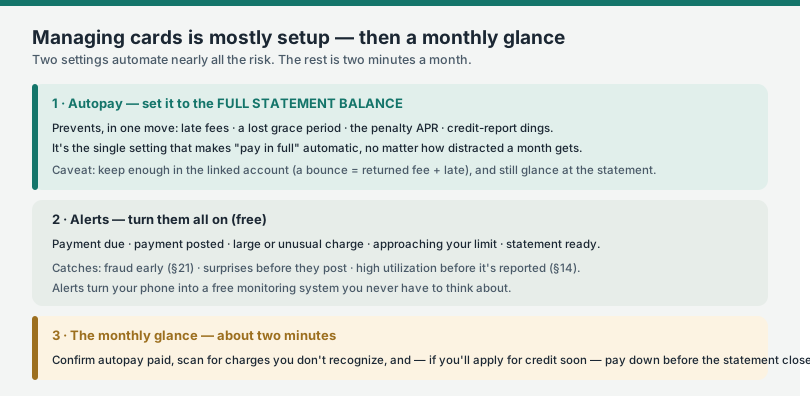
The first setting is the one that does the most work. Autopay set to the full statement balance — not the minimum, not a fixed amount — is the single configuration that automates the entire pay-in-full strategy: it prevents late fees (§8), protects the grace period (§3), keeps the penalty APR (§7) from ever triggering, and shields Maya's credit from late marks, all without her remembering a due date. It converts "pay in full every month," which relies on attention, into something that happens whether or not she's paying attention. The one caveat is that autopay only works if the linked account has the funds — an empty account turns autopay into a returned-payment fee plus a late payment — so the monthly glance still matters, both to confirm the payment cleared and to catch fraud or errors the machine won't.
The second setting is alerts, and they're free monitoring most people never switch on. Turning on notifications for a payment due, a payment posted, a large or unusual charge, an approaching limit, and a ready statement effectively turns Maya's phone into a watchdog: it catches fraud within minutes rather than at month's end (§21), flags surprises before they post, and keeps her utilization visible so she can pay down before a statement closes high (§14). Between autopay and alerts, the dangerous parts of card ownership are largely on autopilot — leaving only the two-minute monthly glance in the gold strip.
Multiple cards are normal and fine if managed this way. People hold several for good reasons — different rewards categories, a backup, more total available credit (which lowers utilization, §14), or separating business from personal spending — and the average cardholder has more than one. The cost is more to track, more due dates, more temptation, and a larger fraud surface — but autopay-on-each and alerts-on-each make several cards as manageable as one. The rule is simply: hold only as many as you can manage flawlessly, and don't open cards chasing tiny rewards gains (the §13 category-chasing trap), because an unmanaged card is where late fees and forgotten balances breed.
The most misunderstood decision in card management is whether to close a card — and the answer surprises people:
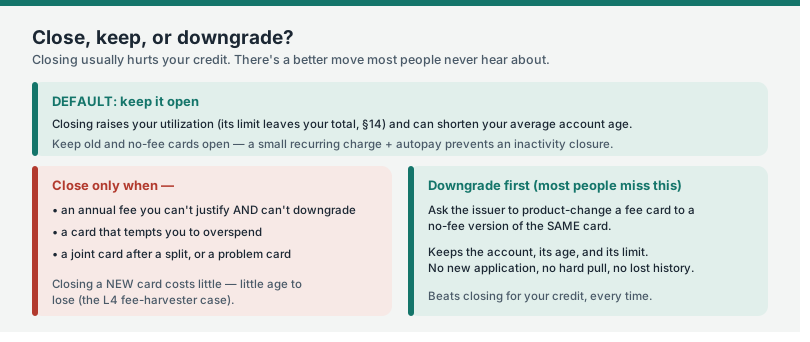
The default, counterintuitively, is keep it open — because closing a card hurts Maya's credit in two ways from §14 and Lesson 4. First, closing removes that card's limit from her total available credit, which instantly raises her utilization on the same balances. Second, it can eventually shorten her average account age (though a closed account in good standing lingers on her report for years, so that effect is delayed). The practical consequence is that the instinct to "clean up" by closing an old card she rarely uses is usually a mistake — the better move is to keep old and no-fee cards open and active, parking one small recurring charge on each (a single subscription) with autopay, so the issuer doesn't close it for inactivity. This is exactly what Maya does with the very first card she opened in Lesson 1: she keeps it open forever, lightly used, because as her oldest account it's quietly anchoring her credit age and her available credit.
Closing genuinely makes sense only in specific cases: an annual fee she can no longer justify and can't downgrade away; a card that tempts her to overspend; a joint card after a relationship ends; or a problem card. And there's the Lesson 4 asymmetry worth recalling — closing a new card (like the fee-harvester) costs almost nothing because there's little age to lose, while closing an old card is costly. So the age of the card flips the calculus.
But before closing a card over its annual fee, there's a move most people have never heard of, and it's the highlight of this section: the product change, or downgrade. Instead of closing a fee card, Maya can ask the issuer to convert it to a no-annual-fee version of the same card. This keeps the account, its original opening date (so its age keeps counting), and its credit limit — all the things that protect her credit — while shedding the fee, with no new application and no hard inquiry. It's strictly better than closing for her credit, and it's how Sofia handles a premium card whose perks she's stopped using: she downgrades it to the free version rather than closing it, preserving a decade of account age for free. (The reverse, an upgrade to a fee card for more rewards, exists too — but the consumer-protective move is knowing she can downgrade to escape a fee without the credit hit of closing.)
A couple of smaller tools round out management: if a card is misplaced, she can freeze it in the app (instantly lockable and unlockable) rather than closing it; and she can periodically request a credit-limit increase (§2, §14) to lower utilization. For Darnell, the management lesson is mostly a don't: don't close cards to "simplify" while rebuilding — keeping them open helps his utilization and age more than tidiness helps anything.
Put together, the whole system is light: autopay-to-full and alerts on every card, keep old and no-fee cards open and lightly active, downgrade rather than close to escape a fee, and a two-minute monthly glance. Set once, it runs itself — which is the point. Good card management isn't vigilance; it's good configuration.
One thing all that management prevents is the situation the next section confronts — the card-debt trap, for the many people who are already carrying a balance and need a way out. That's §20, the next turn.
The Card-Debt Trap — and the Way Out
For everyone on Darnell's side of the line, this is the most important section in the lesson. The "trap" isn't a metaphor — it's a structure, and seeing how it's built is the first step to dismantling it. Three features from earlier sections combine into it: revolving credit means there's no forced payoff date (§1), the minimum payment is engineered at roughly 1% of principal plus interest so it barely touches what's owed (§11), and the APR compounds daily at 20%-plus (§5). Together they produce a balance that shrinks at a crawl while interest constantly reloads it. Pay only the minimum on a real balance and the timeline is measured in decades — but the same balance, paid a fixed amount each month, comes out in a year or two. See the difference for Darnell's $5,000:
$5,000 at 24.99% — your payment changes everything
The minimum keeps you in; a fixed amount above it gets you out.
Minimum payment only (the trap)
16.9 years
~$8,824 in interest
Paying your fixed amount
22 months
~$1,259 in interest
The two boxes side by side are the entire psychology of the trap. Paying the minimum only on $5,000 at 24.99% stretches the payoff across decades and costs thousands in interest, because the minimum is built to cover the interest plus a sliver of principal — it keeps Darnell current without making progress, which is exactly why it feels survivable and never ends. Commit to a fixed $290 a month, and the same balance clears in under two years for a fraction of the interest. The lever isn't a windfall or a rate cut — it's refusing to let the payment shrink with the balance. Holding the payment fixed while the balance falls is what collapses a decades-long trap into a two-year project. And it's worth saying plainly: this is not a moral failing on Darnell's part. The product is designed to keep him paying the minimum (§11); escaping it is about understanding the structure, not about willpower or character.
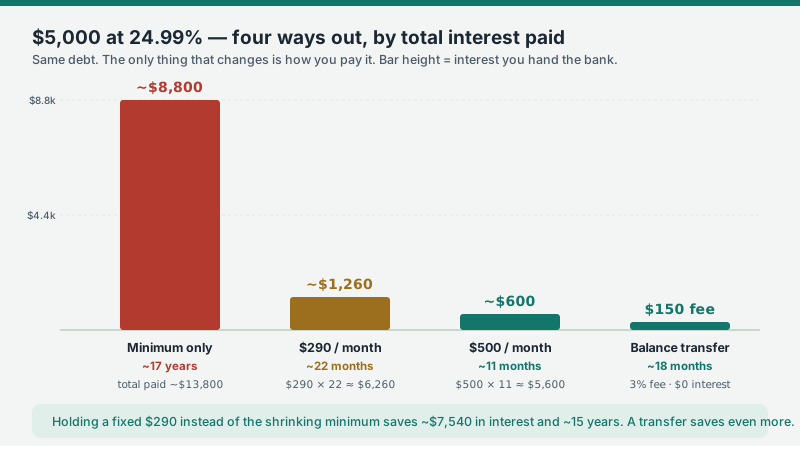
Minimum only — ~17 years, ~$8,800 interest. This is the trap drawn to scale, and it deserves the full walk because the mechanism is what makes the towering red bar so counterintuitive. Recall how the minimum is built (§11): it's roughly 1% of the balance plus that month's interest. On Darnell's $5,000, the first minimum is about $154 — about $50 of principal (1% of $5,000) on top of ~$104 of interest (the balance times the 24.99% daily-compounded rate over the cycle). That structure is the whole problem: the interest portion only treads water, and the principal portion is a mere 1% of whatever's left, so the balance falls by about 1% a month — a genuine crawl. And because the minimum shrinks as the balance shrinks, the payment keeps getting smaller exactly when he'd want it to stay large, so the payoff stretches further and further out. Run that all the way down and Darnell pays roughly $8,800 in interest on a $5,000 debt — handing the bank about $13,800 total, nearly triple what he borrowed — over something like 17 years. This is the psychological cruelty of the trap: the minimum feels responsible because it keeps him "current," the revolving structure imposes no payoff date to alarm him (§1), and so a person can pay faithfully for years while the balance barely moves. It bears repeating from above that this is not a moral failing on his part — the product is engineered to keep him exactly here, and the height of that bar is the design, not his discipline.
$290 a month, held fixed — ~22 months, ~$1,260 interest. Now the single change that collapses the bar, described fully because the contrast is the lesson. The only thing Darnell does differently is refuse to let the payment shrink — he picks $290 and holds it flat, month after month, even as the balance falls. Because the interest portion is still only ~$104 at the start and falling, the rest of that $290 — over $185 in month one, and more every month as interest drops — lands directly on principal. The balance now falls fast instead of crawling. The arithmetic: about $290 × 22 months ≈ $6,260 total paid, of which only roughly $1,260 is interest. Same $5,000, same 24.99% rate, same person — but holding the payment fixed turns seventeen years into under two, and cuts the interest from ~$8,800 to ~$1,260, a saving of about $7,540. That's the number worth sitting with: the lever wasn't a lower rate, a windfall, or a balance transfer — it was consistency, the simple refusal to ride the shrinking minimum down. Every dollar he holds above the minimum is a dollar of principal retired at full speed, and the gap between the red bar and the gold one is what that refusal is worth.
$500 a month, held fixed — ~11 months, ~$600 interest. Pushing the fixed payment higher compounds the effect, and it's worth describing fully because it shows the marginal power of every extra dollar. In month one, the interest is still only ~$104, so of Darnell's $500, nearly $396 goes straight to principal, and the balance plunges. The arithmetic: roughly $500 × 11 months ≈ $5,600 total paid, of which only about $600 is interest. Compared to the $290 plan, he's paying $210 more each month, and for that he saves another ~$660 in interest and finishes eleven months sooner — out in under a year instead of just under two. The lesson inside the lesson: because every dollar above the minimum lands entirely on principal at full speed, raising the payment pays for itself quickly — the extra $210/month isn't lost, it's the fastest-returning "investment" available to him, retiring 24.99% debt dollar for dollar.
Balance transfer (0% for 18 months, 3% fee) — ~18 months, $150 fee, $0 interest. This is the cheapest path of all, and it deserves its full §16 framing alongside the number. If Darnell is disciplined — clears it in the window and doesn't spend on the card — he pays a one-time transfer fee of 3% of $5,000 = $150, and then, during the 0% intro period, no interest accrues at all. Clearing the $5,150 (balance plus fee) at $290/month takes about 18 months, landing just inside the 0% window, and his entire cost is essentially that $150 fee — versus the ~$8,800 in interest the minimum-only path would cost. That's the transfer's whole appeal in one comparison: $150 against $8,800 on the very same debt. The catch, carried over from §18, is that this only holds if he beats the reset date and resists using the new card to spend — a botched payoff means the leftover reverts to roughly the rate he was escaping (though, crucially, not retroactively — the 0% he already used stays 0%, unlike the deferred-interest predator in §22).
Getting out follows a clear sequence, and the math above is the reason it works.
First, stop adding to it. Darnell can't fill and drain the bucket at once, so while he pays down, new purchases go on cash or debit (or pause). Every new swipe on the carried card resets his progress and keeps the grace period gone (§3).
Second, pay more than the minimum — a fixed amount. Every dollar above the minimum goes straight to principal, and under the CARD Act allocation rule (§5), to his highest-APR balance first. The interactive shows that even a modest fixed extra above the minimum changes the timeline by years. The minimum is the floor; the fixed payment is the escape.
Third, choose a payoff method if he has multiple balances. Two approaches, both from Lesson 2: the avalanche pays minimums on everything and throws all extra at the highest-APR card first — mathematically optimal, the least interest and fastest payoff. The snowball throws extra at the smallest balance first — slightly more interest, but the quick wins of clearing a whole card build momentum that keeps people going. The right one is the one he'll actually stick with: avalanche saves the most money, snowball keeps more people in the game, and both crush the minimum-only path.
Fourth, use the right tools. A balance transfer (§16) buys an interest-free runway if he can clear it in the window and stops spending. A lower-rate personal loan for debt consolidation (Lesson 7) can convert his revolving balance into a fixed installment with a set payoff date and often a lower rate — turning the open-ended trap into a finite loan. And he can simply ask his issuer for a lower APR (§7) or a hardship plan; it costs nothing to ask.
Fifth, get help if it's beyond a do-it-yourself fix. A nonprofit credit counselor — through the National Foundation for Credit Counseling, at 1-800-388-2227 — offers free or low-cost guidance and can set up a Debt Management Plan that consolidates his payments and often reduces the interest rates the issuers charge. This is the legitimate, humane counterpart to the Lesson 1 predators — and the thing to avoid is its dark mirror: for-profit "debt settlement" or "debt relief" companies that charge large upfront fees, tell people to stop paying, and wreck their credit in the process. Free nonprofit counseling helps; fee-charging "relief" usually harms.
The reframe to end on is genuinely hopeful, because the math earns it. Card debt feels permanent precisely because the minimum makes it crawl — but as the interactive shows, the timeline isn't fixed at "decades." A fixed extra payment, or a transfer, or a consolidation loan, turns it into a one-or-two-year problem with a visible finish line. It's not a life sentence; it's a math problem with a known solution, and there's free, real help for anyone who needs more than a spreadsheet. For Darnell, the path out is concrete: stop adding, pick a fixed payment he can hold, aim it at the highest rate, and — if the numbers are too steep alone — call a nonprofit counselor. The trap is real, but so is the exit.
Talking to a nonprofit credit counselor is a free, judgment-free place to start, and it's the opposite of the predators the next section warns about.
Fraud & Security
Start with the single most reassuring fact about credit cards, because it reframes everything else in this section: you are not financially on the hook for fraud you report. Under federal law — the Fair Credit Billing Act — Maya's maximum liability for unauthorized charges is capped at $50, and in practice every major issuer waives even that, offering $0 liability. A fraudster who copies her card and runs up $2,000 costs her nothing once she reports it; the charges come off, and the bank absorbs the loss. This isn't a courtesy she has to fight for — it's the baseline. And it's a genuine reason, building on §1, to put pay-in-full spending on a credit card rather than a debit card:
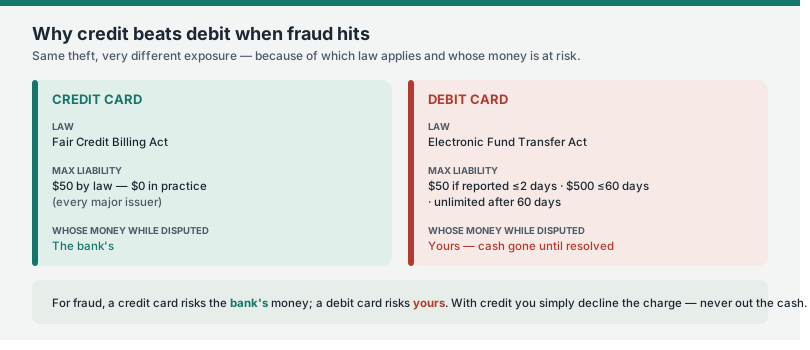
The contrast is sharper than most people realize, and it comes down to which law applies and whose money sits at risk while a dispute plays out. A credit card falls under the Fair Credit Billing Act: Maya's liability is capped at $50 by law and $0 in practice, and — crucially — because she's spending the bank's money, a fraudulent charge is something she simply declines to pay while it's investigated. She's never out of pocket; the disputed amount comes off her balance and the bank carries it. A debit card falls under a different law, the Electronic Fund Transfer Act, with markedly weaker protection: her liability depends on how fast she reports — capped at $50 if she catches it within two days, up to $500 within sixty days, and unlimited after sixty days — and, the part that really stings, the stolen money is her own cash, already gone from her checking account, which she's now fighting to claw back rather than merely refusing to pay. A fraudster draining a debit card can leave Maya unable to cover rent while the bank investigates; a fraudster hitting her credit card is an annoyance she resolves with a phone call. This is the §1 point made concrete: with a credit card, the bank bears the fraud risk, which is one more reason to route pay-in-full spending through credit rather than debit.
That protection matters enormously because most card fraud isn't the cardholder's fault and isn't preventable by being careful — which is exactly why a no-fault financial shield is so valuable. Cards get compromised in a handful of ways, and several are entirely out of Maya's hands:
Skimming is a device secretly attached to a card reader — a gas pump, an ATM, a store terminal — that copies her card's data as she uses it. The chip and contactless ("tap") technologies make this much harder, because they transmit encrypted, one-time data rather than the static stripe; so using the chip or tap instead of the swipe is a real defense (more in part 2).
Data breaches are when a merchant's systems are hacked and thousands of card numbers are exposed at once — entirely beyond Maya's control. If a store she shopped at last year gets breached, her number can surface for sale even though she did nothing wrong.
Phishing is the deceptive route: a fake email, text, or phone call impersonating her bank or a retailer, tricking her into typing her card number, CVV, or password. These have grown sophisticated, but the tell is constant — a legitimate bank will never call or text asking her to confirm her full card number, CVV, or password.
Lost or stolen cards, card-not-present fraud (her number used online without the physical card), and account takeover (a fraudster gaining access to her actual account) round out the common types. The pattern across all of them is that vigilance helps but can't fully prevent fraud — a breach at a merchant or a skimmer she never noticed can compromise her despite perfect habits. That is why the $0-liability shield is the foundation: it means the inevitable becomes an inconvenience rather than a loss.
Reducing the Odds — Practical Defenses
While most fraud isn't preventable, a handful of habits meaningfully lower Maya's exposure and make compromise less likely:
Use the chip or tap, never the swipe. The magnetic stripe transmits the same static data every time — exactly what a skimmer copies. The chip and contactless ("tap") transmit encrypted, one-time data that's far harder to clone, so choosing chip-or-tap at every terminal is the simplest meaningful defense against skimming. The stripe is the vulnerable relic; avoid it whenever a chip or tap reader is available.
Use virtual card numbers for online shopping. Many issuers now offer virtual card numbers — a one-time or merchant-locked number that stands in for Maya's real one. If a site she used gets breached, only the virtual number is exposed, and she can delete or lock it without replacing her actual card or disrupting her other recurring charges. It keeps her real number hidden from merchants entirely, which neutralizes the most common card-not-present route.
Turn on transaction alerts. This is the §19 habit and the single best early-warning tool: an alert for every charge (or every charge over a threshold) means Maya learns about fraud within minutes rather than at month's end, when she can report it before the fraudster does much more. Fast detection is what keeps a compromise small.
Use strong, unique passwords and two-factor authentication on the card account. A unique password means a breach elsewhere can't be used to unlock her card account, and 2FA (a code to her phone) blocks an account takeover even if her password leaks. Reusing passwords is how one breach cascades into many; a password manager and 2FA close that door.
Recognize phishing. Maya should never hand her card number, CVV, or password to an unsolicited caller, text, or email — and the reliable tell is that a legitimate bank will never contact her asking her to confirm her full card number, CVV, or password. If a message claims to be her bank, the safe move is to ignore its links and navigate to the bank herself (the number on her card, the app she already has). The request itself is the red flag.
Freeze the card in the app if it's misplaced. Most issuers let her instantly lock a card from the app — reversible in a tap — so a card left at a restaurant can be frozen until she's sure, without the hassle of closing it (§19). It's the low-stakes first move before assuming the worst.
And the basic hygiene: shop on secure (https) sites, be cautious entering card details on public wifi, protect the physical card and its CVV, and shred old statements. None of these is foolproof, but together they shrink her attack surface — and the $0-liability shield catches whatever slips through.
The Moment It Happens — Your Action Plan
When fraud does appear — an alert for a charge she didn't make, an odd line on a statement — here's the calm, ordered response:
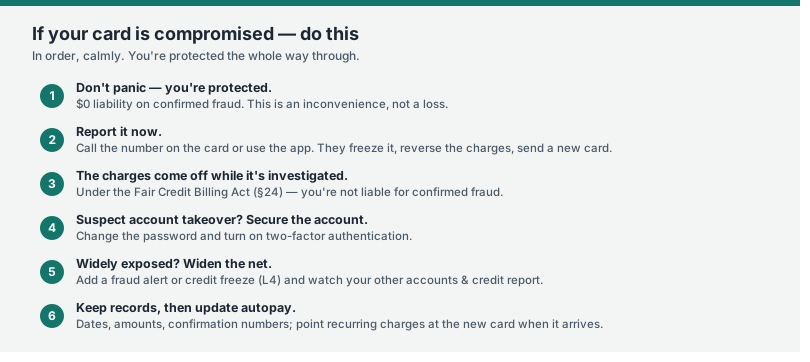
The plan is short precisely because the protection does the heavy lifting. Don't panic is the genuine first step — Maya is shielded by $0 liability, so a fraudulent charge is a problem to resolve, not a loss to absorb. Report it immediately — calling the number on the card or reporting in the app — sets the rest in motion: the issuer freezes the compromised card so no further charges land, reverses the fraudulent ones, and mails a new card with a new number, typically within a few days. The charges come off while it's investigated under the Fair Credit Billing Act (the formal billing-error/dispute process is detailed in §24), and once confirmed as fraud, she owes nothing for them.
The next steps scale to the severity. If she suspects an account takeover — not just a stolen number but someone inside her account — she secures the account by changing the password and enabling 2FA, so the fraudster is locked out, not just the card. If her information appears widely exposed (say her details surface in a large breach), she widens the net: a fraud alert or credit freeze (the Lesson 4 §16 tools) protects her other accounts and her credit file from new fraudulent accounts being opened in her name, and she watches her statements and credit report for a while.
Throughout, she keeps records — dates, amounts, who she spoke to, confirmation numbers — in case the dispute needs follow-up. And the easy-to-forget final step: once the new card arrives, update any autopay and recurring charges to the new number, so a subscription or her own card-bill autopay (§19) doesn't quietly lapse on the dead card.
The Reassurance
It's worth ending this section where it began, because the emotional takeaway matters as much as the mechanics. Card fraud is common — it will likely happen to most people eventually — but because of the $0-liability shield and the dispute process, it is an inconvenience, not a catastrophe. The bank absorbs the loss; Maya makes a phone call, gets a new card in a few days, and resets a couple of autopays. This is, genuinely, one of the credit card's best features, and it traces straight back to §1: because she's spending the bank's money, the bank bears the fraud risk. The right posture isn't fear — it's reasonable care plus good alerts. Use the chip or tap, keep transaction alerts on, don't hand card details to anyone who contacts her first, and if fraud slips through anyway, report it and move on. The system is built to make her whole, and it works.
That covers the security layer. The next section steps back to the broader legal framework — the formal billing-dispute rights, chargebacks, the CARD Act protections, and the recourse stack — that govern disputes beyond fraud (a wrong charge, a product that never arrived, a merchant that won't refund). That's §24, the protections-and-recourse close, the next turn.
Predator Watch — Deferred-Interest "Special Financing"
This is the predator the whole lesson has been quietly building toward, which is why DW#2 (the real 0% offer) came right before it. It's distinct from the prior four — Lesson 1's credit-repair scam, Lesson 2's low-payment trap, Lesson 3's max-approval push, Lesson 4's fee-harvester — and it preys on exactly the person making a big purchase they can't pay cash for: Hector, furnishing an apartment, offered "no interest" at the checkout counter at the moment he's most relieved to hear it.
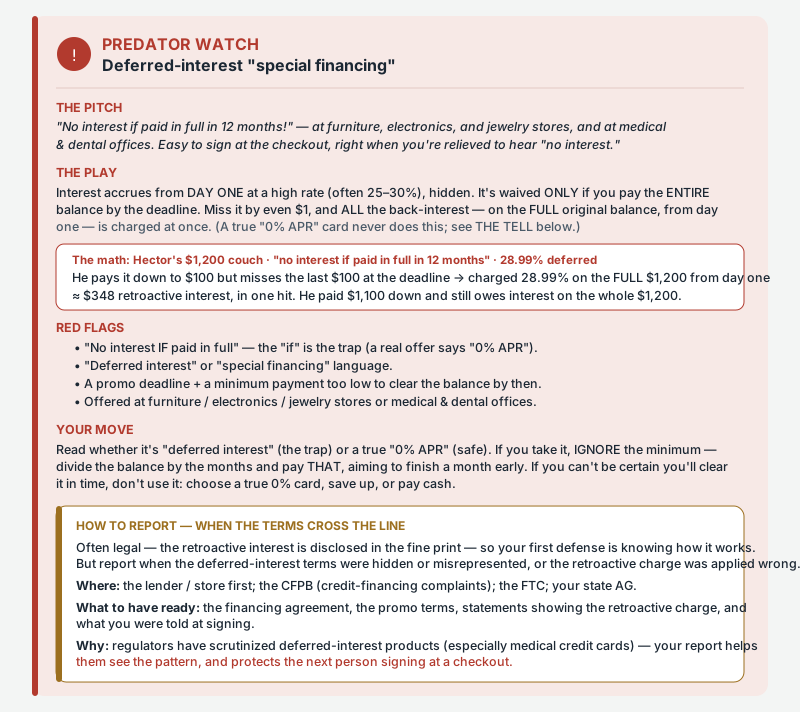
The tell — deferred interest versus a true 0% APR. This is the payoff of having read DW#2 first, and it's the single most valuable thing in this section, so it's worth drawing the contrast in full. The two offers sound identical at the counter — both say something like "no interest" — but they behave like opposites when a deadline is missed:
A true 0% intro APR (the balance-transfer card from §16/§18) is real 0%. During the promo, no interest accrues at all. If Hector misses the payoff deadline, only the remaining balance starts accruing interest, going forward from the reset date — the interest he avoided during the promo stays avoided. A missed deadline costs him interest on what's left, from here on. Bad, but bounded.
Deferred interest is conditional, illusory 0%. Interest is accruing the entire time — silently, from day one, at a high rate (often 25–30%) — and it's merely being held back on the condition that he clears the entire balance by the deadline. Miss it by even a dollar, and all of that accrued interest, calculated on the full original balance from day one — including the part he already paid down — lands in a single retroactive charge. The math in the card shows the cruelty: Hector buys a $1,200 couch on "no interest if paid in full in 12 months," diligently pays it down to $100, then misses the last $100 at the deadline — and gets hit with roughly $348 in retroactive interest, calculated on the whole $1,200 from the very first day, as if the promo never existed. He paid down $1,100 and is still charged interest on the full $1,200. The reset on a true 0% card would have charged him interest only on the leftover $100 going forward — a few dollars. Deferred interest charges him on everything, backward.
So the tell is in the words: a real offer says "0% APR"; the trap says "no interest if paid in full." That little word if is the entire difference between a tool and a trap. When Hector sees "if," he should hear "deferred interest," and treat the 0% as a condition he must perfectly satisfy, not a gift.
The trap inside the trap makes it worse, and it's why this is predatory and not merely unfavorable: the minimum payment on deferred-interest financing is frequently set too low to clear the balance by the deadline. A person who does the "responsible" thing — pays the minimum every month, on time — will arrive at the deadline with a balance still owing, and trigger the full retroactive charge anyway. The structure is engineered so that ordinary, on-time minimum-paying guarantees the penalty. That's the design, not bad luck, and it's exactly the kind of "responsible behavior leads to the trap" mechanic that marks a predator.
Your move follows directly. First, read which kind it is — the words "deferred interest" or "no interest if paid in full" mean danger; "0% APR" means safe. Second, if Hector does take a deferred-interest offer, he should ignore the minimum entirely and instead divide the balance by the number of promo months and pay that — $1,200 over 12 months is $100/month — aiming to finish a month early so a single late or short payment can't blow the deadline. Third, and most protective: if he can't be certain he'll clear it in time, he shouldn't use it at all — a true 0% card, saving up first, or paying cash all avoid the retroactive ambush entirely.
Deferred interest is often legal — the retroactive interest is disclosed somewhere in the fine print — so the first and best defense is understanding how it works. But it crosses into reportable territory when the deferred-interest terms were hidden or misrepresented at signing (a salesperson who said "no interest" and never mentioned the retroactive catch), or when the retroactive charge was applied incorrectly. The path is the familiar recourse stack: the lender or store first, then the CFPB (which has specifically scrutinized deferred-interest products, especially medical credit cards like CareCredit-style offers pushed at dental and medical offices), the FTC, and the state AG — with the financing agreement, the promo terms, the statements showing the retroactive charge, and an account of what you were told at signing in hand.
If This Already Happened to You
Some people reading §22 didn't recognize an offer they're about to be handed — they recognized the retroactive charge that already landed on their statement, the one that appeared after they'd diligently paid a balance almost all the way down. This beat is for them, and the news is better than they fear:
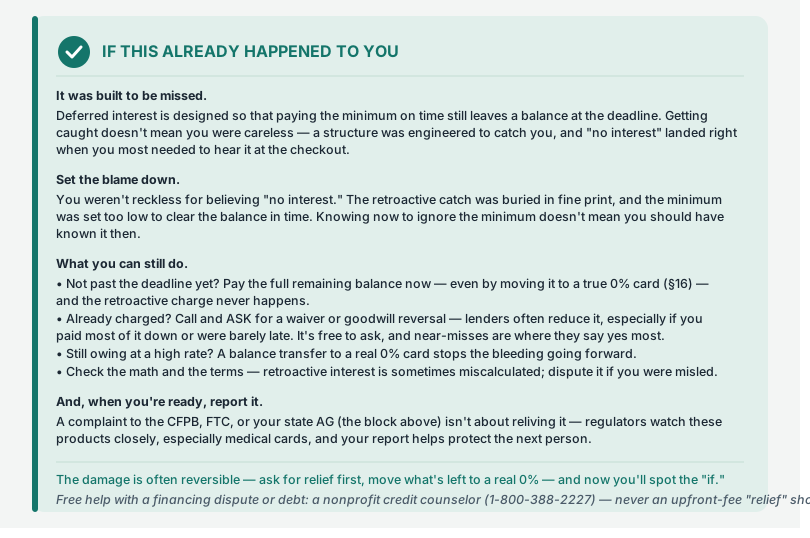
The beat does its four jobs, and the first one is especially important here because deferred interest is designed to make its victims feel foolish. It names the stumble as engineered, not careless: the minimum payment was deliberately set too low to clear the balance by the deadline, so a person doing the "responsible" thing — paying the minimum, on time, every month — still arrives at the deadline owing money and triggers the retroactive charge. Getting caught isn't a failure of diligence; it's the structure working as built, with the "no interest" headline landing at the exact emotional moment — checkout, relief, a big purchase he couldn't pay cash for — when it's hardest to interrogate. It sets the self-blame down, because "you should have read the fine print" is the wrong lesson when the fine print was engineered to be skimmed and the payment schedule was rigged to fail. And it reframes reporting as the civic act it is.
But the genuinely freeing part — worth pulling out of the panel — is in what you can still do, because for deferred interest the damage is unusually reversible, and most people don't know it.
If Hector hasn't hit the deadline yet — if he's reading this with a week to go and $400 still owing — he can still avoid the entire retroactive charge by paying the full remaining balance before the deadline, even if that means moving it to a true 0% balance-transfer card (§16) to do so. The trap only springs at the deadline; until then, the escape hatch is wide open.
And if the retroactive interest has already been charged, the single most valuable move is to call and ask for a waiver or goodwill reversal. Lenders frequently reduce or reverse retroactive interest as a courtesy — especially when someone paid most of the balance down, was only a little late, or calls promptly — because these "near-miss" cases are exactly where a reversal costs the lender little and keeps a customer. It is free to ask, the person on the phone often has discretion to help, and the worst outcome of asking is the situation he's already in. This is the opposite of the helplessness deferred interest is designed to produce: a phone call can genuinely undo it.
The rest of the path is short — if a high rate is now running on the revealed balance, a balance transfer to a real 0% card stops the bleeding going forward (§16); and it's worth checking the math and the terms, because retroactive interest is sometimes miscalculated, and if the "no interest" pitch genuinely misrepresented the catch, that's the §22 dispute path. The help that exists is the opposite of the predator: a nonprofit credit counselor (1-800-388-2227) who'll walk him through a dispute or a payoff plan for free — never an upfront-fee "debt relief" shop.
The throughline of the whole lesson lands here, gently: the skill it built — reading whether an offer is a real 0% or a deferred-interest "if" — isn't only protection going forward. It's also the recovery kit for anyone a "no interest" pitch already caught, because the damage is so often reversible by asking. He's not stuck; he can call, he can transfer, he can dispute — and next time, he'll spot the if before he ever signs.
Protections and Recourse — the Card as a Shield
Section 21 covered fraud security; this section covers the broader dispute rights that make a credit card one of the most consumer-protected ways to pay — for a wrong charge, a product that never arrived, a merchant who won't refund, a subscription that won't die. These protections are why, building on §1 and §21, putting purchases on a credit card is genuinely safer than other payment methods.
The Fair Credit Billing Act — the right to dispute a billing error. The FCBA gives Maya a legal right to challenge a billing error on her statement — and "billing error" is broad: a charge she didn't make, a wrong amount, a charge for goods or services never delivered or not as described, a math error, a charge for something she returned, or a payment the issuer failed to credit. The process is specific: she notifies the issuer in writing within 60 days of the statement showing the error; the issuer must acknowledge within 30 days and resolve it within two billing cycles (about 90 days). Crucially, while it's disputed, she doesn't have to pay the disputed amount or interest on it, and the issuer can't report it as delinquent or send it to collections. This is the formal legal machinery underneath the §21 fraud report — and it extends well beyond fraud to any contested charge.
Chargebacks — the practical version of that right. In day-to-day life, Maya rarely writes the formal FCBA letter; she uses a chargeback — disputing a charge through the app or a phone call, after which the issuer reverses it and pulls the money back from the merchant. It's the card-network (Visa/Mastercard) mechanism, and it's broader and faster than the written process. She reaches for it when a merchant won't refund, goods never arrived, a product was defective or not as described, she was double-charged, or a canceled subscription keeps billing. This is the card as a shield: if a merchant rips her off or a purchase fails, her issuer can claw the money back on her behalf — a protection a debit card offers far more weakly, since with debit her cash is already gone (§21). The etiquette matters: she should try the merchant first, and use the chargeback when they won't make it right — not abuse it for purchases she simply regrets ("friendly fraud"), which is a real problem for merchants and can get a cardholder's account flagged. In short: FCBA is the federal right; the chargeback is how she usually exercises it.
A lesser-known FCBA right — claims and defenses. For a quality dispute on a purchase over $50 made in her home state or within 100 miles, if Maya has genuinely tried to resolve it with the merchant, she can withhold payment on that charge and assert her claim against the issuer, not just the merchant. It's narrow and underused, but it's a real lever when a local merchant sells her something defective and stonewalls — the law lets her bring the card company into it.
The CARD Act guardrails — gathered. Many of the protections threaded through this lesson come from the CARD Act of 2009, and it's worth seeing them in one place, because together they describe a heavily-regulated product: the 21-day minimum grace period before a payment is due (§3); 45 days' notice before a rate increase, and no rate hike on existing balances in the first year (§7); payment allocation of above-minimum payments to the highest-APR balance first (§5); over-limit fees made opt-in, so the default is $0 (§8); late fees required to be "reasonable and proportional" (§8); clear statements with the minimum-payment warning (§3, §11); and the under-21 income/co-signer requirement (§2). Each protected Maya at a specific point in the lesson; collectively, they're why a modern credit card, used with eyes open, is far safer than the cards of twenty years ago.
When a dispute isn't resolved, the recourse path is the cross-cutting one:
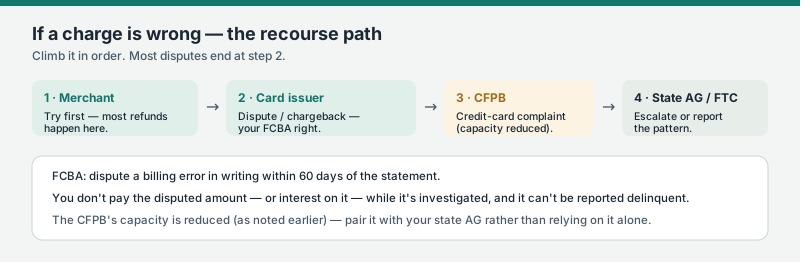
The path is the lesson's recurring recourse stack, applied to cards. Maya tries the merchant first — most refunds happen right here, and going straight to a chargeback without contacting the seller is both poor etiquette and sometimes grounds for the dispute to be denied. If that fails, she goes to her card issuer and files a dispute or chargeback, which invokes her FCBA rights and is where the large majority of contested charges get resolved. Only if that fails does she escalate to the CFPB (whose credit-card complaint process operates, though with the reduced capacity noted earlier in the lesson), and then her state AG and the FTC to escalate or report a pattern. The note carries the two operational facts that make the system work: the 60-day FCBA window to dispute a billing error in writing, and the protection that she doesn't pay the disputed amount or interest while it's investigated and it can't be marked delinquent. And consistent with the recourse stack throughout this curriculum, pairing the CFPB with her state AG — rather than relying on a single reduced-capacity agency — is the resilient move.
The honest framing to close on ties the whole protective layer back to a practical habit: precisely because of the FCBA dispute right, the chargeback shield, and the CARD Act guardrails, a credit card is one of the most consumer-protected ways to pay — which is itself a strong reason (alongside the rewards, the float, and the credit-building) to route purchases through a credit card she pays in full, rather than debit or cash. If a $600 appliance fails or an online order never ships, the card gives Maya leverage that cash never could. The two things to remember are small: dispute within 60 days, and try the merchant first. Used that way, she's rarely without recourse — the card isn't just a way to borrow, it's a layer of protection wrapped around her spending.
That completes the lesson's substance — what a card is, how it works, the documents, rewards, utilization, the balance transfer, managing cards, the debt trap, fraud, the predator, and now the protections. What remains is to gather the questions people always ask and let the reader check themselves — the final turn.
Most Common Questions
The questions people actually ask about credit cards — paraphrased from the kinds of things that fill personal-finance forums.
"Should I pay my statement balance or my current balance?"
Pay the statement balance in full by the due date — that's the exact amount that keeps you interest-free, and it doesn't change during the grace period. Your current balance is higher because it includes new purchases from this cycle that aren't due yet (they're still floating). Paying the current balance isn't wrong — you're just paying early and giving up a few days of free float. To never pay interest and never overthink it, set autopay to "full statement balance."
"Does carrying a small balance help my credit score?"
No — this is the most common and most expensive credit-card myth. You build credit by using the card and paying it off in full, not by carrying a balance, which just costs you interest and does nothing extra for your score. What does help is low utilization — and a low reported balance (even slightly better than $0) is achieved by paying down before the statement closes (§14), not by carrying interest-bearing debt. Pay in full; carry nothing.
"Is it bad to have multiple credit cards?"
No, if you manage them. Several cards can actually help — more total available credit lowers your utilization, and you can match cards to different reward categories. The cost is more to track, but autopay-to-full and alerts on each (§19) make several as easy as one. The rule: hold only as many as you can manage flawlessly, and don't open cards chasing tiny rewards. The average person has more than one; it's normal.
"Should I close a card I don't use anymore?"
Usually no. Closing removes that card's limit from your available credit (raising your utilization) and can shorten your average account age — so closing an old or no-fee card tends to hurt your score. Keep it open with a small recurring charge plus autopay so it isn't closed for inactivity. The main exception is an annual fee you no longer justify — and even then, ask the issuer to downgrade it to a no-fee version of the same card (keeping the account, age, and limit) rather than closing it.
"Are credit card rewards actually worth it?"
Yes — but only if you pay in full and don't change your spending to earn them. Rewards are a rebate on spending you'd do anyway; treated that way, a 2% card quietly returns 2% of your normal life. They become a trap the moment you carry a balance (a 2% reward never beats a 20%+ APR — you lose) or spend more to "earn" more (which leaves you poorer). Rewards are for people who pay in full; if you carry a balance, get the lowest-APR card instead.
"What's the difference between a '0% balance transfer' and 'no interest if paid in full' store financing?"
Everything — when you miss the deadline. A true 0% intro APR is real 0%: if you don't pay it off in time, only the remaining balance starts accruing interest, going forward. "No interest if paid in full" is deferred interest: interest has been accruing silently from day one, and if you don't clear the entire balance by the deadline, all of it — on the full original balance, from day one — is charged retroactively in one hit. The tell is the word if: "0% APR" is safe; "no interest if paid in full" is the trap (§22).
"There's a charge on my card I didn't make — am I going to lose that money?"
No. Credit cards carry $0 fraud liability — report the unauthorized charge (call the number on the card or use the app) and the issuer freezes the card, reverses the charge, and sends a new one. You're not on the hook for confirmed fraud, and because you're spending the bank's money, your own cash is never gone while it's sorted out (unlike a debit card). Card fraud is common but, thanks to this protection, an inconvenience — not a loss.
"Why did my interest rate go up when I didn't do anything?"
Most card APRs are variable — prime rate plus a fixed margin — so when the Federal Reserve moves and prime changes, your rate follows automatically, usually within a billing cycle or two. Your margin (set by your credit when you opened the card) didn't change; the prime part did (§7). A separate cause would be a penalty APR from a 60+-day-late payment — but that requires being very late, with 45 days' notice first. Either way, you can always call and ask for a lower rate.
Check yourself
Six questions across the lesson — tap an answer to see how you did:
Check yourself — credit cards
Six questions across the lesson — tap an answer to see how you did.
1. To avoid interest on purchases, which balance do you pay in full by the due date?
2. Does carrying a small balance month to month help your credit score?
3. You carry just $1 past the due date. What happens to your grace period?
4. Which charges retroactive interest on the WHOLE balance if you miss the payoff deadline?
5. Someone makes an unauthorized charge on your credit card. Your liability once you report it?
6. Closing an old, unused, no-fee credit card usually...
That closes Lesson 5. The lesson opened with one claim — that a credit card is two completely different products separated by a single habit — and everything since has been the proof. Maya, paying in full, gets a free short-term loan, fraud protection, rewards, and a credit-building tool that works for her; Darnell, carrying a balance, faces one of the most expensive loans in consumer finance. The card itself is neither good nor bad — it's a tool that rewards understanding and punishes the lack of it. The single transferable instinct, the one that survives even if every detail fades: pay the full statement balance every month, and the card is a free, rewarded, protected tool; pay less, and the meter starts. Everything else — the documents, the rewards math, utilization timing, the balance transfer, the fraud shield, the deferred-interest tell, the protections — is in service of staying on the first side of that line, and finding the way back if you've slipped to the second.
Key takeaways
- A credit card is two completely different products separated by one habit: pay in full every month for a free, rewarded tool; carry a balance and it becomes one of the most expensive loans in consumer finance.
- The grace period is all-or-nothing — pay even $1 less than the full statement balance and you lose it entirely, with new purchases accruing interest from the day you make them until you pay in full for two consecutive cycles.
- Daily compounding at 20%-plus means a $1,000 balance at 24.99% costs about $0.68 a day, ~$20.50 a month, and the effective annual rate (~28%) is higher than the APR on the label.
- Utilization is a snapshot taken at the statement closing date — a pay-in-full user can still report high utilization if statements close high; pay down before the closing date to protect both your wallet and your score.
- A true 0% balance-transfer APR is real 0% — if you miss the deadline, only the remaining balance accrues interest going forward. Deferred interest is the opposite: interest accrues from day one and hits retroactively on the full original balance if you miss by even a dollar.
- The minimum payment is engineered to be survivable, not to make progress — on $5,000 at 24.99%, paying only the minimum stretches across ~17 years and costs ~$8,800 in interest; the same debt at a fixed $290/month clears in ~22 months for ~$1,260.
- Cards carry $0 fraud liability by practice (capped at $50 by law) and FCBA dispute rights that debit cards can't match — routing pay-in-full spending through a credit card is genuinely safer than paying by debit or cash.
Knowledge check
6 questions
Maya pays $619 instead of her $620 statement balance. What happens?